

What is wrist extensor tendinopathy?
Wrist extensor tendon anatomy
The wrist extensor muscles sit on the outer side of the forearm and their tendons pass over the top of the wrist before reaching the hand. They lift the wrist and stabilise the hand during gripping movements. This tendinopathy causes pain on the top of the wrist, the mirror image of tennis elbow but located lower down.
Why do these tendons become painful?
Pain appears when the wrist extensors are repeatedly loaded beyond their capacity, typically during wrist extension movements and grip stabilisation (tennis backhand, weight training, manual activities). Too rapid an increase in training volume is a common contributing factor.

Physio insight · Thibault
This tendinopathy is closely linked to tennis elbow, both affecting the same extensor muscle group but at different attachment points: the elbow for one, the wrist for the other.

Physio tip · Hemrick
Test your pain by extending your wrist against light resistance, forearm resting on a table palm down: if the pain is clear-cut on the top of the wrist, that’s a good indicator of this tendinopathy.
Causes and risk factors
This tendinopathy develops from repeated overload on the extensor tendons, without enough recovery time for them to adapt.
Biomechanical and personal factors
- A too-rapid increase in training volume or intensity
- A technical movement that overloads wrist extension (the tennis backhand in particular)
- Prolonged or repeated gripping with the wrist in extension
- A lack of strength or endurance in the wrist and forearm extensors
- Poorly fitted equipment (grip size, string tension, workstation ergonomics)
Which sports contribute to wrist extensor tendinopathy?
Any sport with repeated wrist extension exposes these tendons:
- Tennis and badminton (backhand, racquet grip)
- Padel (volleys and full-stretch strikes)
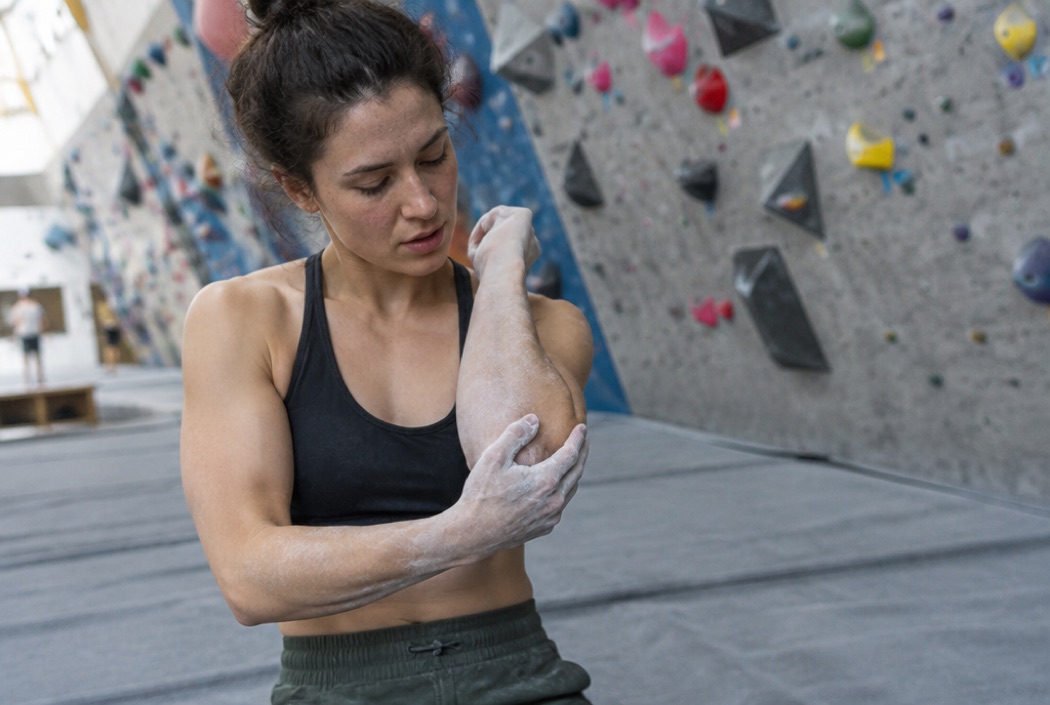
- Climbing (prolonged gripping under tension)
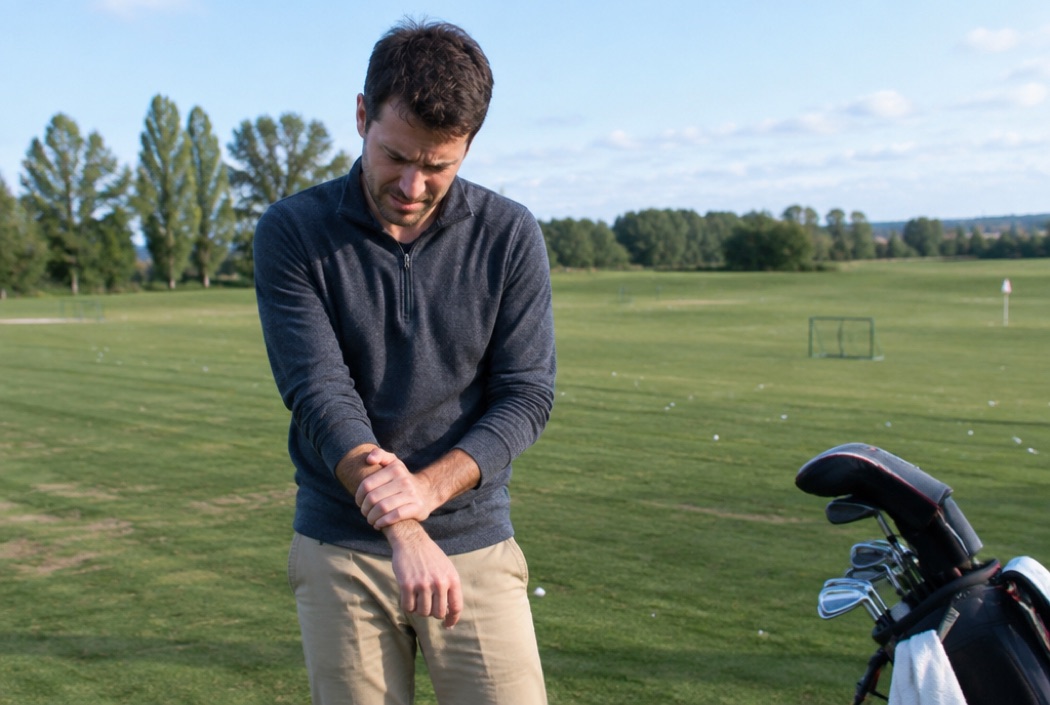
- Golf (repeated ball impact)
- CrossFit and weight training with heavy gripping exercises
- Sports with repeated weight-bearing on the hands (gymnastics) and repetitive manual activities
Wrist extensor tendinitis: the symptoms to watch for
Wrist extensor tendinitis, which physios call extensor tendinopathy, causes pain on the back of the wrist, sometimes as far as the back of the hand or along the forearm. It flares up when you bend the wrist upwards or grip hard: a tennis backhand, a bar in the gym, weight on flat hands, a computer mouse held for hours.[1][2]
When you press on them, the tendons are tender on the back of the wrist, where they run towards the hand. Lifting the wrist against resistance brings the pain on, and so does putting the tendons under tension: with the wrist bent downwards and the fingers closed, you feel a pulling sensation on the back of the forearm and wrist.
The most common signs
Pain on the back of the wrist in extension, when you lift the hand
Pain when gripping a racket, a bar or a handle
Stiffness when you get going, which improves once the wrist is warm
Discomfort when leaning on your hands, flat on the floor: push-ups, planks, gymnastics
Stronger pain the day after a big session, with less strength to hold a load
The word tendinitis suggests inflammation. In reality, the problem is mostly an overloaded tendon that no longer tolerates the load you ask of it: too many shots, too many heavy grips, too fast.[5]
Pain on the back of the wrist: extensors or another injury?
Several tendons run across the back of the wrist, and where the pain sits helps you find your way.[1][4] Pain on the edge of the wrist, on the thumb side, points to De Quervain’s tendinitis. Pain on the little finger side, common in racket players, involves another wrist extensor, the extensor carpi ulnaris.[3] Pain higher up, at the elbow, over the extensor muscle of the forearm, is tennis elbow. Pain on the palm side suggests wrist flexor tendinitis. And a stiff wrist that hurts deep inside in every movement is more likely wrist arthropathy.
Tendinitis, muscle soreness or a muscle tear?
Muscle soreness appears the day after an unusual effort, affects the whole extensor muscle of the forearm and disappears within a few days. A tear happens suddenly, during a violent effort, in the middle of the muscle: this is a forearm muscle injury. Wrist extensor tendinitis, on the other hand, sets in gradually, close to the wrist, and comes back with every session as long as the tendon has not been strengthened.
Ultrasound, MRI: do you need tests?
In most cases, the symptoms and the doctor’s tests are enough to point towards wrist extensor tendinitis. If the pain persists, or if there has been a fall or marked swelling, the doctor may order an ultrasound, an X-ray or an MRI to look at the tendons and the joint.[1][4]
Treating wrist extensor tendinopathy in rehab with a sports physio
The goal of treatment is to progressively strengthen the wrist extensors to restore their capacity to absorb load, particularly through eccentric work.
- 1
Reducing pain and managing load
- 2
Wrist and finger mobility
- 3
Isometric strengthening
- 4
Progressive concentric strengthening
- 5
Eccentric strengthening
- 6
Full forearm work
- 7
Correcting sporting technique
- 8
Strengthening under sport-specific load
- 9
Progressive return to your sport
- 10
Return to competition
“It’s not that the tendon is fragile, it’s that the load needs to be better dosed and distributed.”
Eccentric strengthening, the cornerstone of treatment
Strengthening the wrist extensors, particularly through eccentric work, restores their capacity to absorb the load specific to your sport. This is complemented by comprehensive work on the forearm and wrist stability.
In brief
Eccentric strengthening of the wrist extensors
Progressive, comprehensive forearm work
Correcting technique if needed
Gradual return: mobility, then load, then sport
Ready to take your wrist extensor tendinopathy seriously?
Start the HOPP programme designed by sports physios.
Which exercises for wrist extensor tendinitis?
To treat tendinitis in the wrist, rest alone is not enough. Treatment relies on progressive strengthening exercises: a painful tendon needs to be reloaded, in the right dose, to become able to cope again.[5]
The wrist extensors start at the elbow, run along the back of the forearm and attach at the base of the hand. They lift the wrist, but above all they hold it steady when you grip: without them, the strength of the finger flexors, their antagonists, would make the wrist bend. The harder you clench your hand, the more they work, even without moving. When they lack strength compared with your grip, or when the shoulder stabilises the arm poorly, the imbalance falls on these tendons.
- 1
Restore wrist mobility
: the carpal decoaptation exercise is a gentle mobility drill: it relaxes the joint and prepares the wrist to work without stiffness, without forcing and without bringing the pain back. - 2
Contract without moving
: lifting the wrist against a fixed support and holding the position often calms the pain. This is the starting point when the back of the wrist is still tender. - 3
Strengthen the wrist and grip
: wrist extension with a light load, then a heavier one, is done with a controlled lift and above all a slow lowering phase: slowly holding back the load is the key work for the tendon. Grip strengthening follows, in stages. - 4
Stabilise the shoulder
: the floor clock exercise strengthens the shoulder under body weight. An arm that is well held at the top asks for less clenching from the forearm and wrist.
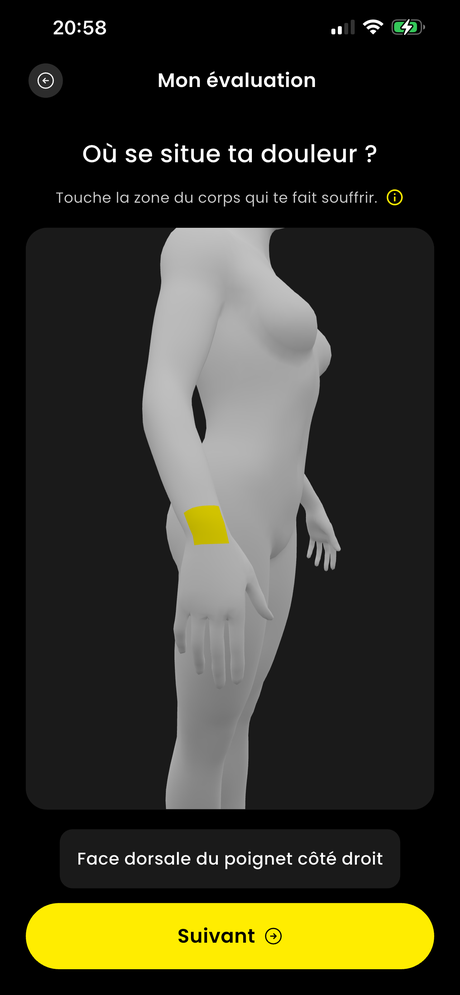
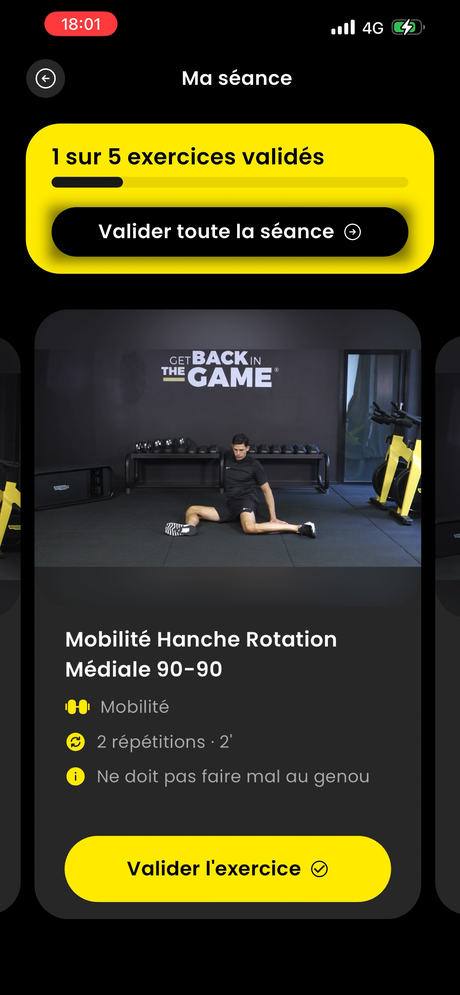
In the HOPP programme, these exercises are shown on video and dosed every day according to your pain and how you feel.
Wrist extensions with dumbbells: the right technique
Rest your forearm on a table or on your thigh, palm facing down, with the hand hanging over the edge. Lift the wrist without letting the forearm come up, then lower slowly, without dropping the load. Choose a light dumbbell to start with: the pain should stay low during the exercise and not increase the next day. If it rises, go lighter or go back to contractions without movement.
Should you rest or keep playing sport?
Total rest is generally not necessary. It’s better to temporarily adapt the movements that clearly reproduce the pain, while starting eccentric strengthening as soon as possible.
Think you might have a different wrist or hand injury?
Take your free test in 3 minutes flat.
When should you see a specialist for this tendinopathy?
If the pain persists for more than four to six weeks despite adapting your activities and following a well-run strengthening programme, a medical opinion is recommended.
Wrist extensor tendinitis: how long does it take to heal?
The recovery time for wrist extensor tendinitis depends mostly on how long the pain has been there. The more recent it is, the faster the tendon responds. These are guidelines, not promises.
3 to 6 weeks
Pain only after effort
6 to 12 weeks
Pain at the start of the movement, eases when warm then returns
3 to 6 months
Pain during and after, gripping is hindered
Indicative timeframes, with regular rehabilitation.
What lengthens recovery: finishing your sessions because the pain eases once you are warm, giving up the racket or the gym for weeks without doing anything else, or dropping the wrist exercises while keeping all your heavy grips. The tendon cannot tell the difference: it is the total volume over the week that counts.
Anti-inflammatories, rest, splint: what really helps
Anti-inflammatories can calm occasional pain, but they do not act on the cause. A wrist extension splint can bring relief for a few days if the pain is sharp, on medical advice, but worn for a long time it weakens the muscles. Complete rest calms the wrist for a while, then the pain returns when you start again. What really helps is lowering the load without stopping it, then strengthening progressively.[2][5]
Wrist pain and tennis: can you keep playing?
In tennis, the wrist extensors work with every shot to hold the racket, and even more on the backhand. The pain often appears after an increase in hours played, a change of racket or strings, or a backhand played entirely from the wrist. In most cases you do not need to stop, but to adapt your game while the tendon gets stronger.[2][3]
Playing tennis with extensor tendinitis
Keep the sessions where the pain stays mild and disappears within the following hours
Cut back on the volume of backhands, especially one-handed, and long series of volleys
Loosen your grip between shots: squeeze only as much as needed at impact
Have your handle size checked: a grip that is too thin demands more clenching
Do a few held contractions, wrist lifted, before stepping onto the court
The same principles apply to padel and badminton, to weight training, where a neutral grip or straps take the pressure off the back of the wrist for a while, to climbing and to golf.
How to stop wrist extensor tendinitis from coming back?
Being pain-free does not mean the tendon is ready: it still has to relearn how to cope with your shots and your grips. A few habits limit the risk of relapse.
The right habits
Keep one wrist extensor strengthening exercise in your week
Count your shots and your heavy grips: increase the volume gradually
Measure out your grip and relax the hand between efforts
Adapt your equipment: a thick enough handle, varied grips on the bar
At your desk, keep the wrist in line with the forearm and take breaks
The HOPP care programmes to treat your extensor tendinopathy and get back to sport
This tendinopathy requires rigorous, progressive eccentric strengthening. HOPP offers you a precise exercise programme, allowing you to get back to your activities as quickly as possible.
The programme runs from 3 to 9 weeks depending on the injury and ends with a reconditioning phase allowing a return to competition in the best possible conditions. Each programme is designed by the HOPP team, made up of two sports physiotherapists who are experts in assessing and treating athletes. You’ll also find theoretical content throughout your progression, so you master every aspect of your recovery and can adjust your treatment independently. If needed, our team of physiotherapists is on hand to support you.
Your HOPP programme, as a subscription
You start for free: 3 days of personalised programme, no credit card. After that, you choose to continue with the subscription, or to stay on limited free access.
3 days
of personalised programme, in the app
- No credit card
- No email needed
- Your first session today
After the 3 days, you choose
I subscribe
Everything unlocked
- Today’s session and your personalised programme
- Daily adjustment of your programme
- Conversations with support
- Plus everything free access already keeps
I stay on free
Limited access
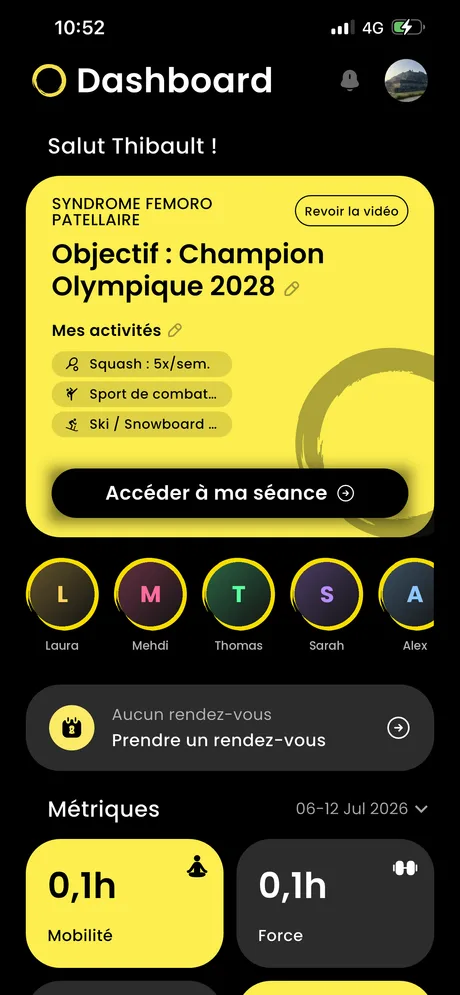
- The dashboard: your progress and your metrics
- Booking a video call with a sports physio
- The HOPP shop
- Today’s session and your personalised programme
- Daily adjustment of your programme
- Conversations with support
Choose your plan
Your personalised programme, adjusted daily to how you feel
€9.99 /month€99 /year
No commitment
- Personalised programme
- Daily tracking
- Daily adjustment
- Return-to-sport assessment
- Reconditioning phase
- Relapse prevention
- HOPP community access
- 1 video call of 20 minutes every month7 video calls of 20 minutes over the year
The same programme, with your sports physio on video
€39.99 /month€299 /year
No commitment
- Personalised programme
- Daily tracking
- Daily adjustment
- Return-to-sport assessment
- Reconditioning phase
- Relapse prevention
- HOPP community access
- 1 video call of 20 minutes every month7 video calls of 20 minutes over the year
A single video call with a FIFA-certified sports physio, no subscription: €35
What your subscription includes
Personalised programme
Built for your injury by two sports physiotherapists, from your assessment.
Daily tracking
Today’s session, your progress and your metrics, all in your dashboard.
Daily adjustment
How you feel today shapes what comes next: more load if all is well, less if the pain complains.
Return-to-sport assessment
A checkpoint to know whether your body is ready to go back to your sport, and at what level.
Video call with a FIFA-certified sports physio
Plan with video callsIn the plan with video calls: 20 minutes to review your progress with them.
Reconditioning
A final phase to get your level back before returning at full intensity.
Prevention
Exercises to strengthen your weak points and lower the risk of a relapse.
Community
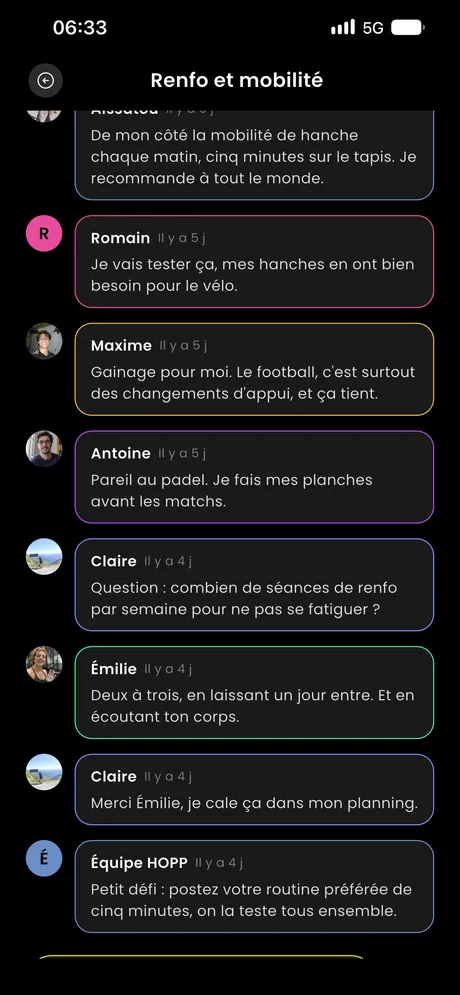
Talk with other athletes going through the same rehab.
The HOPP app, for real
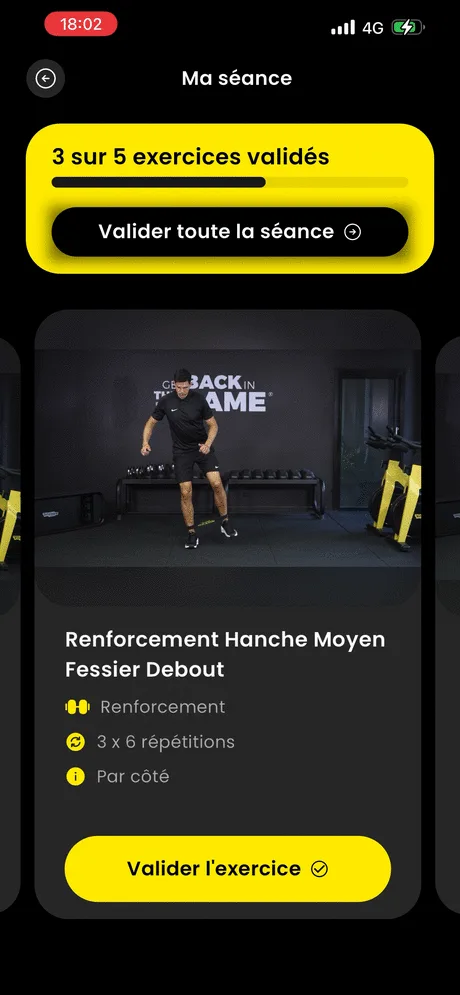
A programme that adapts to you every day
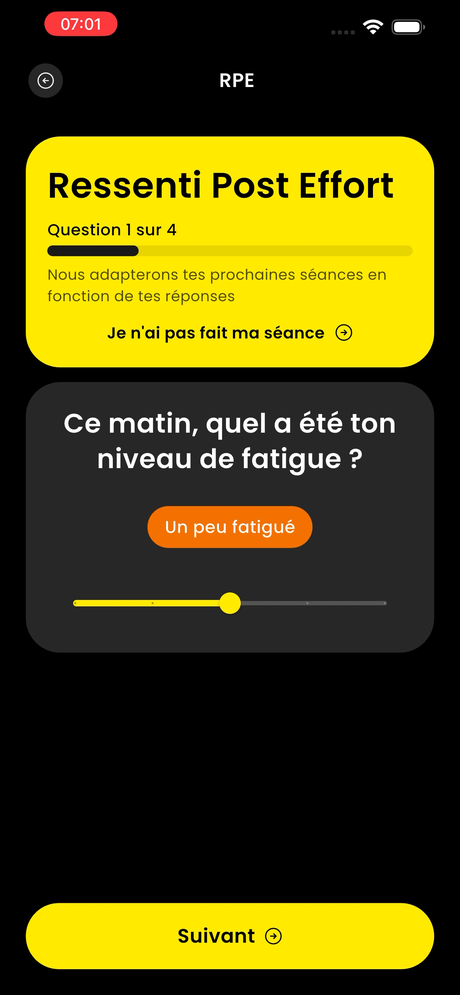
Every day, how you feel (RPE) is factored in to automatically adjust the rest of your programme: more load if all is well, a bit less if your wrist is complaining. This daily personalisation is what makes the difference compared to a fixed, paper-based programme.

Ready to start your programme?
Join the HOPP support programme designed by sports physios.
Keep these pointers close at hand
The wrist extensor tendinitis guide covers recovery times, the right moves and the traps to avoid. You get it by email within a minute.

F.A.Q
Does the HOPP programme replace a medical consultation?
No. HOPP is a support and rehab tool designed by sports physiotherapists, but it doesn’t replace a doctor’s opinion. If in doubt, or if the pain persists, see a health professional.
Is the programme suited to all sporting levels?
Yes. Every programme is personalised to your sport, your level and how you feel each day, whether you’re a recreational athlete or preparing for competition.
Can I keep playing tennis with this tendinopathy?
Not necessarily a complete stop, but a temporary adjustment of volume and sometimes technique (the backhand in particular), while starting eccentric strengthening in parallel.
How long does it take to recover?
This tendinopathy can take longer to heal than others, with gradual improvement over several weeks to a few months depending on how long the symptoms have been present.
What’s the difference with tennis elbow?
Both affect the same extensor muscles, but tennis elbow concerns their attachment at the elbow, whereas this tendinopathy concerns the tendons lower down, at the wrist.
Can a brace or strapping help?
It can temporarily ease things by limiting wrist extension during risky activities, but it’s not a lasting solution: eccentric strengthening remains the foundation of treatment.
Can this tendinopathy become chronic?
Yes, if the load isn’t adapted and the strengthening isn’t seen through to the end. A progressive, complete programme significantly limits this risk.