

What is gluteus medius tendinopathy?
Gluteus medius anatomy
Gluteus medius is a muscle on the outer side of the hip, whose tendon attaches to the greater trochanter (the bony prominence you can feel on the side of the hip). It plays a key role in stabilising the pelvis every time you bear weight on one leg, particularly during running and walking. Its tendinopathy is the most common cause of lateral hip pain in athletes.
Why does this tendon become painful?
Pain appears when gluteus medius is repeatedly loaded beyond its capacity, often linked to weakness in this muscle, which then has to compensate more with every step. Too rapid an increase in running volume, prolonged sitting with legs crossed, or a pelvic imbalance contribute to this tendinopathy.

Physio insight · Thibault
This tendinopathy is often associated with trochanteric bursitis, as the two structures are very close anatomically: the pain may then have a dual origin that needs to be properly identified in order to adapt treatment.
Physio tip · Hemrick
Test your pain by standing on one leg for 30 seconds: if the pain appears or worsens on the side of the weight-bearing hip, that’s a good indicator of gluteus medius tendinopathy.
Causes and risk factors
Gluteus medius tendinopathy most often results from progressive tendon overload, linked to a strength deficit in the muscle, which then has to compensate more with every step.
Biomechanical and personal factors
- A strength deficit in gluteus medius
- A pelvic imbalance during single-leg weight-bearing
- Too rapid an increase in running volume
- Prolonged sitting with legs crossed
Which sports contribute to gluteus medius tendinopathy?
Any sport with repeated single-leg weight-bearing carries a particular risk:
- Running, especially long distance
- Hiking
- Football and team sports
- Cycling with poorly adjusted saddle height
- Dance
- Sports with repeated lateral weight-bearing
Gluteus medius tendinitis: the symptoms on the side of the hip
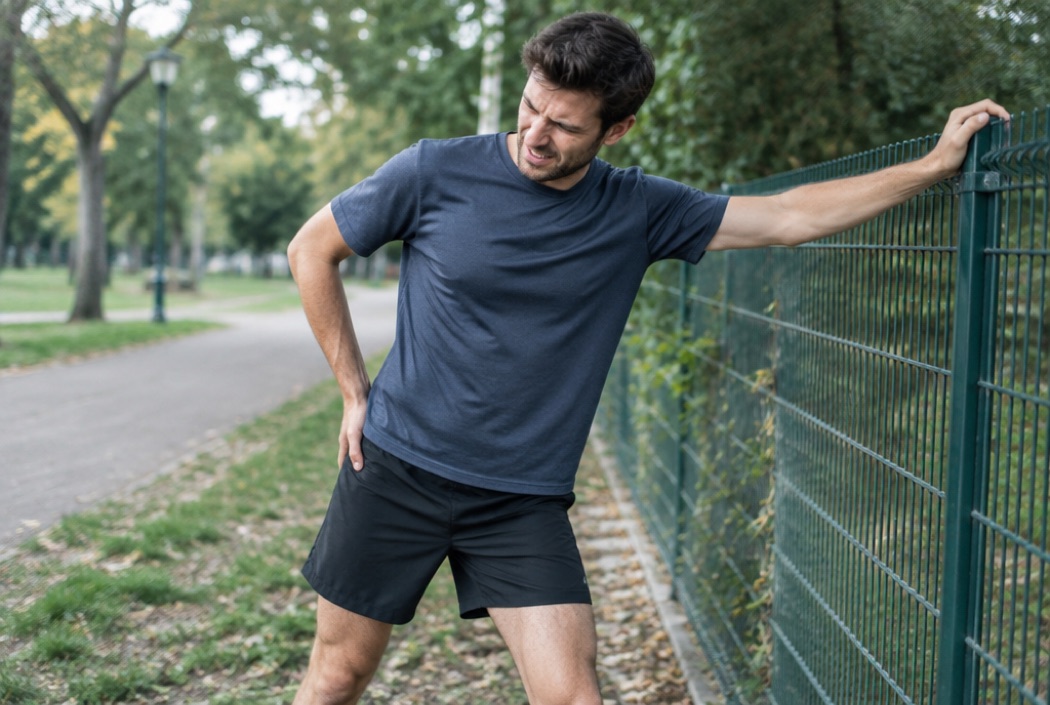
The gluteus medius is the muscle on the side of the hip: it keeps your pelvis level every time you stand on one leg, when walking as well as running. Its tendon attaches to the greater trochanter, the bony bump you can feel on the outer side of the hip. Gluteus medius tendinitis, which physios call gluteal tendinopathy, causes pain on this outer side, which sometimes runs down along the thigh.[1][2]
When you press on it, the bony bump is tender. The pain flares up when you stand on one leg, and when the tendon is put under tension and pressed against the bone: legs crossed, hip pushed out to the side, or lying on the painful side.
The most common signs
Pain at night, lying on your side, sometimes on both sides
Pain on the outer side of the hip when climbing stairs
Stiffness when you get up, after sitting for a long time
Discomfort standing on one leg, for example when getting dressed
Stronger pain the day after a long walk or a long run
How do you get gluteus medius tendinitis? Most often through badly dosed load, too much or too soon, on a muscle that is not strong enough, combined with repeated compression of the tendon against the bone. It is not really an inflammation.[1][4]
Gluteus medius, bursitis or another hip pain?
Trochanteric bursitis affects the small bursa located right next to the tendon: the two often go together and their symptoms are very similar.[2] A pain in the groin, with a stiff hip, points more towards hip osteoarthritis or hip impingement. A pain that starts in the lower back and runs down into the buttock is more often low back pain. And in runners, a pain on the side of the knee suggests IT band syndrome.
Tendinitis, muscle soreness or a gluteus medius tear?
Muscle soreness affects the whole buttock, the day after an unusual effort, and passes within a few days. A tear, or gluteal muscle injury, happens all at once, on a specific movement. Gluteus medius tendinitis sets in little by little, stays located on the side of the hip and shows up mostly at night and when you put weight on the leg.
Ultrasound, MRI: do you need scans?
The doctor’s clinical examination is most often enough to point towards gluteus medius tendinitis. If the pain persists, the doctor may order an ultrasound or an MRI to look at the tendon and the bursa, and an X-ray to check the hip joint.[1]
Treating gluteus medius tendinopathy in rehab with a sports physio
The goal of treatment is to progressively strengthen gluteus medius to restore its pelvis-stabilising function with every step.
- 1
Reducing pain and managing load
- 2
Hip mobility
- 3
Isometric strengthening
- 4
Progressive concentric strengthening
- 5
Eccentric strengthening
- 6
Pelvic chain work
- 7
Correcting sporting technique
- 8
Strengthening under sport-specific load
- 9
Progressive return to your sport
- 10
Return to competition
“It’s not that the tendon is fragile, it’s that the load needs to be better dosed and distributed.”
Strengthening, the cornerstone of treatment
Progressive strengthening of gluteus medius, particularly under load and in single-leg stance, restores its function as a pelvic stabiliser and reduces tendon overload with every step.
In brief
Progressive strengthening of gluteus medius
Pelvic stability work in single-leg stance
Eccentric strengthening
Gradual return: mobility, then load, then sport
Ready to take your gluteus medius tendinopathy seriously?
Start the HOPP programme designed by sports physios.
Which exercises for gluteus medius tendinitis?
How do you treat gluteus medius tendinitis? With two levers: less compression on the tendon in daily life, and progressive strengthening exercises. It is this combination, advice and exercises, that has been studied the most for this hip pain.[3]
The gluteus medius works with the gluteus minimus and the gluteus maximus to stabilise the pelvis, and with the abdominals to hold the trunk. Its opposing muscles are the adductors, on the inside of the thigh. When it lacks strength, the pelvis drops on the opposite side at every step, the hip pushes out to the side, and the tendon is both pulled and compressed. So strengthening targets the whole chain of the pelvis.
- 1
Contract without moving
: sustained contractions of the gluteus medius, without movement, calm the pain and wake the muscle up. This is the starting point while the hip is still sensitive. - 2
Strengthen the gluteus medius on the floor
: lying down, you lift the leg out to the side under control, without letting the pelvis roll. Strengthening then gets heavier, slowly, always below the threshold that stirs up the pain. - 3
Stabilise on one leg
: standing on one leg, you learn to keep the pelvis level. Foot stability on an unstable surface completes this work, which gets closer to walking and running.[1] - 4
Keep some mobility, without forcing or compressing
: the standing adductor stretch is done as gentle mobility, without forcing and without stirring up the pain. It maintains hip mobility without pressing the tendon against the bone, unlike glute stretches with the leg crossed.
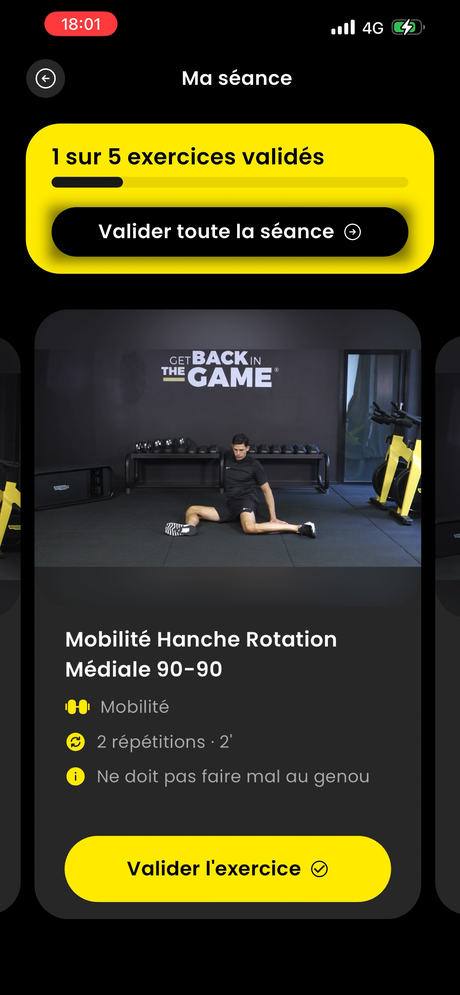
In the HOPP programme, these exercises are shown on video and dosed every day according to your pain and how you feel.
Stretching the gluteus medius: the false friend
When the side of the hip feels tight, the reflex is to stretch the glute. For this tendon, you need the opposite: with the leg crossed, it presses against the bone and gets more irritated. Same effect sitting with your legs crossed, or standing with your weight dropped onto one hip. Early on, if in doubt, do not stretch. This tendon wants strength, not length.[1]
Should you rest or keep playing sport?
Total rest is generally not necessary. It’s better to temporarily adapt your running volume and avoid the positions that clearly reproduce the pain (prolonged sitting with legs crossed), while starting strengthening as soon as possible.
Think you might have a different hip injury?
Take your free test in 3 minutes flat.
When should you see a specialist for gluteus medius tendinopathy?
If the pain persists for more than four weeks despite adapting your activities, a medical opinion is recommended to rule out associated bursitis or another cause of lateral hip pain.
Gluteus medius tendinitis: what is the healing time?
How long does gluteus medius tendinitis last? The healing time depends mostly on how long the pain has been there and what it gets in the way of: the end of your runs, stairs, or walking and sleep. Here are some pointers, not promises: every tendon has its own pace.
3 to 6 weeks
Pain at the end of a run, which fades quickly
6 to 12 weeks
Pain while running and on stairs
3 to 6 months
Pain at night, when walking, for a long time
Indicative timeframes, with regular rehabilitation.
A tendon gets stronger slowly: judge the trend over several weeks rather than over one day. What lengthens the timeline: stopping everything and letting the muscle weaken, carrying on running on it hoping it will pass, or keeping the positions that compress the tendon, day and night.[4]
Anti-inflammatories, rest, stretching: what really helps
Anti-inflammatories can calm an occasional pain, without acting on the cause. Complete rest is not necessary and glute stretches do not help. What brings relief day to day: uncrossing your legs, standing on both feet, sleeping with a cushion between your knees. And what treats it: progressive strengthening.[3]
Can you walk with gluteus medius tendinitis?
Yes. Walking with gluteus medius tendinitis does not damage the tendon, and staying active is better than complete rest. But every step means standing on one leg: it is the gluteus medius that holds the pelvis. So you need to dose your walking and make it more comfortable for the hip.
Walking with gluteus medius tendinitis
Choose several short walks over one long outing
Shorten your steps a little: the pelvis is held better
For a while, avoid cambered ground, long downhills and repeated stairs
Judge the next morning: if the side of the hip is more sensitive, the dose was too high
Lengthen your outings in stages, keeping to flat ground first
The same principles apply to running and trail running, where flat ground comes back first and volume next, to cycling, provided your saddle is properly adjusted, and to football or golf, where standing on one leg happens again and again.
How do you stop gluteus medius tendinitis from coming back?
No longer being in pain does not mean the tendon has healed: keep up the strengthening to avoid a relapse. A few habits protect the hip over the long term.
The right habits
Keep one gluteus medius strengthening exercise in your week
Increase your walking or running volume gradually
When sitting, keep your knees hip-width apart, feet on the floor
When standing, spread your weight over both feet, without dropping onto one hip
Keep the cushion between your knees if you sleep on your side
The HOPP care programmes to treat your gluteus medius tendinopathy and get back to sport
This tendinopathy requires targeted, progressive strengthening. HOPP offers you a precise exercise programme, allowing you to get back to your activities as quickly as possible.
The programme runs from 3 to 9 weeks depending on the injury and ends with a reconditioning phase allowing a return to competition in the best possible conditions. Each programme is designed by the HOPP team, made up of two sports physiotherapists who are experts in assessing and treating athletes. You’ll also find theoretical content throughout your progression, so you master every aspect of your recovery and can adjust your treatment independently. If needed, our team of physiotherapists is on hand to support you.
Your HOPP programme, as a subscription
You start for free: 3 days of personalised programme, no credit card. After that, you choose to continue with the subscription, or to stay on limited free access.
3 days
of personalised programme, in the app
- No credit card
- No email needed
- Your first session today
After the 3 days, you choose
I subscribe
Everything unlocked
- Today’s session and your personalised programme
- Daily adjustment of your programme
- Conversations with support
- Plus everything free access already keeps
I stay on free
Limited access
- The dashboard: your progress and your metrics
- Booking a video call with a sports physio
- The HOPP shop
- Today’s session and your personalised programme
- Daily adjustment of your programme
- Conversations with support
Choose your plan
Your personalised programme, adjusted daily to how you feel
€9.99 /month€99 /year
No commitment
- Personalised programme
- Daily tracking
- Daily adjustment
- Return-to-sport assessment
- Reconditioning phase
- Relapse prevention
- HOPP community access
- 1 video call of 20 minutes every month7 video calls of 20 minutes over the year
The same programme, with your sports physio on video
€39.99 /month€299 /year
No commitment
- Personalised programme
- Daily tracking
- Daily adjustment
- Return-to-sport assessment
- Reconditioning phase
- Relapse prevention
- HOPP community access
- 1 video call of 20 minutes every month7 video calls of 20 minutes over the year
A single video call with a FIFA-certified sports physio, no subscription: €35
What your subscription includes
Personalised programme
Built for your injury by two sports physiotherapists, from your assessment.
Daily tracking
Today’s session, your progress and your metrics, all in your dashboard.
Daily adjustment
How you feel today shapes what comes next: more load if all is well, less if the pain complains.
Return-to-sport assessment
A checkpoint to know whether your body is ready to go back to your sport, and at what level.
Video call with a FIFA-certified sports physio
Plan with video callsIn the plan with video calls: 20 minutes to review your progress with them.
Reconditioning
A final phase to get your level back before returning at full intensity.
Prevention
Exercises to strengthen your weak points and lower the risk of a relapse.
Community
Talk with other athletes going through the same rehab.
The HOPP app, for real
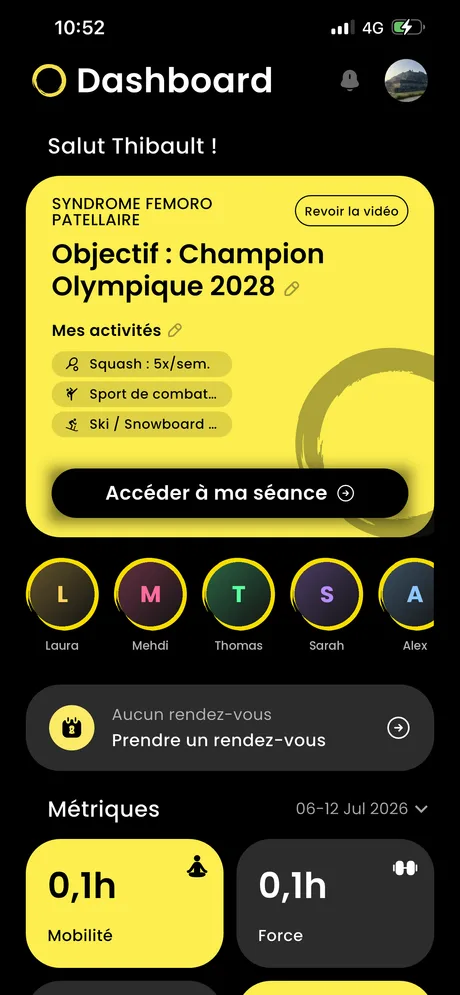
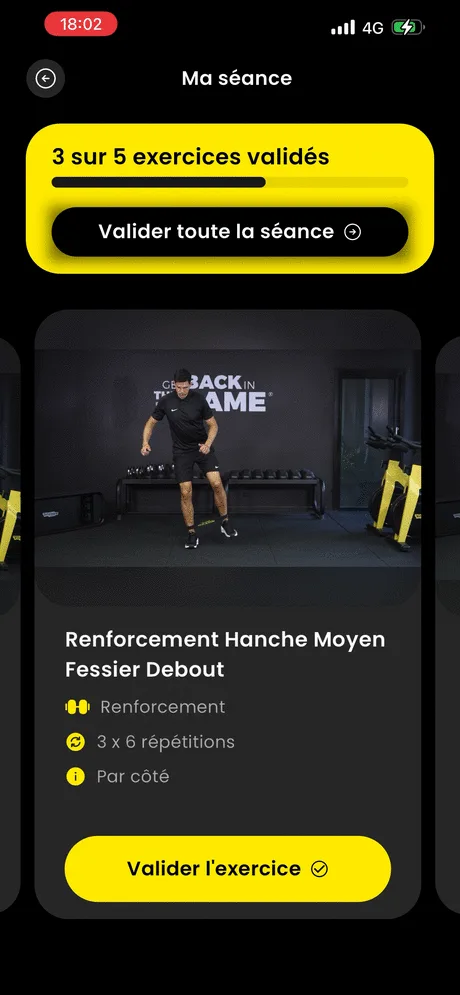
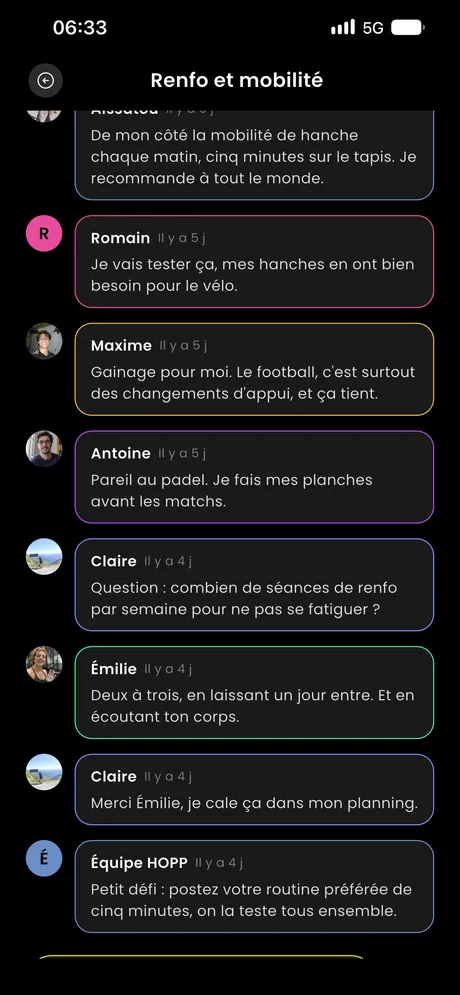
A programme that adapts to you every day
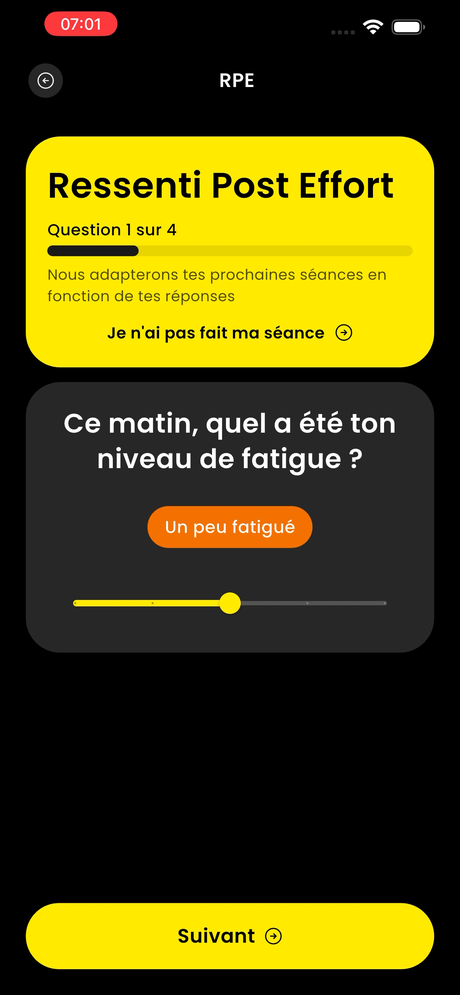
Every day, how you feel (RPE) is factored in to automatically adjust the rest of your programme: more load if all is well, a bit less if your hip is complaining. This daily personalisation is what makes the difference compared to a fixed, paper-based programme.

Ready to start your programme?
Join the HOPP support programme designed by sports physios.
Keep these pointers close at hand
The gluteus medius tendinitis guide covers the timelines, the right moves and the traps to avoid. You get it by email in one minute.

F.A.Q
Does the HOPP programme replace a medical consultation?
No. HOPP is a support and rehab tool designed by sports physiotherapists, but it doesn’t replace a doctor’s opinion. If in doubt, or if the pain persists, see a health professional.
Is the programme suited to all sporting levels?
Yes. Every programme is personalised to your sport, your level and how you feel each day, whether you’re a recreational athlete or preparing for competition.
Can I keep running with this tendinopathy?
In most cases, yes, by temporarily adapting your volume, while starting strengthening in parallel.
How long does it take to recover?
A structured programme generally brings clear improvement within a few weeks, with a full return to sport after several weeks of progressive strengthening.
What’s the difference with trochanteric bursitis?
The tendinopathy affects the tendon itself, while bursitis affects the small adjacent fluid-filled sac. The two can coexist and cause similar pain on the side of the hip.
Should I avoid sleeping on the painful side?
It’s best to avoid direct pressure on the painful hip at night, placing a pillow between your knees when lying on your side: this reduces compression of the tendon against the greater trochanter and improves sleep comfort.
Is stretching gluteus medius recommended?
Stretches that are too intense or too frequent can actually compress the tendon against the bone and worsen the pain: progressive strengthening is a better focus, and remains the reference treatment for this tendinopathy.