

What is low back pain?
The anatomy of the lower back
The lower back is made up of five lumbar vertebrae, separated by intervertebral discs that absorb strain and linked together by spinal ligaments, the whole surrounded by a powerful network of back muscles (spinal erectors, quadratus lumborum, deep abdominals) that stabilises the trunk with every movement. Low back pain refers to any pain felt in this region, from the lower back down to the top of the buttocks. In more than 90% of cases in athletes, it’s described as “common” or “non-specific”: it isn’t linked to a serious structural injury, but to mechanical overload of this region.[1]
Why does this area become painful?
Pain most often appears when the lower back is subjected to a repeated or sudden load beyond its capacity to adapt at a given moment: a flexion-rotation movement under load, a training volume increased too quickly, lack of sleep, stress or a period of general fatigue can all temporarily lower this tolerance threshold, without any structural “malfunction” of the back.
Acute, subacute, chronic low back pain: definitions
- Acute: less than 6 weeks, the most common case
- Subacute: between 6 and 12 weeks
- Chronic: more than 12 weeks, which applies to a minority of cases but calls for more comprehensive care
In everyday language, the term “lumbago” refers to a sudden episode of acute low back pain, often following a flexion-rotation movement.
Symptoms and diagnosis of low back pain
Typical pain and what triggers it
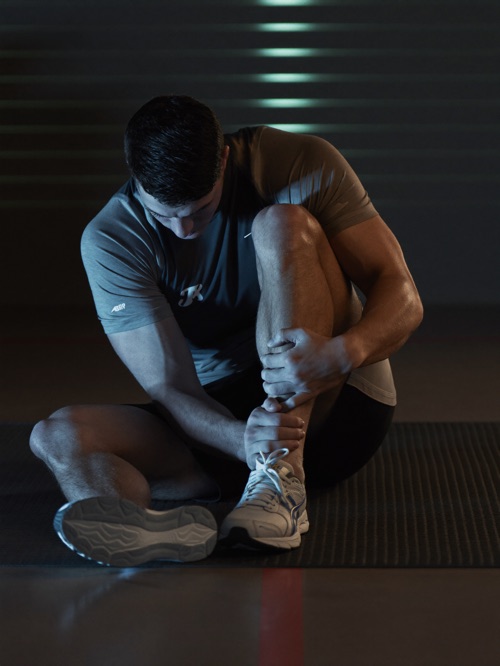
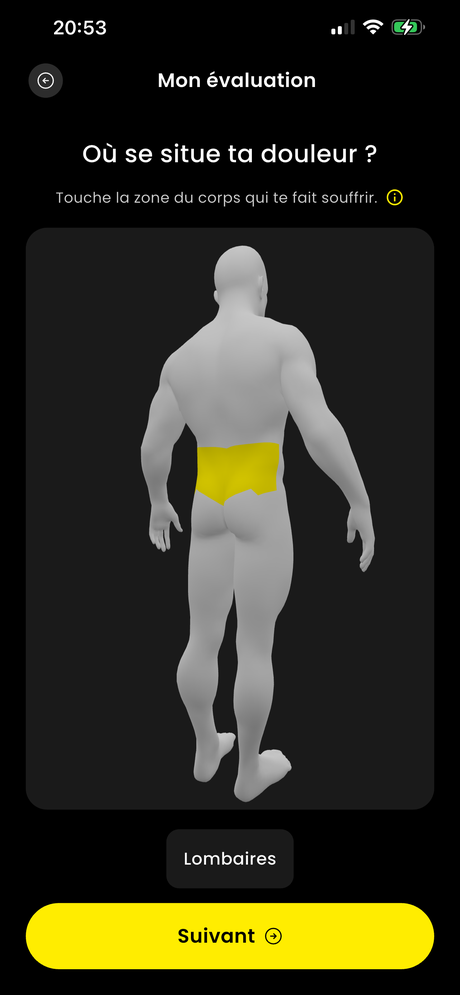
The pain is located in the lower back, sometimes radiating to the buttock or upper thigh, without going further down into the legs for common low back pain. A reflex muscle contraction (spasm) often accompanies the episode, particularly at the start. The pain is typically triggered by flexion-rotation under load, prolonged postures (sitting, bending forward), or waking up with stiffness that eases with movement.
How symptoms progress without treatment
Contrary to popular belief, the main risk isn’t the worsening of a structural injury, but the onset of fear of movement, which leads to avoiding certain movements, which in turn maintains muscular deconditioning and prolongs the pain well beyond the natural recovery time.[3]
Differential diagnosis
Certain signs should point towards a diagnosis other than common low back pain:
- True sciatica: pain that clearly extends below the knee along the path of the sciatic nerve, from nerve compression linked to a symptomatic herniated disc
- Spondylolysis or spondylolisthesis: a bone stress fracture of the vertebra, to consider in young athletes practising sports with repeated hyperextension (gymnastics, throwing sports, dance)
- Facet joint arthritis: wear of the posterior spinal joints, with pain more often triggered by spinal extension and rotation, more common with age
Causes and risk factors
Low back pain rarely results from a single cause: it’s most often a combination of mechanical and non-mechanical factors that lowers the spine’s tolerance at a given moment. A direct trauma (fall, impact), on the other hand, is a rarer cause in athletes than progressive overload.
Biomechanical and personal factors
- A deficit in deep core strength (transverse abdominis, multifidus)
- A lack of hip mobility, often compensated for by excess movement in the lower back
- Too rapid an increase in training volume or load
- Repeated asymmetric loading (unilateral sports)
- Age-related disc degeneration signs, present in many athletes with no associated pain: their presence on imaging doesn’t automatically mean they’re the cause of the pain
Non-mechanical factors, often underestimated
Insufficient sleep, stress and periods of general fatigue lower the back’s tolerance to load, independently of any specific movement. This is one of the particularities of low back pain: it’s rarely purely “mechanical”.
Which sports contribute to low back pain?
All sports that place heavy load or repeated rotation on the trunk carry a particular risk:
- Strength training and weightlifting (deadlift, squat)
- Golf and other trunk-rotation sports
- Rowing
- High-volume running
- Combat and contact sports
- CrossFit with heavy loads
Why does low back pain sometimes appear with no clear trigger?
This is the most common scenario: no sudden movement, and yet pain appears. It’s almost always the result of a build-up of small overloads (repeated movements, fatigue, stress) that gradually exceeds the back’s tolerance, without any single identifiable event.
Treating low back pain in rehab with a sports physio
The goal of treatment is to help you stay active despite the pain, by progressively strengthening the lower back and correcting overload factors, rather than waiting for the pain to disappear completely before moving.
- 1Understanding your pain and reassurance
- 2Staying appropriately active from the start
- 3Mobility of the lumbar spine and pelvis
- 4Deep core strengthening
- 5Strengthening the spinal erectors
- 6Overall posterior chain strengthening
- 7Correcting the at-risk sporting movement
- 8Strengthening under sport-specific load
- 9Progressive return to your sport
- 10Return to competition
DEMONSTRATION
Video by Hemrick, co-founder of HOPP.
DEMONSTRATION
Video by Hemrick, co-founder of HOPP.
“The back isn’t fragile: it’s built to move, bend and carry load, even when it hurts.”
Strengthening and movement, the cornerstones of treatment
Strengthening the deep core and spinal erectors, combined with staying regularly active rather than immobilisation, is currently the most scientifically documented treatment for common low back pain.[2] Staying active, even with moderate pain, speeds up recovery compared with strict rest.
In brief
- Staying appropriately active from the start
- Deep core strengthening
- Strengthening the spinal erectors
- Gradual return: mobility, then load, then sport
Ready to take your low back pain seriously?
Start the HOPP programme designed by sports physios.
Should you rest or keep playing sport?
Strict rest is now discouraged in the vast majority of cases of common low back pain: it delays recovery and can reinforce fear of movement.[2] It’s better to temporarily adjust the intensity of your activities while staying active, and start progressive strengthening as soon as possible.
Think you might have a different back problem?
Take your free test in 3 minutes flat.
When should you see a specialist for low back pain?
A prompt medical consultation is recommended in the case of unusually intense night pain, loss of strength or numbness in a leg, loss of bladder or bowel control (a possible sign of spinal cord or nerve root compression), or accompanying fever. Outside of these rare signs, low back pain that persists beyond four to six weeks despite active care also warrants a further opinion.
Recovery time for low back pain
The vast majority of acute low back pain improves significantly within 2 to 6 weeks by staying active. The risk of it becoming chronic (beyond 12 weeks) is more closely linked to fear of movement and deconditioning than to the initial severity of the pain.[3]
Factors that speed up or slow down recovery
- Staying appropriately active from the first few days
- Consistency in deep core strengthening
- Managing sleep and stress
- Not prolonging avoidance of painful movements
Preventing re-injury
Low back pain often recurs, but a back that’s regularly strengthened and kept moving is a better-protected back.
The 10% progression rule
Not increasing training volume or load by more than 10% per week limits the risk of a new lower-back overload.
Regular deep core maintenance
Regular deep core work (transverse abdominis, multifidus), combined with maintaining hip mobility, remains the best-documented measure for reducing the risk of recurrence. Gentle stretches for the back and lower limbs can complement this work for comfort, without being its cornerstone. This kind of maintenance work, even brief but regular, matters more than intense but occasional sessions.
The HOPP care programmes to treat your low back pain and get back to sport
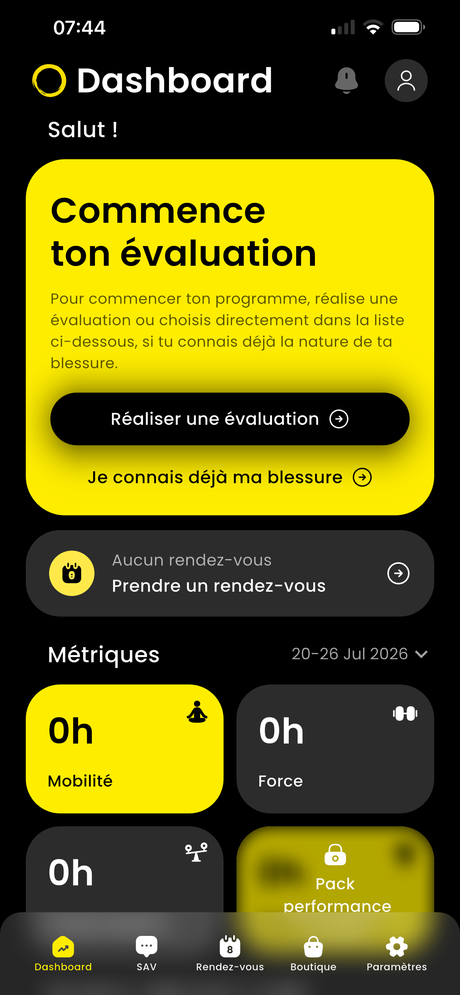
Low back pain requires active support that combines progressive strengthening with staying in motion. HOPP offers you a precise exercise programme, allowing you to get back to your activities as quickly as possible.
The programme runs from 3 to 9 weeks depending on the injury and ends with a reconditioning phase allowing a return to competition in the best possible conditions. Each programme is designed by the HOPP team, made up of two sports physiotherapists who are experts in assessing and treating athletes. You’ll also find theoretical content throughout your progression, so you master every aspect of your recovery and can adjust your treatment independently. If needed, our team of physiotherapists is on hand to support you.
Essential
FROM INJURY TO
BACK TO YOUR ACTIVITIES
59€
One-time payment
“AT YOUR OWN PACE WITH
DAILY ADAPTATION”
- 100% of the treatment programme
- Daily personalisation
- Flexibility / Mobility
- Strengthening
- Proprioception
- Progress tracking
- Return-to-running programme
- Theoretical content included
Performance
TO GET BACK TO SPORT
IN THE BEST CONDITIONS
79€
One-time payment
“GET BACK TO YOUR LEVEL
WITHOUT RISK OF RELAPSE”
- 100% of the treatment programme
- Daily personalisation
- Flexibility / Mobility
- Strengthening
- Proprioception
- Progress tracking
- Return-to-running programme
- Theoretical content included
- + 4-week return-to-play plan with 6 difficulty levels
Expert
PERSONALISED VIDEO-CALL
SUPPORT, ANY TIME
149€
One-time payment
“A PHYSIO
WHENEVER YOU NEED”
- 100% of the treatment programme
- Daily personalisation
- Flexibility / Mobility, Strengthening, Proprioception
- Progress tracking
- Return-to-running programme
- Theoretical content included
- + 4-week return-to-play plan with 6 difficulty levels
- + 2 video calls with an expert sports physio / return check-up
A programme that adapts to you every day
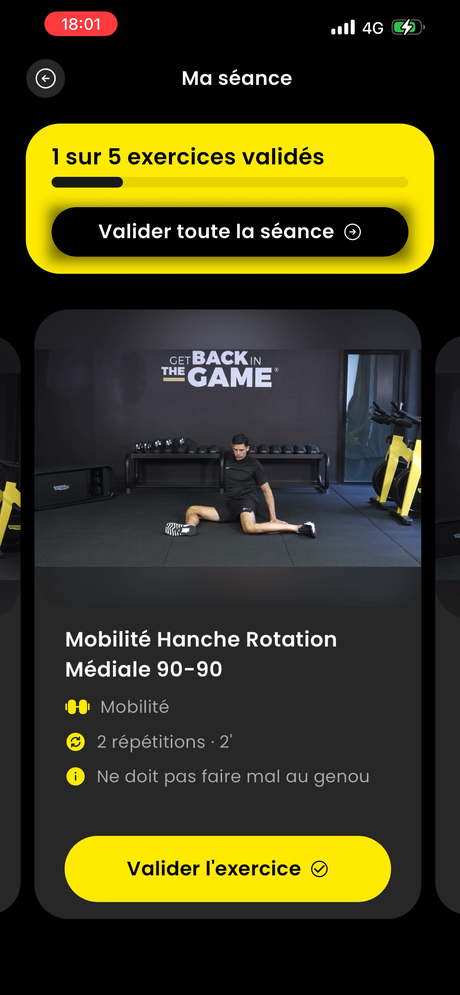
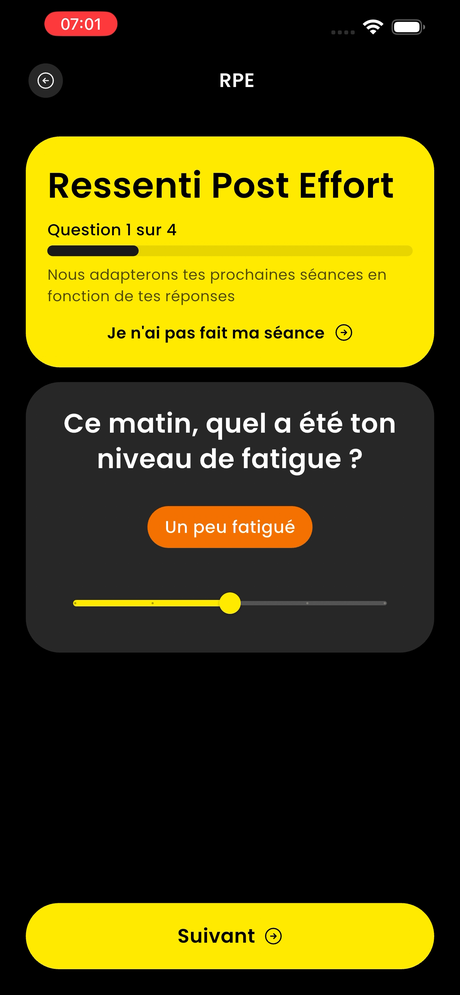
Every day, how you feel (RPE) is factored in to automatically adjust the rest of your programme: more load if all is well, a bit less if your back is complaining. This daily personalisation is what makes the difference compared to a fixed, paper-based programme.

Ready to start your programme?
Join the HOPP support programme designed by sports physios.
Does your low back pain feel different from a simple strain?
Take the “is my back pain serious?” quiz to find out if you need a doctor’s opinion.
Does your pain travel down your leg?
Take the “sciatica or piriformis syndrome?” quiz to better understand where it’s coming from.
F.A.Q
Does the HOPP programme replace a medical consultation?
No. HOPP is a support and rehab tool designed by sports physiotherapists, but it doesn’t replace a doctor’s opinion. If in doubt, or if the pain persists, see a health professional.
Is the programme suited to all sporting levels?
Yes. Every programme is personalised to your sport, your level and how you feel each day, whether you’re a recreational athlete or preparing for competition.
Does my low back pain mean I have a herniated disc?
Not necessarily. The vast majority of low back pain, even in athletes, is described as common and isn’t linked to a symptomatic herniated disc. Only certain specific signs (pain radiating down the leg along a clear nerve pathway) point towards this possibility.
Can I keep playing sport with low back pain?
In the vast majority of cases, yes, by temporarily adjusting intensity and avoiding movements that clearly reproduce the pain, while starting strengthening work alongside it. Staying active is in fact recommended.
How long does it take to recover from low back pain?
Most common low back pain improves significantly within a few weeks with active care. Some pain can recur in episodes, which is common and doesn’t mean it’s getting worse.
Should I avoid lifting or bending?
No, systematically avoiding these movements reinforces fear of movement and doesn’t help recovery. The back needs to relearn how to bend and carry load progressively, which is precisely part of the treatment.
Can low back pain become chronic?
A minority of cases of low back pain persist beyond 12 weeks. This risk is more closely linked to fear of movement and prolonged inactivity than to the initial severity of the pain, which is why staying active from the start matters.
Is core bracing enough to prevent low back pain?
It’s an important pillar, but not enough on its own: hip mobility, managing training volume, and factors like sleep and stress also play a role in preventing recurrence.
Is a lumbar support belt useful?
It can offer short-term reassurance, but evidence for its long-term effectiveness is limited[4], and it doesn’t replace muscle strengthening. Prolonged use can even encourage your natural core bracing to switch off.
Do anti-inflammatories or painkillers help?
They can relieve pain in the short term and make it easier to get moving again, but they don’t treat the cause. Their use should stay occasional and be discussed with a doctor or pharmacist.