



The role of the tendon in athletes
The tendon is the end part of the muscle that attaches to the bone; it’s through the tendon that the muscle moves a joint. It has a limited blood supply but is rich in nerve fibres, which allows the body to fine-tune sporting movement precisely.
For an athlete, healthy tendons are therefore essential for the precision and coordination of movement.

How tendinitis develops
A tendon suffers when it’s subjected to more strain than it can handle: this is tendinitis, or tendinopathy.[1] This excess strain can be a one-off (a day of DIY) or repeated (too high a training load for a runner).
The classic signs of inflammation then appear: a painful, red and swollen area, sometimes morning stiffness or night-time pain. Ultrasound can confirm the diagnosis and assess the severity of the injury.
The most common types of tendinitis in athletes
How to treat tendinitis
The key is to dose the strain applied to the tendon, without removing it altogether: a tendon needs to be worked progressively in order to strengthen. Eccentric strengthening is particularly effective for this type of injury.[2]
Complete rest is therefore not always the best solution: a progressive, supervised return, combined with the right pain-management techniques, often leads to a faster and more lasting recovery.
The HOPP solution to support you
HOPP helps you understand your tendinitis and follow a progressive strengthening programme suited to the affected area.
A programme calibrated to your tendon
HOPP identifies the affected area and offers you progressive strengthening exercises, including eccentric work, suited to your injury.

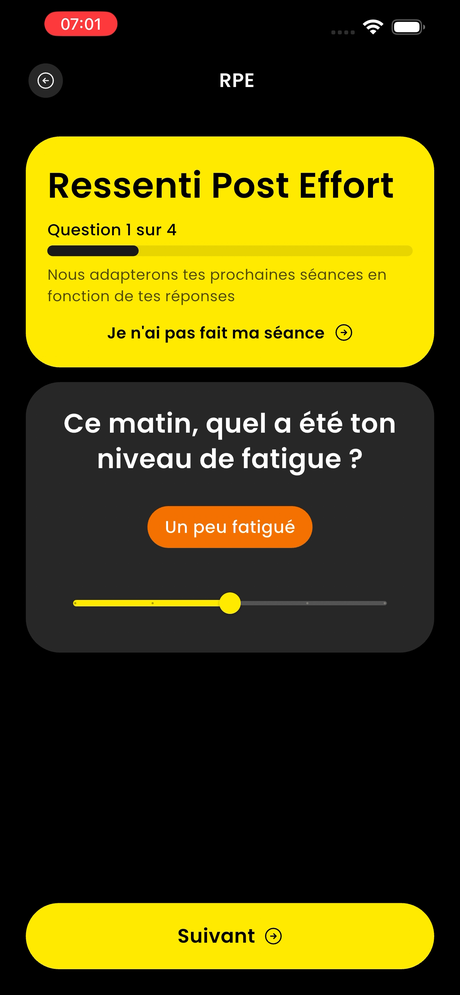
Daily tracking of your pain
You indicate how you feel every day to adjust the load and avoid turning your tendinitis into chronic pain.
Frequently asked questions
Do I need to stop sport completely with tendinitis?
Not necessarily. Adapted activity at a reduced load is often more beneficial than complete rest, provided you respect your pain thresholds.
How long does tendinitis last?
This varies depending on the severity and the area affected, from a few weeks to several months if care is delayed or poorly suited.
What is eccentric strengthening?
It’s a type of contraction where the muscle lengthens while contracting (for example, lowering the calf off a step). It’s particularly effective for strengthening an irritated tendon.[2]
Can tendinitis become chronic?
Yes, if it’s not treated early and properly. That’s why early, well-suited care is essential.
Does your pain sound like tendinitis?
Get a clear answer in 3 minutes and start your suitable programme.
Scientific references
- Cook JL, Purdam CR. Is tendon pathology a continuum? A pathology model to explain the clinical presentation of load-induced tendinopathy. British Journal of Sports Medicine, 2009;43(6):409-416. PubMed : pubmed.ncbi.nlm.nih.gov/18812414
- Alfredson H, Pietilä T, Jonsson P, Lorentzon R. Heavy-load eccentric calf muscle training for the treatment of chronic Achilles tendinosis. American Journal of Sports Medicine, 1998;26(3):360-366. PubMed : pubmed.ncbi.nlm.nih.gov/9617396
This page is based on peer-reviewed scientific publications. It remains a general self-assessment tool and does not replace medical advice.