


Running is a sport of repeated impact: every stride puts strain on your tendons, joints and muscles hundreds of times per kilometre. That’s what makes it an accessible and effective sport, but also one where the slightest error in progression is paid for in full. HOPP was designed by FIFA-certified sports physiotherapists to help you understand your runner’s injury and get back to it without getting hurt a second time.

The most common running injuries
Some injuries come back far more often than others among runners, and that’s no coincidence: they almost always affect the same areas, worked continuously with every stride.
The most common, and why
Shin splints
— the most common in runners who increase their volume too fast.Patellofemoral pain syndrome
— “runner’s knee,” linked to a poorly dosed training load.Iliotibial band syndrome
— common as soon as mileage climbs quickly.Achilles tendinopathy
— tendon overload from too rapid a progression.Plantar fasciitis
— overuse, also linked to unsuitable dosing.

Find your runner’s injury
10 running-related injuries are covered by the HOPP app. Select the one that matches your situation to access dedicated content: how the injury happens, its link to training load, and a suitable programme.
Not sure exactly what you have?
Take the HOPP test and get a clear answer about your injury.
Cause #1: a training load problem
Bad shoes, uneven terrain, imperfect technique: these factors play a role, but the most common cause of running injuries lies elsewhere. In the vast majority of cases, it’s a training load problem: the body receives a load it hasn’t had time to adapt to, and a tissue eventually gives way.
The most common dosing mistakes
Increasing your running volume by more than 10% per week
Increasing intensity and volume at the same time
Coming back after a break at the same level as before stopping
Not allowing enough recovery days between runs

HOPP physio tip
before changing shoes or revisiting your stride, the first question to ask yourself is almost always the same: have I increased my training load too fast? That’s the factor most often at fault, and also the easiest to fix once identified.
The risks of doing nothing
Continuing to run without understanding what’s going on is never a good strategy. Without proper care, a runner’s injury almost always follows the same script.
What you risk without proper care
An injury that gets worse if you keep running without adjusting your load
A longer recovery period than with prompt care
A higher risk of relapse on your return, if the cause hasn’t been treated
HOPP takes care of every type of runner
An experienced marathoner, a Sunday runner squeezing in a run between two meetings, someone getting back into running to stay fit: every type of runner has different needs, but none is left out by HOPP.
The profiles HOPP supports
How HOPP supports you, day after day
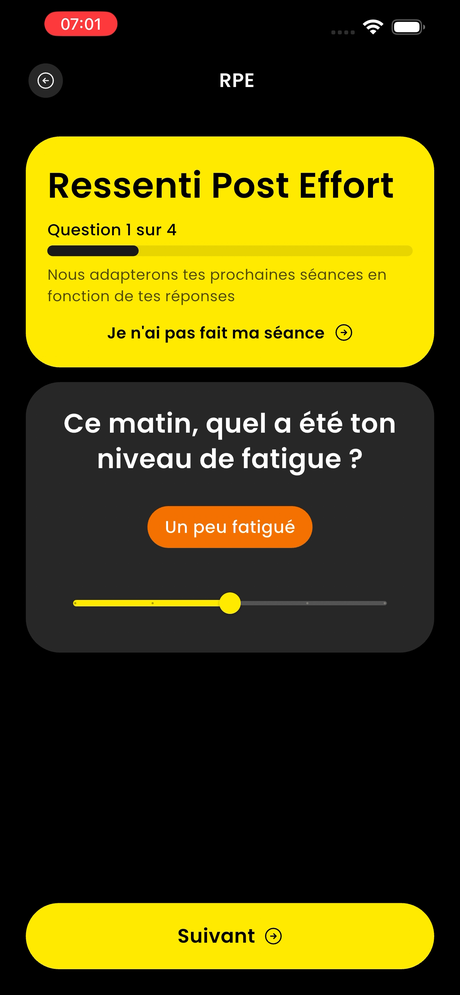
Since dosing is the number one cause of a runner’s injury, it’s also the first thing HOPP helps you manage better. Every morning, you indicate how you feel, and your programme adjusts accordingly: a bit more load if all is well, a bit less if the area is complaining. No more guessing whether you can fit in your weekend long run after a heavy week: the programme helps you find the right dose, day after day.

Good to know
HOPP is an injury information tool designed by sports physiotherapists. It doesn’t replace a doctor’s opinion.
Frequently asked questions
Does HOPP replace a medical consultation?
No. HOPP is an injury information tool designed by sports physiotherapists, it doesn’t replace a doctor’s opinion. It gives you clear, quick guidance to understand your situation and know how to act, and directs you to a professional if needed.
Do I need to stop running completely during the programme?
Not necessarily. The programme adapts to your injury and how you feel each day: depending on the case, running can be reduced, adapted, or temporarily replaced by other exercises rather than stopped all at once.
I’m just starting out in running, is HOPP right for me?
Yes. The programme is calibrated to your actual practice, whether you’ve been running for a few weeks or several years. It’s not designed only for experienced runners.
How long before I feel an improvement?
It depends on the injury and how long you’ve had it. You get a first clear explanation in 3 minutes, then the care programme gives you a realistic return trajectory, adjusted every day based on how you feel.
What if my condition doesn’t improve with the programme?
You can talk it through by teleconsultation with an expert sports physiotherapist to review your situation. HOPP also directs you to a medical consultation if your symptoms require it.
Is the 3-minute test really free?
Yes, the test that explains your injury is free and with no commitment. You then freely choose whether you want to start a suitable care programme.
Ready to get back to running without delay?
Start your personalised programme today, without waiting.