

What is tibialis posterior tendinopathy?
Tibialis posterior anatomy
Tibialis posterior is a deep muscle in the leg whose tendon passes behind the inner ankle bone before attaching under the foot. It plays a key role in supporting the arch of the foot and stabilising the ankle during running and walking. An untreated tendinopathy can, over time, contribute to a collapsing arch (acquired flat foot).
Why does this tendon become painful?
Pain appears when tibialis posterior is repeatedly loaded beyond its capacity, particularly in people whose foot tends to roll inward (excessive pronation). Too rapid an increase in training volume, footwear with poor arch support, or weight gain can also contribute to this tendinopathy.

Physio insight · Thibault
An untreated tibialis posterior tendinopathy that progresses toward a gradually collapsing arch should be taken seriously: the earlier the care, the better the chances of avoiding progression to acquired flat foot.
Which sports contribute to tibialis posterior tendinopathy?
Any sport with repeated impact and pronation control demands this tendon:
Running, particularly for runners with marked pronation
Hiking and trail running
Tennis and racquet sports
Dance
Sports with prolonged standing
Physio tip · Hemrick
Look at your arch while standing, from the front and from behind: a visible collapse on one side compared with the other, combined with pain behind the inner ankle bone, is suggestive of tibialis posterior tendinopathy that should be addressed promptly.
Causes and risk factors
This tendinopathy develops when tibialis posterior is repeatedly loaded beyond its capacity, particularly in people whose foot tends to roll inward.
Risk factors
- Excessive foot pronation (the arch collapsing inward)
- A too-rapid increase in training volume
- Footwear with poor arch support
- Recent weight gain
- A strength deficit in the foot and ankle stabiliser muscles
Tibialis posterior tendinitis: the symptoms not to let drag on
Tibialis posterior tendinitis, which physios call tibialis posterior tendinopathy and which is also known as posterior tibial tendonitis, causes pain on the inner side of the ankle, behind and below the inner ankle bone. It can run down to the inside of the arch of the foot. The tibialis posterior muscle holds that arch up with every step: so the pain flares up with prolonged walking, with running and when you stay on your feet for a long time.[1][4]
When you run a finger along the tendon, behind the inner ankle bone, the area is tender and sometimes slightly swollen. Turning the foot inwards against resistance brings on the pain. So does rising onto the toes of one foot: it is the movement that asks the most of the tendon.[3]
The most common signs
Pain behind the inner ankle bone, on the inside of the ankle
Stiffness when you get going, with the first steps, which improves once you are warmed up
Pain or weakness when rising onto the toes of one foot
An arch that flattens more on one side than the other
A shoe that deforms inwards, or pain under the foot, on the inside of the arch
People often talk about inflammation of the tibialis posterior tendon. In reality, the problem is mostly an overloaded tendon that can no longer cope with what is asked of it.[5] And this tendon has one particular feature: if it stays fatigued for too long, it holds the arch less well, and the arch can gradually drop.[4]
Tibialis posterior pain or another ankle injury?
Not all pain on the inner side of the ankle comes from the tibialis posterior. Pain higher up, along the inner edge of the shin bone, points more towards posterior shin splints. Pain under the heel with the first steps in the morning suggests plantar fasciitis. Pain behind the ankle bone that flares up when you push off the big toe suggests tendinitis of the long flexor of the big toe. Pain at the back of the heel more often matches Achilles tendinitis. And tingling or burning under the foot does not feel like tendon pain: talk to your doctor about it.
Tendinitis, muscle soreness or a muscle tear?
Muscle soreness shows up the day after an unusual effort, affects the whole calf and disappears within a few days. A calf muscle tear happens suddenly, in the middle of an acceleration, higher up the leg. Tibialis posterior tendinitis sets in gradually, sits around the inner ankle bone and keeps coming back until the tendon has been strengthened.
Ultrasound, MRI: do you need scans?
The doctor’s clinical examination is often enough to point towards tibialis posterior tendinitis. If the pain persists, or if the arch of the foot is dropping, the doctor may order an ultrasound or an MRI to look at the state of the tendon.[3][4]
Treating tibialis posterior tendinopathy in rehab with a sports physio
The goal of treatment is to progressively strengthen tibialis posterior to restore its arch-supporting function, acting early to prevent any progression toward structural collapse.
- 1
Reducing pain and managing load
- 2
Ankle mobility
- 3
Isometric strengthening
- 4
Progressive concentric strengthening
- 5
Eccentric strengthening
- 6
Ankle proprioceptive work
- 7
Correcting technique and footing
- 8
Strengthening under sport-specific load
- 9
Progressive return to running
- 10
Return to competition
“It’s not that the tendon is fragile, it’s that the load needs to be better dosed and distributed.”
Strengthening, the cornerstone of treatment
Progressive strengthening of tibialis posterior restores its capacity to support the arch with every step. Comprehensive foot and ankle work, along with suitable footwear, effectively completes the treatment.
In brief
Progressive strengthening of tibialis posterior
Comprehensive arch-support work
Adjusting footwear if needed
Gradual return: mobility, then load, then sport
Ready to take your tibialis posterior tendinopathy seriously?
Start the HOPP programme designed by sports physios.
Tibialis posterior strengthening: which exercises?
Treatment for tibialis posterior tendinitis is built on progressive strengthening of the tendon and the foot. Studies on the subject point the same way: suitable exercises, often combined with arch support, improve pain and function.[1][2]
The tibialis posterior is a deep muscle of the lower leg, hidden behind the shin bone, under the calf. It works with the small muscles of the foot, which lift the arch, and with the calf, which propels you forward. Opposite it, the peroneals, its antagonists, pull the foot outwards. Higher up, the glutes control the knee and stop the leg from collapsing inwards. When one link in this chain lacks strength, the foot drops further and the tendon compensates with every step.
- 1
Relax the calf
: a massage roller, or foam roller, rolled under the calf relaxes muscles that are often stiff. An ankle that bends better lets the foot roll through without collapsing inwards. - 2
Contract without moving
: static strengthening means pushing the inside of the foot against a piece of furniture or a band, then holding. The tendon works without movement, which lets you start even while the pain is still there. - 3
Lift the arch, then rise onto your toes
: you lift the arch while keeping the toes flat, without clenching them. Then come calf raises, on two feet then on one, heels moving towards each other at the top of the movement. - 4
Stabilise the foot
: balance on an unstable surface teaches the foot to hold its arch without you thinking about it. Light hops, then running, come last.
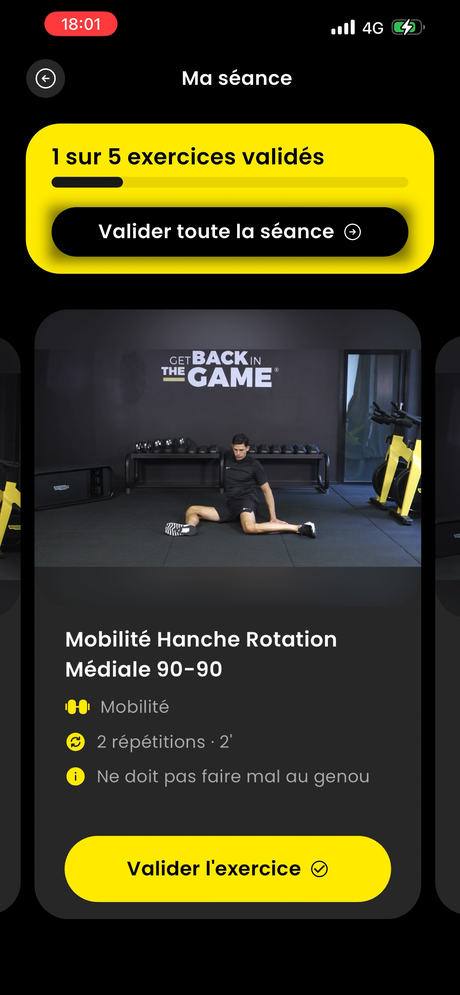
In the HOPP programme, these exercises are shown on video and adjusted every day to your pain and your form.
Insoles, ankle brace: useful or not?
An insole with arch support or a stable shoe eases the tendon while it rebuilds.[2] An ankle brace can be reassuring on a busy day. But neither strengthens the tibialis posterior: they go alongside the work, they do not replace it. For a custom insole, ask your doctor or a podiatrist for advice.
Should you rest or keep playing sport?
Total rest is generally not necessary. It’s better to temporarily adapt the activities that clearly reproduce the pain, while starting progressive strengthening as soon as possible.
Think you might have a different ankle injury?
Take your free test in 3 minutes flat.
When should you see a specialist for tibialis posterior tendinopathy?
If the pain persists for more than four weeks, or if you notice your arch gradually collapsing, a medical opinion is recommended to assess the tendon and prevent any unfavourable progression.
Tibialis posterior tendinitis: how long does it take to heal?
The healing time for tibialis posterior tendinitis depends above all on how long you have had it and on the state of the arch of the foot. Here are some pointers, not promises: every ankle has its own pace.
3 to 6 weeks
Recent pain behind the inner ankle bone
6 weeks to 3 months
Established pain, stiff when starting
3 to 6 months
Old pain, arch beginning to collapse
Indicative timeframes, with regular rehabilitation.
Pain that has lasted for months is not inevitable, but this tendon is one of those you do not let drag on. What makes it take longer: waiting for it to pass on its own, relying on insoles to do everything as before, standing around for hours, or going back to running all at once.[5]
Anti-inflammatories, rest, insoles: what really helps
Anti-inflammatories can calm an occasional flare of pain, on the advice of your doctor or pharmacist, but they do not give the tendon its strength back. Neither does complete rest: the tendon settles, then the pain comes back when you start again. What really helps is lowering the load without switching it off, supporting the arch for a while, and strengthening regularly.[1]
Running with tibialis posterior tendinitis: is it possible?
In running, the tibialis posterior holds the arch up with every foot strike. The pain often appears after an increase in volume, with worn-out shoes, or in runners whose foot drops inwards. Running often remains possible, provided the pain stays mild and the arch does not flatten any further.
Running with tibialis posterior tendinitis
Keep your runs short, at an easy pace, if the pain stays below 3 out of 10 and fades within the following hours
Swap some of the impact for cycling or swimming
Choose a stable shoe, and replace the pair if it has deformed inwards
Avoid cambered roads, very uneven ground and long downhills for a while
Judge the trend over several days: a tendon that swells behind the ankle bone means going back to the previous stage
The same pointers apply to trail running and hiking, where uneven ground loads the tendon, and to tennis and padel, where side-to-side movement puts heavy demands on the inside of the ankle.
How do you stop tibialis posterior tendinitis from coming back?
No longer being in pain does not mean the tendon is ready for anything: it still has to relearn to carry the arch while running. A few habits limit the risk of a relapse.
The right reflexes
Keep calf raises and one arch exercise in your week
Walk barefoot at home, on a safe floor: the foot works without you thinking about it
Increase your walking and running volume in stages
Break up time spent standing: sit down for a few minutes rather than standing around for hours
Compare your two arches from time to time, in a mirror or in a photo taken from behind
The HOPP care programmes to treat your tibialis posterior tendinopathy and get back to sport
This tendinopathy calls for early care and progressive strengthening. HOPP offers you a precise exercise programme, allowing you to get back to your activities as quickly as possible.
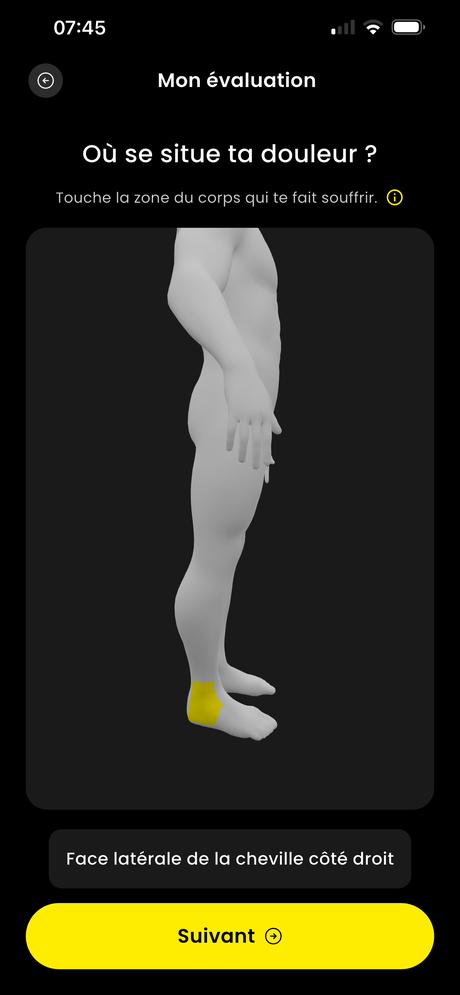
The programme runs from 3 to 9 weeks depending on the injury and ends with a reconditioning phase allowing a return to competition in the best possible conditions. Each programme is designed by the HOPP team, made up of two sports physiotherapists who are experts in assessing and treating athletes. You’ll also find theoretical content throughout your progression, so you master every aspect of your recovery and can adjust your treatment independently. If needed, our team of physiotherapists is on hand to support you.
Your HOPP programme, as a subscription
You start for free: 3 days of personalised programme, no credit card. After that, you choose to continue with the subscription, or to stay on limited free access.
3 days
of personalised programme, in the app
- No credit card
- No email needed
- Your first session today
After the 3 days, you choose
I subscribe
Everything unlocked
- Today’s session and your personalised programme
- Daily adjustment of your programme
- Conversations with support
- Plus everything free access already keeps
I stay on free
Limited access
- The dashboard: your progress and your metrics
- Booking a video call with a sports physio
- The HOPP shop
- Today’s session and your personalised programme
- Daily adjustment of your programme
- Conversations with support
Choose your plan
Your personalised programme, adjusted daily to how you feel
€9.99 /month€99 /year
No commitment
- Personalised programme
- Daily tracking
- Daily adjustment
- Return-to-sport assessment
- Reconditioning phase
- Relapse prevention
- HOPP community access
- 1 video call of 20 minutes every month7 video calls of 20 minutes over the year
The same programme, with your sports physio on video
€39.99 /month€299 /year
No commitment
- Personalised programme
- Daily tracking
- Daily adjustment
- Return-to-sport assessment
- Reconditioning phase
- Relapse prevention
- HOPP community access
- 1 video call of 20 minutes every month7 video calls of 20 minutes over the year
A single video call with a FIFA-certified sports physio, no subscription: €35
What your subscription includes
Personalised programme
Built for your injury by two sports physiotherapists, from your assessment.
Daily tracking
Today’s session, your progress and your metrics, all in your dashboard.
Daily adjustment
How you feel today shapes what comes next: more load if all is well, less if the pain complains.
Return-to-sport assessment
A checkpoint to know whether your body is ready to go back to your sport, and at what level.
Video call with a FIFA-certified sports physio
Plan with video callsIn the plan with video calls: 20 minutes to review your progress with them.
Reconditioning
A final phase to get your level back before returning at full intensity.
Prevention
Exercises to strengthen your weak points and lower the risk of a relapse.
Community
Talk with other athletes going through the same rehab.
The HOPP app, for real
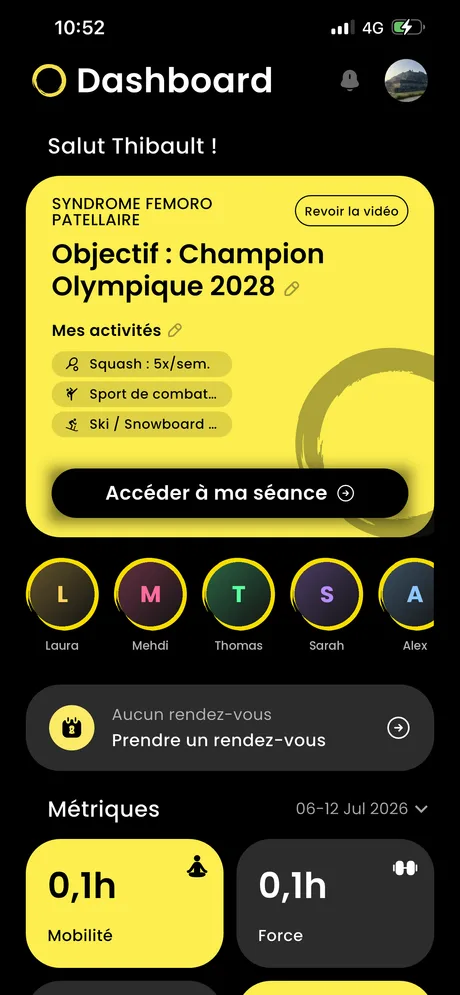
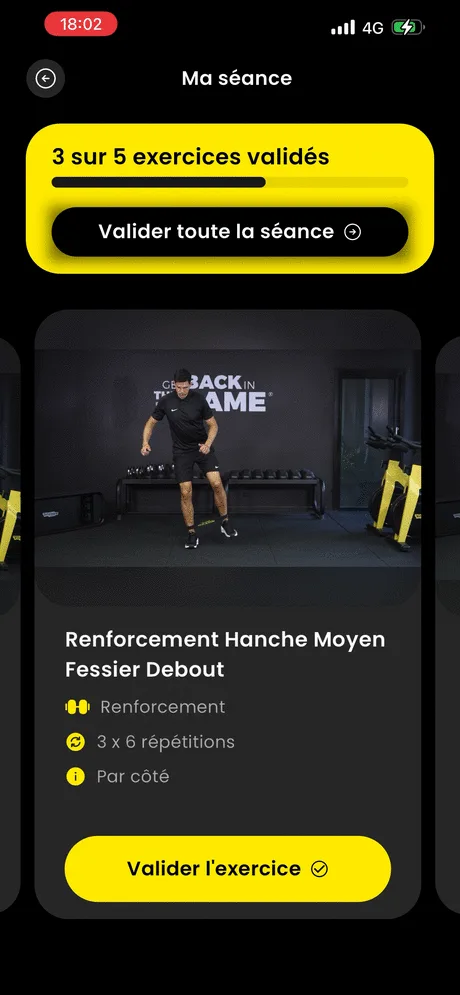
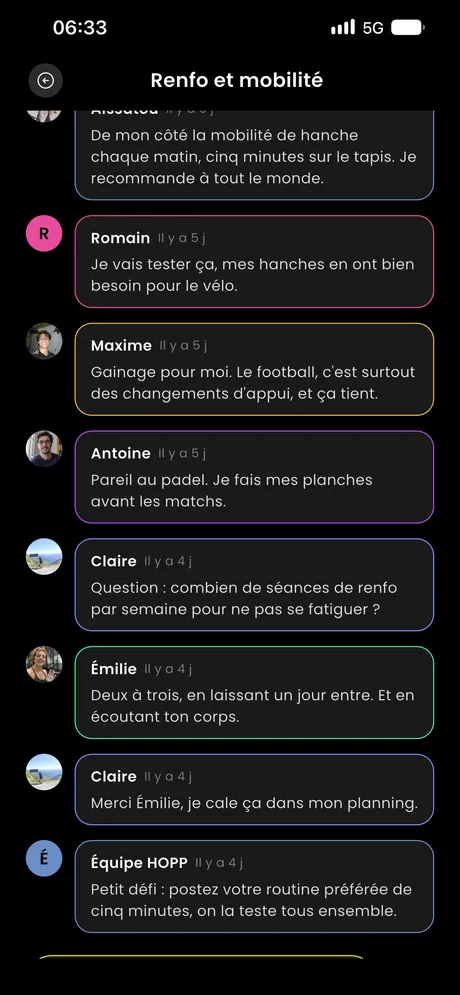
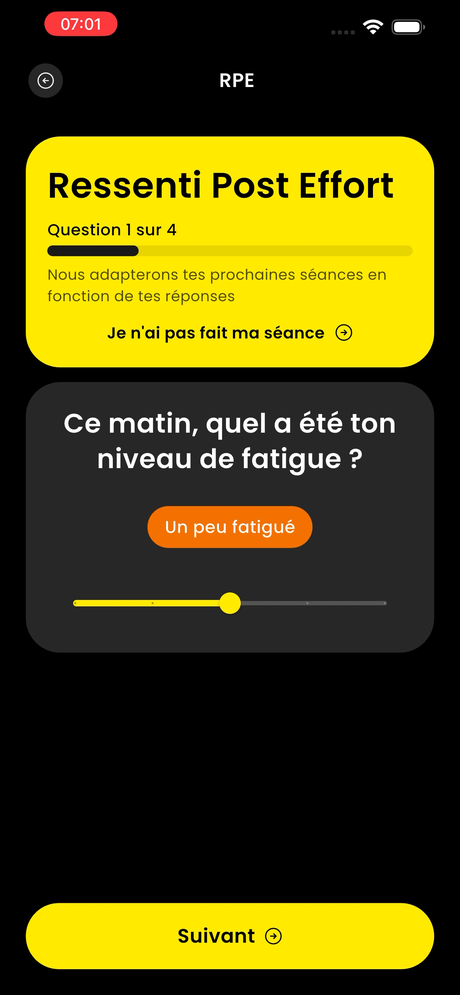
A programme that adapts to you every day
Every day, how you feel (RPE) is factored in to automatically adjust the rest of your programme: more load if all is well, a bit less if your ankle is complaining. This daily personalisation is what makes the difference compared to a fixed, paper-based programme.

Ready to start your programme?
Join the HOPP support programme designed by sports physios.
Keep these pointers close at hand
The tibialis posterior tendinitis guide covers healing times, the right moves and the traps to avoid. You get it by email within a minute.
F.A.Q
Does the HOPP programme replace a medical consultation?
No. HOPP is a support and rehab tool designed by sports physiotherapists, but it doesn’t replace a doctor’s opinion. If in doubt, or if the pain persists, see a health professional.
Is the programme suited to all sporting levels?
Yes. Every programme is personalised to your sport, your level and how you feel each day, whether you’re a recreational athlete or preparing for competition.
Can this tendinopathy lead to flat feet?
A long-standing, untreated tendinopathy can indeed contribute to a gradually collapsing arch. That’s why early care is recommended.
How long does it take to recover?
A structured programme generally brings clear improvement within a few weeks, with a full return to sport after several weeks of progressive strengthening.
Can orthotic insoles help?
An insole with arch support can temporarily ease tension on the tendon, but it doesn’t replace progressive strengthening, which remains the underlying treatment.
What’s the difference from posterior tibial shin splints?
Shin splints affect the shin bone, while tendinopathy affects the tendon behind the inner ankle bone. The two can coexist, which is why an accurate diagnosis matters for targeting the right treatment.
Can you keep walking with this tendinopathy?
Yes, everyday walking generally remains possible. It’s better to adapt the activities that clearly reproduce the pain while starting progressive strengthening as soon as possible.