

What is flexor hallucis longus tendinopathy?
Flexor hallucis longus tendon anatomy
Flexor hallucis longus is a deep muscle in the leg whose tendon passes behind the ankle, through a narrow tunnel just behind the inner ankle bone, before reaching the big toe. It flexes the big toe and plays a key role in the push-off phase of the stride, particularly when up on the toes. This tendinopathy, sometimes called “dancer’s tendinitis”, particularly affects activities that demand being up on the toes.
Why does this tendon become painful?
Pain appears when the tendon undergoes repeated friction or load in its narrow tunnel behind the ankle, particularly during repeated toe-point movements or strong push-off on the big toe. Too rapid an increase in training volume or a running technique with strong forefoot push-off are common contributing factors.

Physio insight · Thibault
This tendinopathy is particularly common in ballet dancers (hence its nickname “dancer’s tendinitis”), but it also affects runners and athletes who heavily demand forefoot push-off.

Physio tip · Hemrick
Test your pain by strongly flexing your big toe against light resistance, or by rising up onto your toes: if the pain is clear-cut behind the ankle or under the big toe, that’s a good indicator of this tendinopathy.
Causes and risk factors
This tendinopathy develops following repeated friction or overload of the tendon in its narrow tunnel behind the ankle.
Biomechanical and personal factors
- Too rapid an increase in training volume or intensity
- A running or footing technique with strong forefoot push-off
- A lack of ankle mobility that increases demand on the tendon
- A strength deficit in the big toe flexor and the foot chain
Which sports contribute to this tendinopathy?
Any sport that heavily demands being up on the toes or push-off through the big toe carries a particular risk:
- Ballet (pointe, demi-pointe)
- Running, particularly on uneven terrain
- Football and sports with fast changes of footing
- Gymnastics
- Basketball and volleyball (repeated jumping)
- Martial arts, including boxing, with forefoot weight-bearing
Big toe tendinitis: the symptoms that should alert you
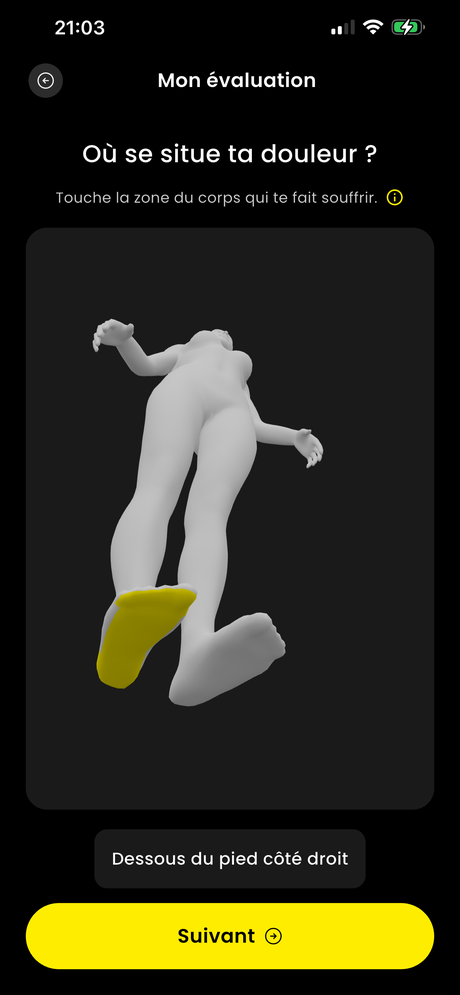
Big toe tendinitis, which physios call flexor hallucis longus tendinopathy, affects the tendon that bends your big toe. This tendon starts from a deep muscle in the leg, passes through a narrow tunnel behind the inner ankle bone, runs under the foot and attaches at the tip of the toe. So the pain can sit in two places: behind the ankle, on the inner side, or under the foot and the big toe.[2][3]
It flares up when the big toe pushes hard: rising onto your toes, taking off for a jump, a hill, the end of the stride. If you bend the big toe against the resistance of your hand, you find the pain again. And when you move it, the discomfort behind the ankle follows the movement: that is the most telling sign.
The most common signs
Pain behind the ankle, on the inner side, further forward than the Achilles tendon
Tendon tender under the foot or under the big toe at push-off
Discomfort on your toes or on demi-pointe
Big toe stiff when you lift it, sometimes with a catch: the toe sticks then releases[1]
Pain more marked on hills, when jumping or on rough ground
People often talk about inflammation of the big toe tendon. In reality, it is mostly an overloaded tendon that rubs in its tunnel and no longer tolerates the push-off asked of it.[5]
Big toe tendon pain or another foot injury?
This tendinitis is often mistaken for something else.[1][2] Behind the ankle, it gets confused with Achilles tendinitis, although the pain is further to the inside, or with tibialis posterior tendinopathy, which hurts when you lift the inner edge of the foot. A pinch deep in the ankle, with the foot pointed, suggests posterior ankle impingement, which often goes with it in dancers. Under the foot, pain near the heel points towards plantar fasciitis, and under the forefoot towards metatarsalgia. Pain on the top of the big toe has more to do with the extensor tendon, from the family of the foot extensors. Finally, a big toe that is red, hot and swollen at the joint, or stiff and painful all the time, is not tendinitis: see a doctor.
Tendinitis, muscle soreness or a muscle tear?
Muscle soreness is felt in the calf or under the arch of the foot the day after an unusual effort and passes within a few days. A muscle tear happens suddenly, in the middle of an effort. Big toe tendinitis, on the other hand, sets in gradually, follows the path of the tendon and comes back with every session of pointe work, jumping or running until the tendon has been strengthened.
Ultrasound, MRI: do you need scans?
Most often, the clinical examination is enough to point towards the flexor tendon of the big toe. If the pain persists or the toe catches, the doctor may order an ultrasound or an MRI to look at the tendon, its sheath and the back of the ankle.[2][3]
Treating flexor hallucis longus tendinopathy in rehab with a sports physio
The goal of treatment is to reduce friction of the tendon in its tunnel while progressively strengthening its capacity to absorb push-off load.
- 1
Reducing pain and managing load
- 2
Foot and ankle mobility
- 3
Isometric strengthening
- 4
Progressive concentric strengthening
- 5
Eccentric strengthening
- 6
Foot proprioceptive work
- 7
Correcting technique and footing
- 8
Strengthening under sport-specific load
- 9
Progressive return to running
- 10
Return to competition
“It’s not that the tendon is fragile, it’s that the load needs to be better dosed and distributed.”
Strengthening, the cornerstone of treatment
Progressive strengthening of flexor hallucis longus, combined with comprehensive foot and ankle work, restores the tendon’s capacity to withstand the push-off strain specific to your activity.
In brief
Progressive strengthening of the big toe flexor
Comprehensive foot chain work
Eccentric strengthening
Gradual return: mobility, then load, then sport
Ready to take your flexor hallucis longus tendinopathy seriously?
Start the HOPP programme designed by sports physios.
Big toe tendinitis: what to do, which exercises?
The treatment of big toe tendinitis relies first on adapting movements up on the toes, then on progressive exercises. The vast majority of cases improve without surgery, with well-managed care.[2][4]
The big toe flexor does not work alone. On every step, it finishes the push started by the calf and supports the arch of the foot together with the tibialis posterior and the small muscles of the sole. When the calf or the foot lacks strength, the big toe compensates and its tendon tires. That is why you strengthen toe flexion, but also everything around it.
- 1
Keep the big toe mobile
: flexion and extension movements of the big toe, gentle and repeated, make the tendon glide in its tunnel and stop the toe from stiffening. This is gentle mobility: without forcing at the end of the range, and without bringing on the pain. - 2
Contract without moving
: pressing the big toe into the floor and holding the contraction wakes up the muscle without making the tendon rub. This exercise often calms the pain and serves as a starting point. - 3
Strengthen the push-off
: strengthening of the big toe flexor continues with rises onto demi-pointe, pushing well through the toe, then with slow lowerings. This braking work is the pillar of tendon strengthening. - 4
Stabilise the foot, then bounce
: balance on an unstable surface makes the foot, ankle and calf work together. Hops, then the strides and toe work of your sport, come last.
In the HOPP programme, these exercises are shown on video and dosed every day according to your pain and how you feel.
The right landmark: load the toe, not just the calf
Because the pain is behind the ankle, many people work only the calf, as for an Achilles tendon, and see no result. Here, it is big toe flexion that needs strengthening first. Your landmark for moving forward: rising onto the toes of one foot while pushing through the big toe, with no pain behind the ankle.
Should you rest or keep playing sport?
Total rest is generally not necessary. It’s better to temporarily adapt the toe-point movements that clearly reproduce the pain, while starting progressive strengthening of the tendon.
Think you might have a different foot injury?
Take your free test in 3 minutes flat.
When should you see a specialist for this tendinopathy?
If the pain persists for more than three to four weeks, or if you feel a mechanical blocking sensation in the big toe (sometimes linked to a nodule on the tendon), a medical opinion is recommended.
Big toe tendinitis: how long does it take to heal?
The healing time for big toe tendinitis depends mainly on how long the pain has been there and on what it stops you from doing. Here are estimated guideposts, not promises: every tendon has its own pace.
3 to 4 weeks
Recent pain, only on tiptoe
4 to 8 weeks
Established pain, present when walking fast
2 to 3 months
Old pain, tendon sensitive in daily life
Indicative timeframes, with regular rehabilitation.
What lengthens recovery: carrying on with pointe work and jumps because the pain warms up then fades, which keeps the rubbing in the tunnel going, or on the contrary stopping everything. At rest, the tendon loses capacity, the big toe stiffens and the pain comes back when you start again.[5]
Anti-inflammatories, rest, ice: what really helps
Anti-inflammatories and ice can calm occasional pain, but they do not act on the cause. Complete rest is not necessary: just set aside the movements on your toes that clearly bring on the pain. After that, it is reloading in stages, on the flat, then on your toes, then jumping, that gives the tendon its strength back. If the toe stays locked or catches more and more, ask for medical advice.[2]
Big toe tendinitis, running and dance: can you carry on?
In running, the big toe tendon works at the end of every stride, when the foot leaves the ground. The pain appears mostly after the run, on hills, in sprints, on rough ground or after a quick rise in volume. In most cases, you can carry on by adapting what you do, as long as the pain stays mild and does not get worse the next day.
Running with big toe tendinitis
Keep your runs at an easy pace, on flat, even ground
Set aside hills, sprints and jumps, where the big toe pushes the most
For a while, avoid shoes that are very flexible or very thin at the front
Lengthen your foot and ankle warm-up before heading out
Bring back speed and elevation in stages, once rising onto your toes is pain-free again
It is also called “dancer’s tendinitis”: in ballet, repeated pointe and demi-pointe work loads this tendon more than any other movement.[1][4] The principle stays the same: reduce pointe work for a while, keep the rest, then come back to it gradually. This also applies to gymnastics, football, basketball and volleyball, where take-offs and jumps are repeated.
How to stop big toe tendinitis coming back?
Once the pain has gone, the tendon remains sensitive to the same causes: too much push-off, too fast, on a foot that is not strong enough. A few habits limit the risk of relapse.
The right habits
Keep a big toe and calf strengthening exercise in your week
Gradually increase the volume of pointe work, jumps or running
Keep your big toe and ankle mobile, gently, without forcing
Also strengthen the muscles of the arch: a well-supported big toe works less on its own
Warm up your foot before take-offs and pointe work
The HOPP care programmes to treat your tendinopathy and get back to sport
This tendinopathy requires progressive, well-dosed strengthening. HOPP offers you a precise exercise programme, allowing you to get back to your activities as quickly as possible.
The programme runs from 3 to 9 weeks depending on the injury and ends with a reconditioning phase allowing a return to competition in the best possible conditions. Each programme is designed by the HOPP team, made up of two sports physiotherapists who are experts in assessing and treating athletes. You’ll also find theoretical content throughout your progression, so you master every aspect of your recovery and can adjust your treatment independently. If needed, our team of physiotherapists is on hand to support you.
Your HOPP programme, as a subscription
You start for free: 3 days of personalised programme, no credit card. After that, you choose to continue with the subscription, or to stay on limited free access.
3 days
of personalised programme, in the app
- No credit card
- No email needed
- Your first session today
After the 3 days, you choose
I subscribe
Everything unlocked
- Today’s session and your personalised programme
- Daily adjustment of your programme
- Conversations with support
- Plus everything free access already keeps
I stay on free
Limited access
- The dashboard: your progress and your metrics
- Booking a video call with a sports physio
- The HOPP shop
- Today’s session and your personalised programme
- Daily adjustment of your programme
- Conversations with support
Choose your plan
Your personalised programme, adjusted daily to how you feel
€9.99 /month€99 /year
No commitment
- Personalised programme
- Daily tracking
- Daily adjustment
- Return-to-sport assessment
- Reconditioning phase
- Relapse prevention
- HOPP community access
- 1 video call of 20 minutes every month7 video calls of 20 minutes over the year
The same programme, with your sports physio on video
€39.99 /month€299 /year
No commitment
- Personalised programme
- Daily tracking
- Daily adjustment
- Return-to-sport assessment
- Reconditioning phase
- Relapse prevention
- HOPP community access
- 1 video call of 20 minutes every month7 video calls of 20 minutes over the year
A single video call with a FIFA-certified sports physio, no subscription: €35
What your subscription includes
Personalised programme
Built for your injury by two sports physiotherapists, from your assessment.
Daily tracking
Today’s session, your progress and your metrics, all in your dashboard.
Daily adjustment
How you feel today shapes what comes next: more load if all is well, less if the pain complains.
Return-to-sport assessment
A checkpoint to know whether your body is ready to go back to your sport, and at what level.
Video call with a FIFA-certified sports physio
Plan with video callsIn the plan with video calls: 20 minutes to review your progress with them.
Reconditioning
A final phase to get your level back before returning at full intensity.
Prevention
Exercises to strengthen your weak points and lower the risk of a relapse.
Community
Talk with other athletes going through the same rehab.
The HOPP app, for real
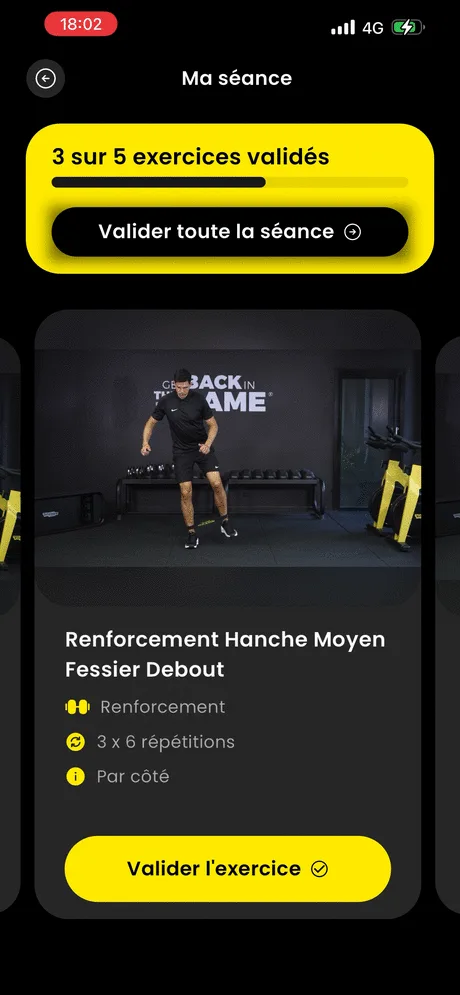
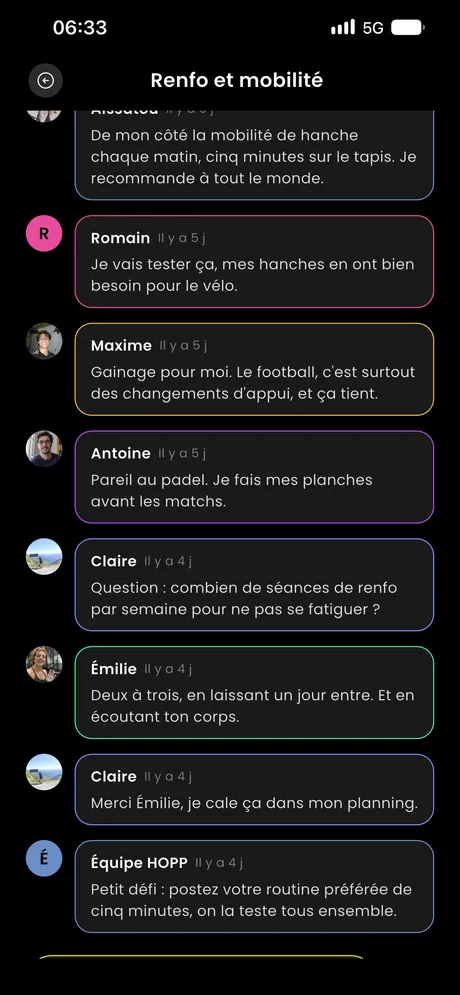
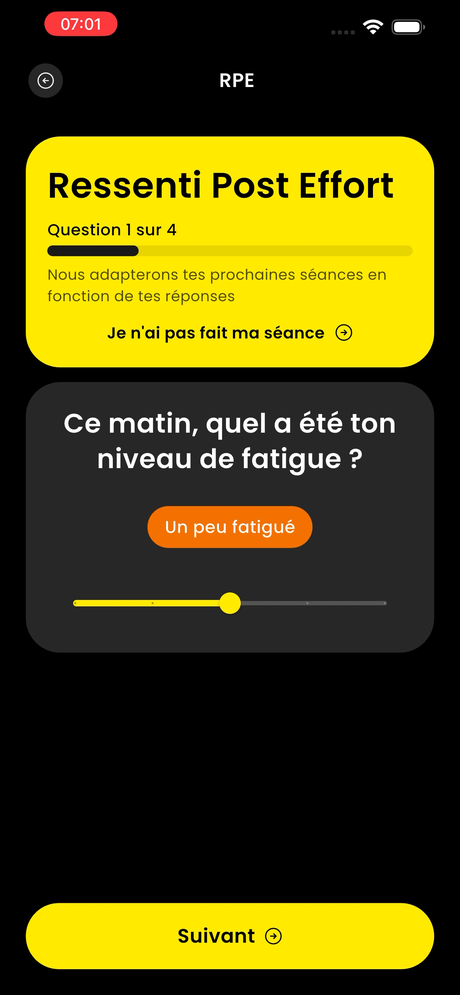
A programme that adapts to you every day
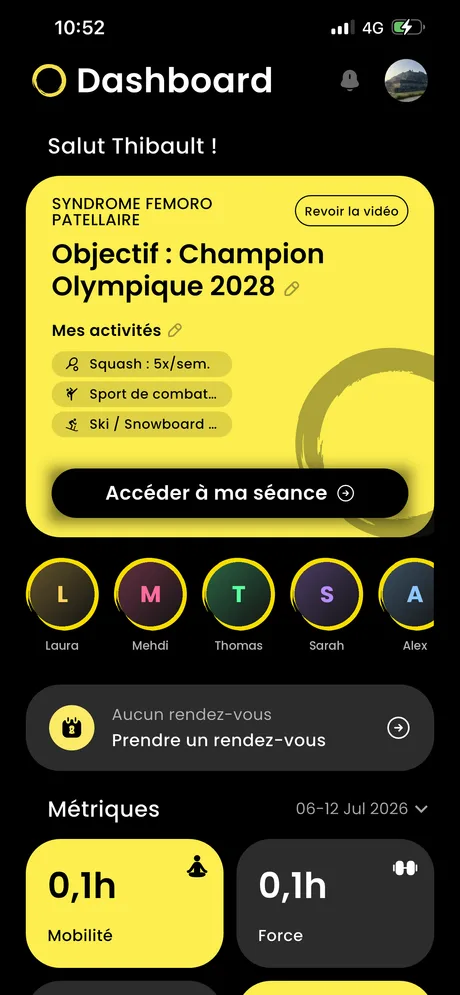
Every day, how you feel (RPE) is factored in to automatically adjust the rest of your programme: more load if all is well, a bit less if your foot is complaining. This daily personalisation is what makes the difference compared to a fixed, paper-based programme.

Ready to start your programme?
Join the HOPP support programme designed by sports physios.
Keep these pointers close at hand
The big toe tendinitis guide covers the timelines, the right moves and the pitfalls to avoid. You get it by email within a minute.

F.A.Q
Does the HOPP programme replace a medical consultation?
No. HOPP is a support and rehab tool designed by sports physiotherapists, but it doesn’t replace a doctor’s opinion. If in doubt, or if the pain persists, see a health professional.
Is the programme suited to all sporting levels?
Yes. Every programme is personalised to your sport, your level and how you feel each day, whether you’re a recreational athlete or preparing for competition.
Can I keep dancing or running with this tendinopathy?
In most cases, yes, by temporarily adapting the toe-point movements that reproduce the pain, while starting strengthening in parallel.
How long does it take to recover?
A structured programme generally brings clear improvement within a few weeks, with a full return to activity after several weeks of progressive strengthening.
Why is it called “dancer’s tendinitis”?
Because it’s particularly common among ballet dancers, due to the repeated pointe and demi-pointe weight-bearing that heavily strains this tendon.
How do I tell this tendinopathy apart from posterior ankle impingement?
Both affect the back of the ankle and are common in dancers. Posterior impingement mainly shows up as pain at the very end of the toe-point position, linked to bony pinching, whereas flexor hallucis longus tendinopathy tends to be triggered by resisted flexion of the big toe. A sports physio can tell the difference on clinical examination.
Can this tendinopathy come back?
Yes, particularly if strengthening is stopped too soon or if training volume increases rapidly again. Regular strengthening work and a cautious progression clearly limit this risk.