



Understanding training load
An injury appears when the stress placed on a tissue (muscle, tendon, bone, ligament) exceeds its capacity to absorb it. This stress depends on several factors that, combined, make up your total training load.[1]
It’s not just about volume: duration, intensity, the type of contraction involved, technical demands and external loads (weight, terrain, equipment) all come into play.

What makes up your training load
Session duration and volume
Intensity of the effort
Type of contraction involved (concentric, eccentric, isometric)
Technical demands of the sporting movement
External loads: weight, terrain, equipment
The pillars of recovery
Two essential levers
Sleep lets your tissues recover and rebuild between sessions[2]
Suitable nutrition supports recovery and tolerance to training
Progression after an injury
Returning to training after an injury follows precise steps: an initial phase of immobilisation or relative rest, then progressive strengthening of the affected tissue.
Getting back to sport then goes through low-impact activities (gentle running, cycling, swimming) before progressively reintroducing the specific demands of your sport.

The HOPP solution to support you
HOPP helps you adapt your training load at every stage of your rehab, so you can progress without getting injured again.
A programme that follows your progress
HOPP adjusts the exercises offered to your actual load capacity, for a progressive, safe return.

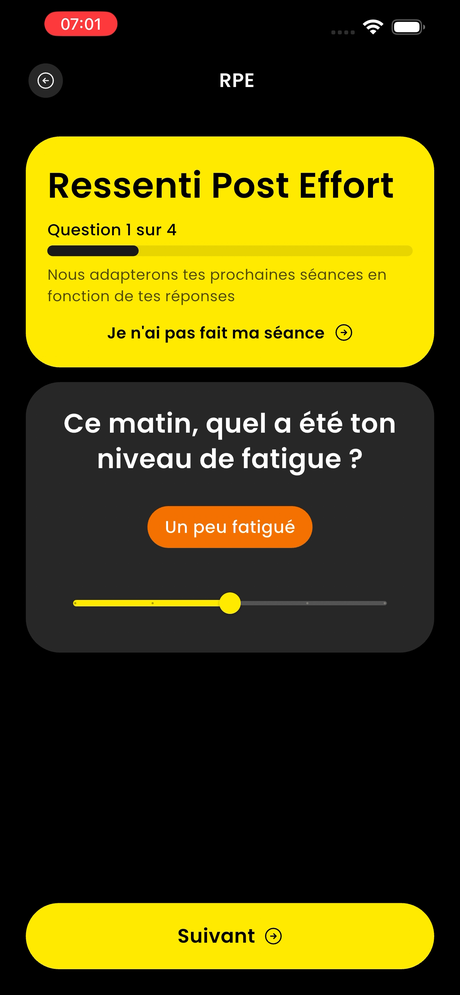
Daily tracking of your perceived load
You log every day how your body responds to training, to adjust your progression in real time.
Feeling more tired than usual?
Take the “am I overtraining?” quiz to check if your training load is to blame.
Frequently asked questions
What actually causes an overload injury?
An injury happens when the stress placed on a tissue exceeds its capacity to absorb it. This stress results from the combination of duration, intensity, type of contraction, technique and external loads.[1]
Does sleep really affect injury risk?
Yes, sleep is an essential pillar of recovery. Repeated lack of sleep reduces your tissues’ capacity to absorb training load.[2]
Where should you start your return after an injury?
The return follows a step-by-step progression: initial relative rest, progressive strengthening, then reintroducing low-impact activities before the specific demands of your sport.
How do you know if your training load is too high?
Pain that increases with sessions, abnormal fatigue, or incomplete recovery between training sessions are signals to factor in when adjusting your load.
Ready to better manage your training?
Start your free assessment in 3 minutes and get your personalised programme.