


Quiz: are you overtraining?
Performance drop, disrupted sleep, fatigue that won’t quit: on their own, these signs don’t mean much. Together, they may point to an imbalance between your training load and your recovery. Check in with yourself in 1 minute.

Understanding overtraining
Making progress requires pushing the body beyond its usual level, but that balance is fragile: as soon as training load exceeds recovery capacity for too long, the body enters a spiral of maladaptation.[1] There are several degrees, from plain temporary fatigue to true overtraining syndrome.
Functional overreaching, non-functional overreaching, or full syndrome
A performance dip lasting a few days after an intense training camp, followed by a rebound, is normal: that’s functional overreaching, often sought deliberately. When this dip persists for weeks despite rest, it’s called non-functional overreaching, then overtraining syndrome if it continues.[1]

Signs affecting the whole body, not just the muscles
Overtraining isn’t just muscular fatigue: it also affects sleep, mood, motivation, and sometimes immune defenses (more frequent infections). This whole-body dimension is what sets it apart from simple post-exercise fatigue.[2]
What to do if several signs are present
The good news is that the answer is simple in principle, even if it takes discipline: reduce your training load before the situation sets in, rather than trying to “push through” the fatigue.
Why a temporary drop in load isn’t a failure
Deliberately reducing your volume or intensity for one to two weeks, at the first signs, most often prevents a longer spiral. It’s a performance strategy, not giving up.
Want more clarity on your training load?
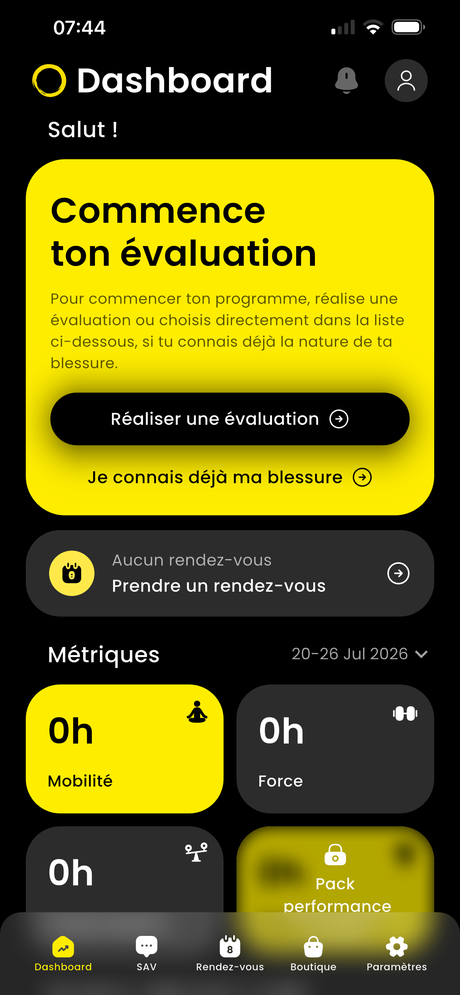
Do your HOPP assessment for a program that respects your recovery.
Tracking your load day to day, without overcomplicating it
You don’t need sophisticated equipment to spot the first signs of imbalance: simple, regular tracking is enough to see a trend coming before it settles in.[3]
Three simple indicators to log
Sleep quality, rate of perceived exertion (RPE) after each session, and overall motivation, logged daily on a scale of 1 to 10: this trio is enough to spot a downward trend over several weeks, well before it turns into a real drop in performance.
Who is most exposed
Risk rises sharply during a too-fast comeback after a break, during intense preparation for a goal, or when poor sleep and everyday stress add to an already high training load. The body doesn’t distinguish physical stress from everyday life stress: both draw on the same recovery reserves.
Preventing rather than enduring
The best way to manage overtraining is to see it coming, by building training progression around cycles of load and recovery rather than a continuous rise.
Three simple principles to apply
Never increase volume and intensity at the same time, vary the types of sessions rather than always repeating the same effort, and stick to a regular lighter week: three simple rules that clearly cut the risk before the first signs even appear.
Need help pacing your load?
Do your HOPP assessment for a program that respects your recovery.
Overtraining vocabulary
Overreaching, load, periodization: these terms come up often in training literature, here’s what they mean.
Functional overreaching
A temporary, often deliberate performance dip, followed by a rebound after a few days of recovery. It’s a normal mechanism, sometimes even sought during intense training blocks.
Overtraining syndrome
A state of prolonged fatigue that doesn’t improve despite rest, along with hormonal, immune, and psychological disturbances. It’s the most advanced stage of the imbalance between load and recovery.
RPE
Short for “rating of perceived exertion”: a simple scale, usually 1 to 10, for rating how hard a session felt.
Training load
The combination of volume (duration, distance, number of sessions) and intensity of training over a given period. It’s the balance between this load and recovery that determines overtraining risk.
Periodization
Organizing training in cycles of load and recovery, rather than a continuous increase, to progress over the long run without burning out.
Frequently asked questions
What are the first signs of overtraining?
A drop in performance over several weeks despite steady or increased training, sleep problems, fatigue that doesn’t ease with rest, and unusual irritability or low motivation. Taken alone, these signs can have other causes, but their combination over several weeks suggests an imbalance between training load and recovery.
What’s the difference between functional overreaching and overtraining?
Functional overreaching is a temporary performance dip, followed by a rebound after a few days of recovery: it’s sometimes even sought deliberately during certain training blocks. Overtraining syndrome is a prolonged maladaptation that persists despite several weeks of rest, and needs more thorough management.
How long does it take to recover from overtraining?
It depends on how deep the exhaustion is: mild functional overreaching can resolve within days to two weeks, while true overtraining syndrome can take several weeks, even months, of drastically reduced load and comprehensive care.
Does overtraining only affect elite athletes?
No. It can affect any athlete, amateur or elite, who increases their training load too fast or doesn’t leave enough room for recovery, especially during an intense comeback or when building toward a goal.
How do you track your training load day to day?
Simple tools are enough: note your sleep quality, your rate of perceived exertion (RPE) after each session, and your overall motivation on a scale of 1 to 10. Tracked over several weeks, this kind of simple log often reveals a downward trend before it becomes a real problem.
Who is most at risk of overtraining?
Anyone who ramps up their training load too fast is at risk, especially after a comeback or while building toward a goal. Poor sleep, everyday stress, and insufficient nutrition relative to energy output all clearly amplify the risk, even at the same training load.
How do you prevent overtraining rather than deal with it after the fact?
Regularly scheduling lighter weeks (generally every 3 to 4 weeks) into a training plan, varying intensities, and not increasing volume and intensity at the same time are simple principles that clearly cut the risk before the first signs even show up.
Does this quiz replace a medical opinion?
No, it’s a general self-assessment tool that gives you a direction, not a diagnosis. If the signs persist despite reducing your training load, see a healthcare professional to rule out other causes of fatigue.
Ready to take back control of your load?
Do your assessment and get a personalized program in 3 minutes.


Go further
Scientific references
- Meeusen R, Duclos M, Foster C, et al. Prevention, diagnosis, and treatment of the overtraining syndrome: joint consensus statement of the ECSS and ACSM. Medicine & Science in Sports & Exercise, 2013;45(1):186-205. PubMed: pubmed.ncbi.nlm.nih.gov/23247672
- Kreher JB, Schwartz JB. Overtraining syndrome: a practical guide. Sports Health, 2012;4(2):128-138. PubMed: pubmed.ncbi.nlm.nih.gov/23016079
- Halson SL. Monitoring Training Load to Understand Fatigue in Athletes. Sports Medicine, 2014;44(Suppl 2):S139-147. PubMed: pubmed.ncbi.nlm.nih.gov/25200666
This page is based on peer-reviewed scientific publications. It remains a general self-assessment tool and does not replace medical advice.