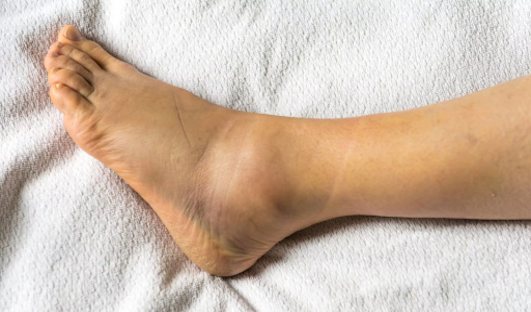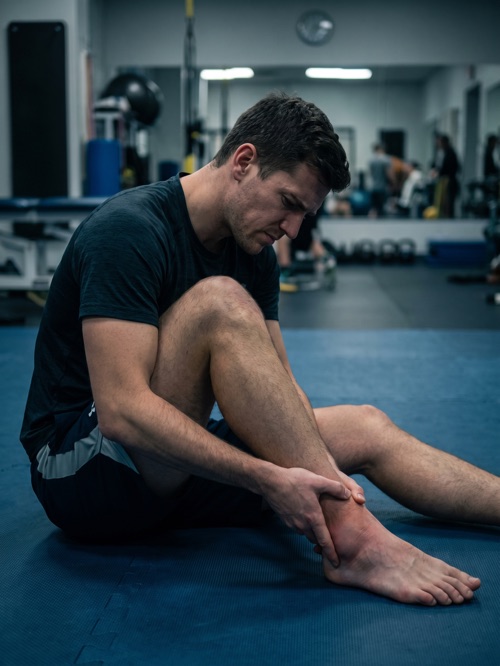


What is an ankle sprain?
Ankle ligament anatomy
The ankle is stabilised by several ligaments, mainly the lateral collateral ligament (outer), the most commonly affected, made up of three bands. An ankle sprain, the most common sporting injury across all disciplines, is a stretch, or even a partial or complete tear, of these ligaments, most often following the foot twisting inward.[1]
Why does this joint get injured?
An ankle sprain most often occurs during a poorly controlled jump landing, weight-bearing on uneven ground or on an opponent’s foot, or a sudden change of direction. A previous sprain that wasn’t fully rehabilitated is the main risk factor for recurrence.
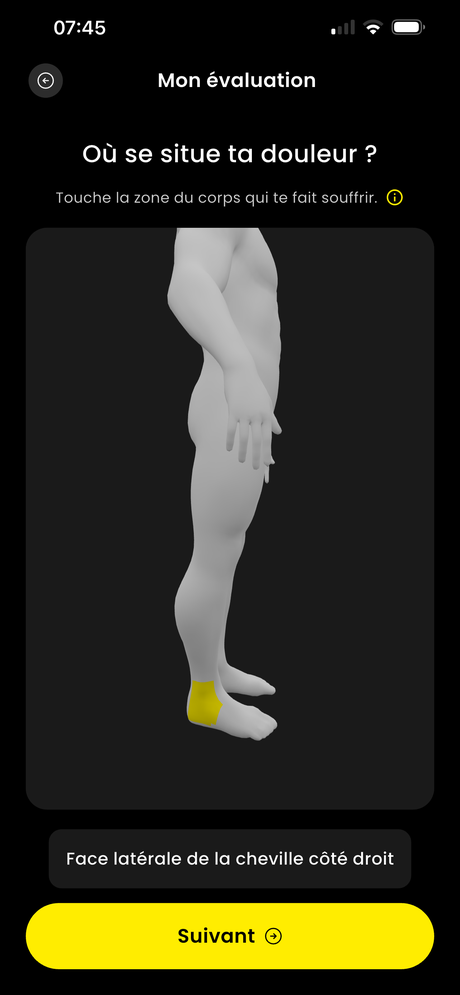
The 3 severity stages of an ankle sprain
- 1Stage 1, mild sprain: a simple stretch of the ligament, with no fibre tearing. Moderate swelling, weight-bearing possible.
- 2Stage 2, moderate sprain: partial tear of the ligament. More noticeable swelling, weight-bearing painful but possible.
- 3Stage 3, severe sprain: complete tear of one or more ligament bands. Significant swelling, weight-bearing often impossible in the first few hours.
The ligaments involved
The lateral collateral ligament, on the outer side of the ankle, is made up of three bands:
- The anterior talofibular ligament, the most commonly affected, particularly during a twist in plantar flexion
- The calcaneofibular ligament, affected in more severe sprains
- The posterior talofibular ligament, rarely injured, only in very severe sprains
Symptoms and diagnosis of an ankle sprain
Typical pain and its triggers
The pain is immediate at the moment of injury, usually located in front of and below the outer ankle bone. It’s often accompanied by swelling (oedema) that appears within minutes to hours, sometimes bruising that develops over 24 to 48 hours. Weight-bearing and walking reproduce the pain, in proportion to the severity of the sprain.
How symptoms progress without treatment
Without complete proprioceptive rehab, the main risk is chronic instability setting in: the ankle “gives way” or twists easily, even on flat ground, with repeated sprains that progressively weaken the joint.[1]
Differential diagnosis
Certain signs should raise suspicion of an injury other than a simple ligament sprain:
- A fracture: precise bony tenderness on palpation of the ankle bones or the base of the 5th metatarsal, total inability to bear weight (Ottawa ankle rules, see below)
- A syndesmosis sprain (high ankle sprain): higher pain, between the tibia and fibula, often a rotational mechanism, longer healing
- An associated peroneal tendinopathy, common with repeated sprains
Causes and risk factors
An ankle sprain is often an isolated accident, but certain factors clearly increase the risk, particularly of recurrence.
Biomechanical and personal factors
- A history of a poorly or incompletely rehabilitated sprain, the leading risk factor for recurrence
- A residual proprioceptive deficit, even without any feeling of instability
- Weakness in the peroneal muscles, the ankle’s lateral stabilisers
- Unsuitable footwear or uneven ground
Which sports contribute to ankle sprains?
Any sport with jumping, changes of direction, or uneven ground exposes you to this sprain, the most common in sport:
- Basketball and handball (jump landings)
- Football and rugby
- Trail running and hiking
- Racquet sports
- Dance
- Volleyball
Why do ankle sprains recur so often?
After a sprain, the ligament’s sensory receptors that tell the brain where the ankle is positioned are often impaired, even once the pain has gone. Without specific proprioceptive work, this deficit persists silently, which explains why so many athletes re-sprain their ankle months, or even years, after the first sprain.
Treating an ankle sprain in rehab with a sports physio
The goal of treatment is to allow the ligaments to heal under good conditions, while working on proprioception early, essential to prevent recurrence, which is very common without suitable rehab.
Phase 1 – Protection (the PEACE protocol)
For the first 3 days, the goal is to protect the healing ligament while avoiding strict immobilisation: Protection of the area, Elevation, avoiding anti-inflammatories and prolonged icing, Compression, Education about the importance of a gradual return to load.
Phase 2 – Active recovery (the LOVE protocol)
As soon as the acute pain allows, it’s time for progressive reloading, mobility work, and above all intensive proprioceptive training, the single most decisive factor in preventing recurrence.
Phase 3 – Return to sport
The final phase progressively reintroduces running, jumping and changes of direction, with proprioceptive work maintained right up to a full return to competition.
In practice, this programme breaks down into 10 concrete steps:
- 1Protection and pain reduction (PEACE protocol)
- 2Recovering pain-free mobility
- 3Isometric strengthening
- 4Progressive concentric strengthening
- 5Intensive proprioceptive work
- 6Closed-chain strengthening (weight-bearing)
- 7Returning to walking then running
- 8Strengthening under sport-specific load
- 9Progressive return to your sport
- 10Return to competition
DEMONSTRATION
Video by Hemrick, co-founder of HOPP.
“The best prevention against your next sprain is the complete rehab of the previous one.”
Proprioceptive work, the cornerstone of treatment
Intensive proprioceptive work, on unstable surfaces then in dynamic situations, restores the ankle’s protective reflexes that are impaired after a sprain. It’s the most decisive factor in preventing recurrence, far more than muscle strengthening alone.[3]
In brief
- Early, intensive proprioceptive work
- Strengthening the stabiliser muscles
- Progressive return to weight-bearing
- Gradual return: mobility, then load, then sport
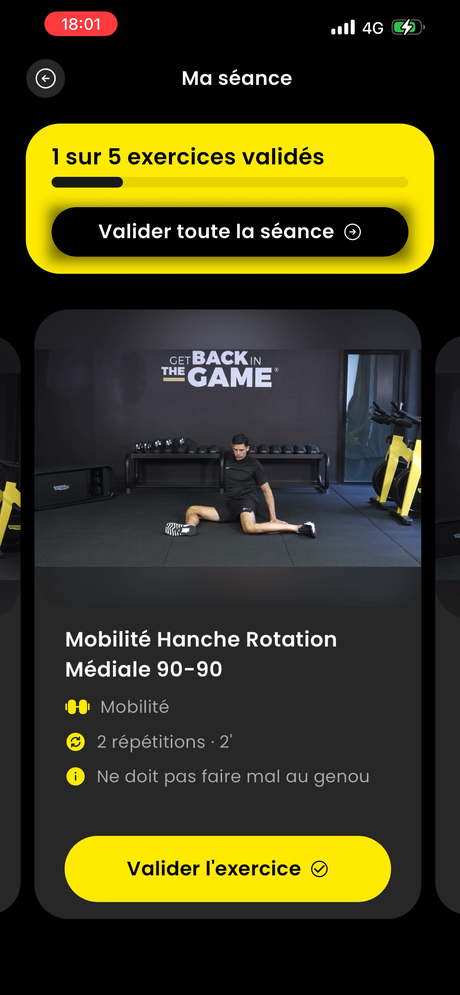
Ready to take your ankle sprain seriously?
Start the HOPP programme designed by sports physios.
Should you rest or keep playing sport?
Prolonged strict rest is no longer recommended: current evidence shows that early, progressive reloading, as soon as the acute pain allows, gives better functional results than prolonged immobilisation.[2]
Think you might have a different ankle injury?
Take your free test in 3 minutes flat.
When should you see a specialist for an ankle sprain?
If you can’t put any weight on the foot at all, if you notice visible deformity, or if the swelling is very significant and immediate, prompt medical attention is needed to rule out an associated fracture (Ottawa ankle rules).[4]
Recovery time: how long does it take to recover from an ankle sprain?
Recovery time depends directly on the severity stage identified above:
- Stage 1 (mild): 1 to 2 weeks
- Stage 2 (moderate): 3 to 6 weeks
- Stage 3 (severe): 6 to 12 weeks, sometimes more
These timeframes relate to returning to sport with a functional ankle. Complete disappearance of swelling and tenderness can take longer, without that preventing a progressive, guided return.
Preventing relapses
The ankle sprain is the sporting injury that comes back most often, due to incomplete proprioceptive rehab after the first episode.
The 10% progression rule
Not increasing training volume or intensity by more than 10% per week limits the risk of a new sprain during the return-to-sport phase.
Regular proprioceptive training
Working on a wobble board or proprioceptive cushion, for about 10 minutes, 3 times a week, significantly reduces the risk of recurrence according to several studies on athletes with a history of sprains. This work remains useful as maintenance well after the initial rehab is over, particularly before the start of a new sporting season.
The HOPP care programmes to treat your ankle sprain and safely get back to sport
This sprain requires progressive support for ligament healing and above all rigorous proprioceptive work. HOPP offers you a precise exercise programme, allowing you to get back to your activities as quickly as possible.
The programme runs from 3 to 9 weeks depending on the injury and ends with a reconditioning phase allowing a return to competition in the best possible conditions. Each programme is designed by the HOPP team, made up of two sports physiotherapists who are experts in assessing and treating athletes. You’ll also find theoretical content throughout your progression, so you master every aspect of your recovery and can adjust your treatment independently. If needed, our team of physiotherapists is on hand to support you.
Essential
FROM INJURY TO
BACK TO YOUR ACTIVITIES
59€
One-time payment
“AT YOUR OWN PACE WITH
DAILY ADAPTATION”
- 100% of the treatment programme
- Daily personalisation
- Flexibility / Mobility
- Strengthening
- Proprioception
- Progress tracking
- Return-to-running programme
- Theoretical content included
Performance
TO GET BACK TO SPORT
IN THE BEST CONDITIONS
79€
One-time payment
“GET BACK TO YOUR LEVEL
WITHOUT RISK OF RELAPSE”
- 100% of the treatment programme
- Daily personalisation
- Flexibility / Mobility
- Strengthening
- Proprioception
- Progress tracking
- Return-to-running programme
- Theoretical content included
- + 4-week return-to-play plan with 6 difficulty levels
Expert
PERSONALISED VIDEO-CALL
SUPPORT, ANY TIME
149€
One-time payment
“A PHYSIO
WHENEVER YOU NEED”
- 100% of the treatment programme
- Daily personalisation
- Flexibility / Mobility, Strengthening, Proprioception
- Progress tracking
- Return-to-running programme
- Theoretical content included
- + 4-week return-to-play plan with 6 difficulty levels
- + 2 video calls with an expert sports physio / return check-up
A programme that adapts to you every day
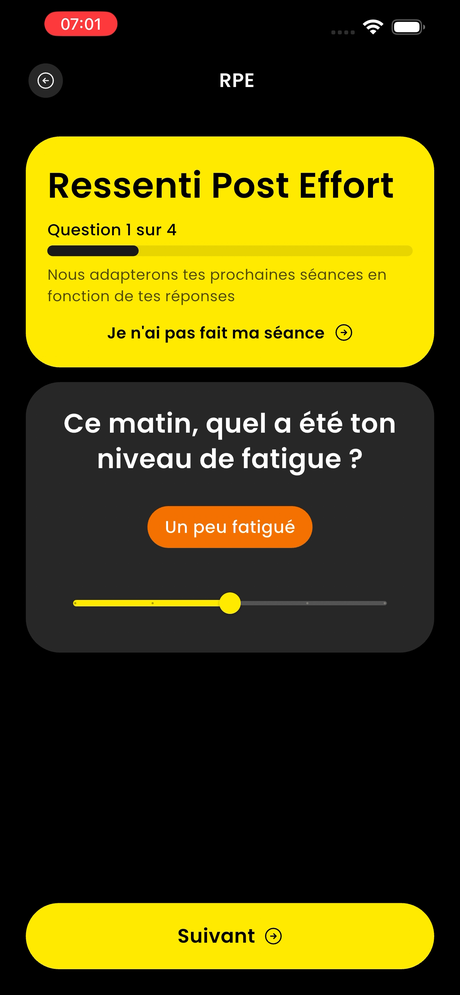
Every day, how you feel (RPE) is factored in to automatically adjust the rest of your programme: more load if all is well, a bit less if your ankle is complaining. This daily personalisation is what makes the difference compared to a fixed, paper-based programme.

Ready to start your programme?
Join the HOPP support programme designed by sports physios.
What’s the likely grade of your sprain?
Take the quiz to estimate its severity and find out if you need an X-ray.
F.A.Q
Does the HOPP programme replace a medical consultation?
No. HOPP is a support and rehab tool designed by sports physiotherapists, but it doesn’t replace a doctor’s opinion. If in doubt, or if the pain persists, see a health professional.
Is the programme suited to all sporting levels?
Yes. Every programme is personalised to your sport, your level and how you feel each day, whether you’re a recreational athlete or preparing for competition.
How long does it take to get back to sport after a sprain?
For a simple sprain, returning to sport generally happens between two and six weeks, depending on severity and the sport practised, provided you follow a complete proprioceptive rehab.
Should I wear a brace to get back to sport?
A brace or strapping can be useful temporarily when returning to sport, particularly for high-risk sports, but it shouldn’t replace active proprioceptive rehab work.
Why do I keep spraining my ankle?
It’s a sign of chronic instability linked to incomplete proprioceptive rehab after one or more previous sprains. Specific work can restore this stability.
How do I know if my sprain is severe?
Your ability to bear weight is the simplest, best indicator: being able to bear weight despite the pain points toward a mild to moderate sprain, while a total inability to bear weight means you should see someone quickly to rule out a severe sprain or an associated fracture.
Should you ice an ankle sprain?
Recent recommendations (the PEACE & LOVE protocol) advise against prolonged or repeated icing, as it may slow the ligament’s natural healing. A brief application can ease the pain, but it shouldn’t become the main treatment.