

What is an ankle joint condition?
The anatomy of the ankle joint
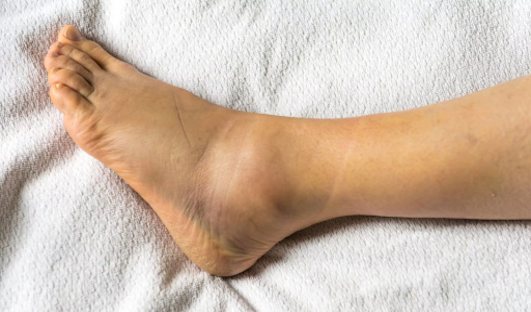
The ankle joint (talocrural joint) brings together the tibia, fibula and talus. A joint condition here refers to a problem affecting this joint that causes pain, sometimes with gradual stiffening, without necessarily being advanced osteoarthritis. It can follow repeated trauma (multiple sprains) or gradual wear of the joint cartilage.
Why does this joint become painful?
Pain appears when the joint is repeatedly loaded beyond its capacity to adapt, often linked to a history of repeated trauma (multiple sprains, fractures) that gradually weakens the cartilage and joint alignment.
Symptoms and diagnosis of an ankle joint condition
Typical pain and its triggers
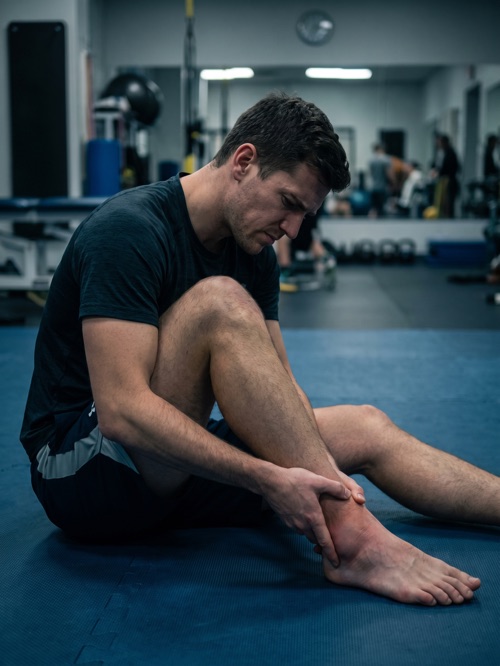
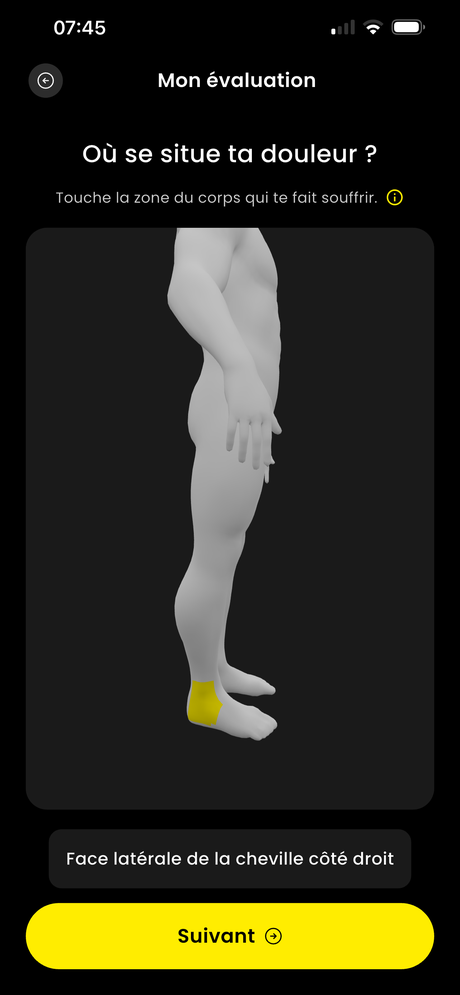
The pain is located at the joint itself, often accompanied by morning stiffness that improves with movement.[2] It’s typically triggered by prolonged walking, running on uneven terrain, or changes of direction.
How symptoms progress without treatment
Without treatment, stiffness and pain can progress, with a gradual reduction in available ankle range of motion, particularly dorsiflexion.
Differential diagnosis
Several types of ankle pain can resemble a joint condition:
- Anterior or posterior ankle impingement, a localised irritation of the soft tissue rather than an overall joint problem
- Associated peroneal tendinopathy, common with repeated sprains
- Residual chronic instability from a sprain, without structural cartilage damage
Causes and risk factors
An athlete’s ankle joint condition most often results from a history of repeated trauma rather than wear linked purely to age.[1]
Biomechanical and personal factors
- A history of multiple sprains, particularly ones poorly rehabbed
- Residual chronic instability
- A history of ankle fracture
- Prolonged, intensive sporting activity over several years
Which sports are associated with an ankle joint condition?
All sports involving repeated impact or a history of multiple ankle injuries are relevant here:
- Football and rugby
- Basketball and handball
- Combat sports
- Running and trail running over many years
- Sports with a history of repeated sprains
Why does this pain develop gradually?
Unlike an acute sprain, a joint condition develops slowly: each traumatic episode leaves a mark on the cartilage and joint alignment, until this build-up exceeds the joint’s capacity to adapt, without any single isolated event explaining the pain.
Treating an ankle joint condition in rehab with a sports physio
The goal of treatment is to maintain optimal joint mobility and strengthen the surrounding muscles to better distribute strain and preserve function in the long run.
- 1Reducing pain and managing load
- 2Recovering available mobility
- 3Isometric strengthening
- 4Progressive concentric strengthening
- 5Ankle proprioceptive work
- 6Closed-chain strengthening (weight-bearing)
- 7Optimising the sporting movement
- 8Strengthening under sport-specific load
- 9Progressive return to your sport
- 10Return to competition
“A joint that moves and gets stronger stays a joint that works, whatever its condition.”
Maintaining function, the cornerstone of treatment
Strengthening the stabilising muscles and maintaining regular active mobility helps preserve ankle function and limit the progression of symptoms, even with an established joint condition.
In brief
- Maintaining active mobility
- Strengthening the stabilising muscles
- Suitably managed sporting load
- Gradual return: mobility, then load, then sport
Ready to take your ankle joint condition seriously?
Start the HOPP programme designed by sports physios.
Should you rest or keep playing sport?
Complete rest generally isn’t the best option for an established joint condition: maintaining suitable, regular activity is what best preserves joint function over time.
Think you might have a different ankle injury?
Take your free test in 3 minutes flat.
When should you see a specialist for an ankle joint condition?
A medical opinion is recommended to confirm the diagnosis with a clinical examination and suitable imaging, particularly in the case of persistent swelling, clear mechanical locking, or pain that worsens despite rehab.
What progress can you expect with a suitable programme?
Cartilage that’s already damaged doesn’t regenerate[2]: what improves is your day-to-day pain and function. Most athletes notice a clear improvement after 6 to 10 weeks of strengthening and mobility work, with better tolerance for walking and activity.
Factors that influence this progress
- The stage of joint damage at the time treatment starts
- Consistency with strengthening and mobility work
- Preventing new sprains
- Adjusting your sporting activity volume
Slowing the progression
Preventing new trauma is the most effective way to slow the progression of the condition.
Preventing repeat sprains
Regular proprioceptive work, even after finishing rehab for a sprain, reduces the risk of new episodes that would worsen the joint damage.[3] It’s the best-documented measure for protecting an ankle that’s already weakened.
Staying active rather than immobile
Contrary to popular belief, inactivity doesn’t protect the joint: cartilage is nourished by movement. Regular, moderate-impact activity, combined with muscle strengthening, maintains ankle function in the long run.
The HOPP care programmes to treat your ankle joint condition and get back to sport
This condition requires suitably managed load and regular strengthening. HOPP offers you a precise exercise programme, allowing you to get back to your activities as quickly as possible.
The programme runs from 3 to 9 weeks depending on the injury and ends with a reconditioning phase allowing a return to competition in the best possible conditions. Each programme is designed by the HOPP team, made up of two sports physiotherapists who are experts in assessing and treating athletes. You’ll also find theoretical content throughout your progression, so you master every aspect of your recovery and can adjust your treatment independently. If needed, our team of physiotherapists is on hand to support you.
Essential
FROM INJURY TO
BACK TO YOUR ACTIVITIES
59€
One-time payment
“AT YOUR OWN PACE WITH
DAILY ADAPTATION”
- 100% of the treatment programme
- Daily personalisation
- Flexibility / Mobility
- Strengthening
- Proprioception
- Progress tracking
- Return-to-running programme
- Theoretical content included
Performance
TO GET BACK TO SPORT
IN THE BEST CONDITIONS
79€
One-time payment
“GET BACK TO YOUR LEVEL
WITHOUT RISK OF RELAPSE”
- 100% of the treatment programme
- Daily personalisation
- Flexibility / Mobility
- Strengthening
- Proprioception
- Progress tracking
- Return-to-running programme
- Theoretical content included
- + 4-week return-to-play plan with 6 difficulty levels
Expert
PERSONALISED VIDEO-CALL
SUPPORT, ANY TIME
149€
One-time payment
“A PHYSIO
WHENEVER YOU NEED”
- 100% of the treatment programme
- Daily personalisation
- Flexibility / Mobility, Strengthening, Proprioception
- Progress tracking
- Return-to-running programme
- Theoretical content included
- + 4-week return-to-play plan with 6 difficulty levels
- + 2 video calls with an expert sports physio / return check-up
A programme that adapts to you every day
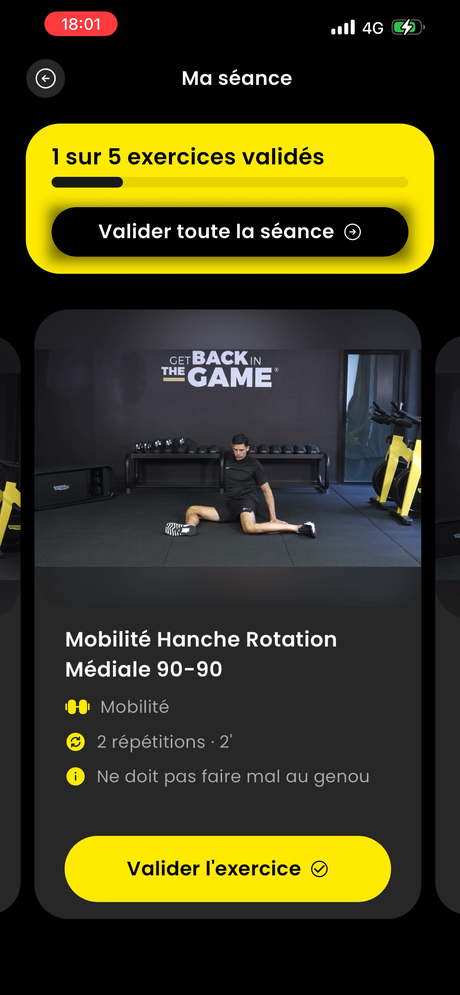
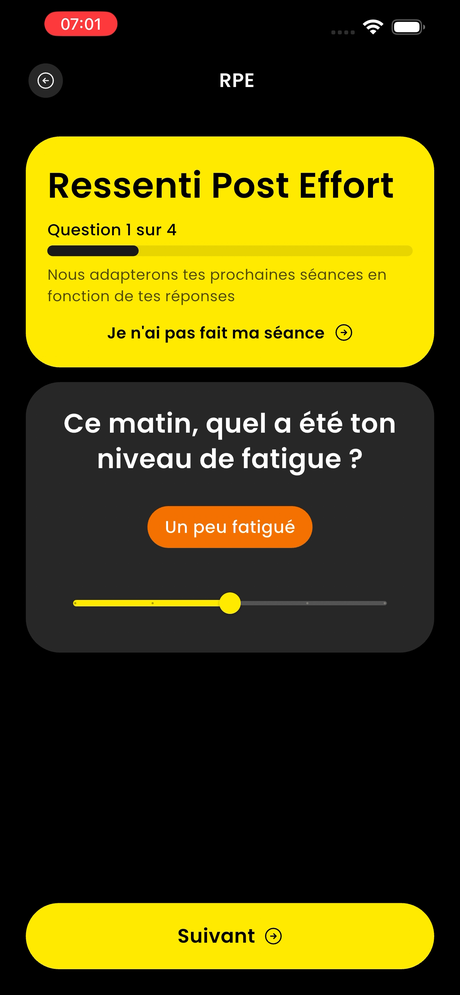
Every day, how you feel (RPE) is factored in to automatically adjust the rest of your programme: more load if all is well, a bit less if your ankle is complaining. This daily personalisation is what makes the difference compared to a fixed, paper-based programme.

Ready to start your programme?
Join the HOPP support programme designed by sports physios.
F.A.Q
Does the HOPP programme replace a medical consultation?
No. HOPP is a support and rehab tool designed by sports physiotherapists, but it doesn’t replace a doctor’s opinion. If in doubt, or if the pain persists, see a health professional.
Is the programme suited to all sporting levels?
Yes. Every programme is personalised to your sport, your level and how you feel each day, whether you’re a recreational athlete or preparing for competition.
Do I need to stop sport with this condition?
Not necessarily. Suitable, well-dosed activity is generally beneficial for maintaining joint function, rather than stopping completely.
Will this condition get worse?
Suitably managed load and regular strengthening can often slow the progression of symptoms and preserve function in the long run.
Is surgery necessary?
Rarely as a first option. Rehab and adapting your activity often manage symptoms satisfactorily, with surgery considered in the most advanced cases.
How many sprains does it take to develop a joint condition?
There’s no precise number: it depends on the severity of each episode and the quality of the rehab that followed. A single severe sprain that’s poorly rehabbed can be enough, just as several mild sprains that are well managed can leave no lasting effects.
Should you avoid impact sports for good?
Not necessarily. Suitable, well-dosed activity generally remains beneficial. The adjustment mainly concerns volume and managing flare-ups, not stopping altogether.