



What is muscle soreness?
Muscle soreness, or DOMS (“delayed onset muscle soreness”), kicks in between 24 and 48 hours after intense or unusual exertion, usually of an eccentric type. This exertion creates micro-tears in the muscle fibres.[1]
It’s the inflammatory response accompanying the healing of these micro-tears that causes the pain, which can last from two to ten days.

The consequences of sore muscles
Having sore muscles temporarily reduces your physical capacity:
Diffuse pain in the muscle affected
Reduced active range of motion
Reduced muscle strength
Loss of proprioception
How to use muscle soreness to progress
Pain is a warning to listen to and interpret. Feeling sore means you’ve put in an intense effort for the muscle; it’s also by working it hard enough that you strengthen it.
Muscle soreness is, in a way, the line between maximal effort and a muscle injury: it indicates that pushing the intensity further on that exercise would risk a tear or a strain.
Don’t confuse it with a real injury
If the pain doesn’t follow this pattern (delayed onset, gradually easing over a few days), it may be a more serious injury:
The HOPP solution to support you
HOPP helps you tell the difference between simple muscle soreness and a more serious muscle injury, and adjust your training load accordingly.
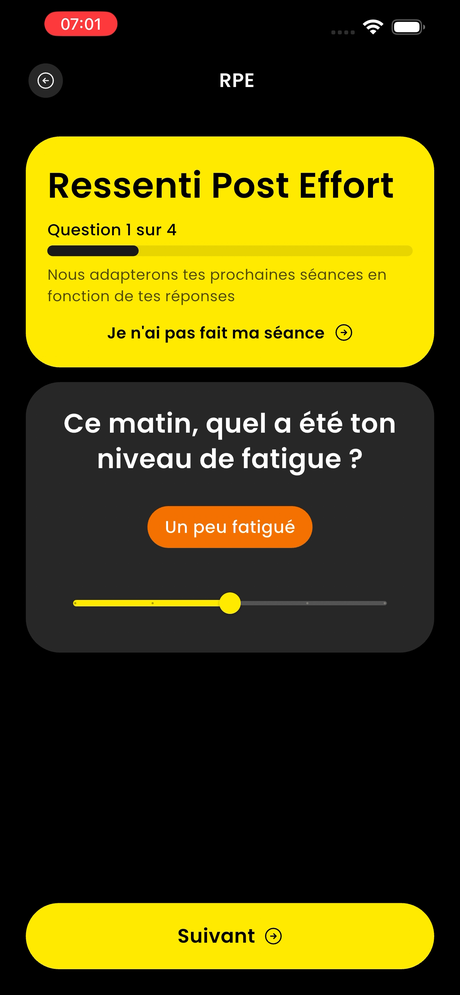
Daily tracking of how you feel
You indicate your level of muscle fatigue every day to adjust your load and avoid turning muscle soreness into an injury.
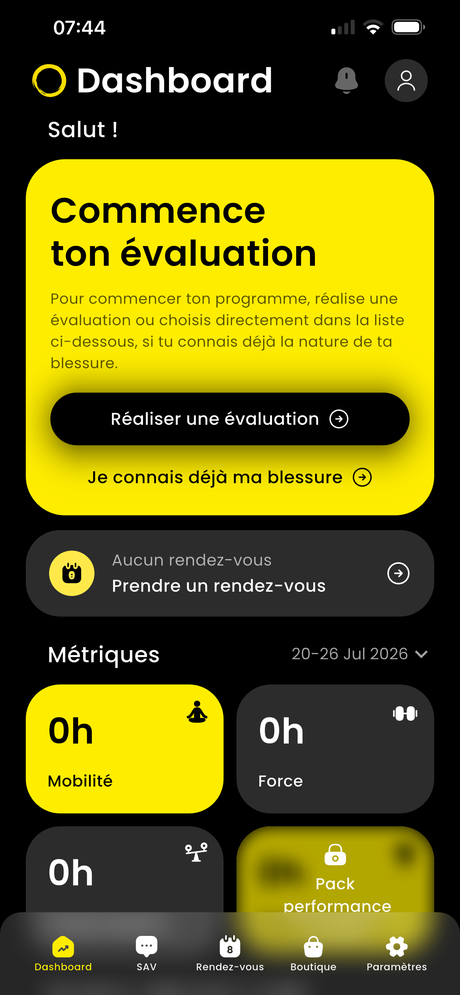
Clear guidance if you’re unsure
If the pain doesn’t follow the typical pattern of muscle soreness, HOPP helps you identify what it actually is.
Sore muscles or a real muscle injury?
Take the 1-minute quiz to find out where you stand.
Frequently asked questions
Should I worry about sore muscles?
No, it’s not considered an injury despite the pain felt. It’s a normal reaction to intense or unusual exertion.
How do I tell the difference between sore muscles and a muscle tear?
Muscle soreness appears 24 to 48 hours after exertion and gradually eases over a few days. A tear causes sharper pain, often felt immediately during exertion, sometimes with a haematoma.
Should I stretch to get rid of sore muscles?
Stretching can bring slight relief but doesn’t significantly reduce how long it lasts.[2] Relative rest and a gradual return remain the best approach.
Can I train with sore muscles?
Yes, by adjusting the intensity. Light activity can even help recovery, as long as you don’t overload the painful area.
Does your pain not feel like ordinary muscle soreness?
Get a clear answer in 3 minutes and start your suitable programme.
Scientific references
- Cheung K, Hume PA, Maxwell L. Delayed onset muscle soreness: treatment strategies and performance factors. Sports Medicine, 2003;33(2):145-164. PubMed : pubmed.ncbi.nlm.nih.gov/12617692
- Herbert RD, de Noronha M, Kamper SJ. Stretching to prevent or reduce muscle soreness after exercise. Cochrane Database of Systematic Reviews, 2011;(7):CD004577. PubMed : pubmed.ncbi.nlm.nih.gov/21735398
This page is based on peer-reviewed scientific publications. It remains a general self-assessment tool and does not replace medical advice.