


Injury
Proximal hamstring tendinopathy: the dancer’s injury
In athletes, a hamstring tendinopathy usually means pain behind the knee. Yet there is another form, less well known but just as disabling: the one that affects the upper insertion of the muscle, on the ischium. I see it very regularly in female and male dancers, more rarely in other sports, and it calls for a noticeably different approach from a classic tendinopathy.
 By Thibault
31 October 2026
5 min read
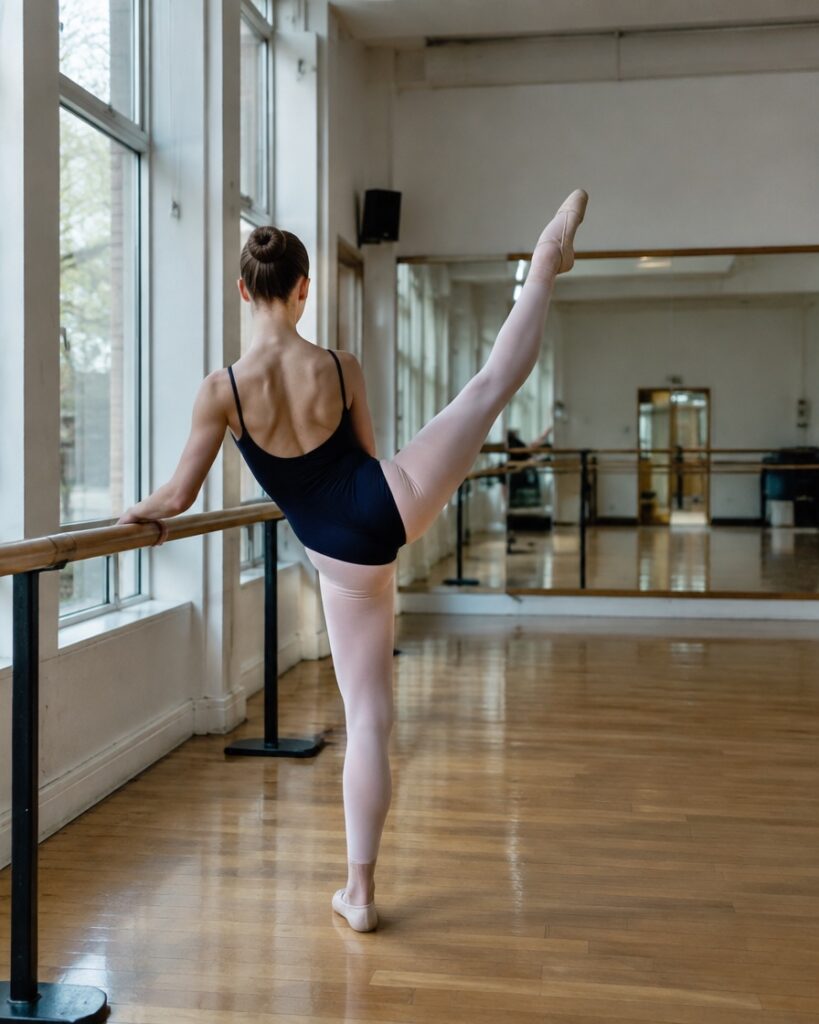
An injury I mostly see in female dancers
A very specific profile
This is an injury I come across almost exclusively in female dancers, sometimes in male dancers. It occurs more rarely in other sports, and on much rarer occasions I have followed runners with this same condition.
The mechanism: building strength in extreme range of motion
In dancers, the injury most often comes from the drive to build strength at extreme hip ranges, the pushed-mobility work that defines the discipline. The upper insertion of the hamstrings, on the ischial tuberosity, is precisely the area under most stress when the hip is flexed and the knee straight at maximum range, the very position of a split or a développé[1][3]. Repeated and loaded, this stress ends up irritating the tendon insertion.
What should make you think of the upper insertion
- A deep pain in the lower buttock, right where you sit
- Discomfort that increases when sitting for a long time or in an extreme hip stretch
- Pain that shows up mostly in large-range movements, not in simple running
Why this tendinopathy is not treated like the others
The foundation stays the same: isometrics, then progressive reloading
As with all tendons, treatment starts with an isometric phase followed by progressive reloading[2]. This foundation does not change, whether it is a patellar, Achilles or hamstring tendinopathy.
But mobility of the hip, pelvis and lower back is just as essential
What changes with the upper insertion is that it is essential to restore mobility to the hip, pelvis and lower back. This mobility lets you distribute stress more efficiently across the whole chain, and therefore reduce the load on the ischium, the very load that caused the injury. In this tendinopathy, work on flexibility and mobility is as important as classic reloading work.
Physio’s take
Dancers often come in for this injury because it is hard to treat effectively on your own. Working only on load without restoring mobility, or the other way around, is not enough: it is the combination of the two that makes the difference to recovery time.
Management that is more demanding than a classic tendinopathy
More restrictive than a tendinopathy at the knee insertions
This is why managing a hamstring tendinopathy at its upper insertion is more restrictive than a tendinopathy at the knee insertions[5]. It is not enough to apply a standard loading protocol: you have to combine it in parallel with real mobility work for the hip, pelvis and lower back, which takes more time and more rigor in follow-up.
Neglecting one of the two axes, load or mobility, exposes you to incomplete healing or a relapse as soon as you return to dancing. A solid framework and rigorous follow-up are the most important factors for a quick return under the best conditions.
Fascia work, in the clinic and at home
In a physio session, fascia work on the back of the thigh and around the ischium is very relevant to support this mobility work. At home, I replace it with a foam roller or a massage ball: the myofascial release it provides improves perceived flexibility and the sensation of tissue stretch[4].
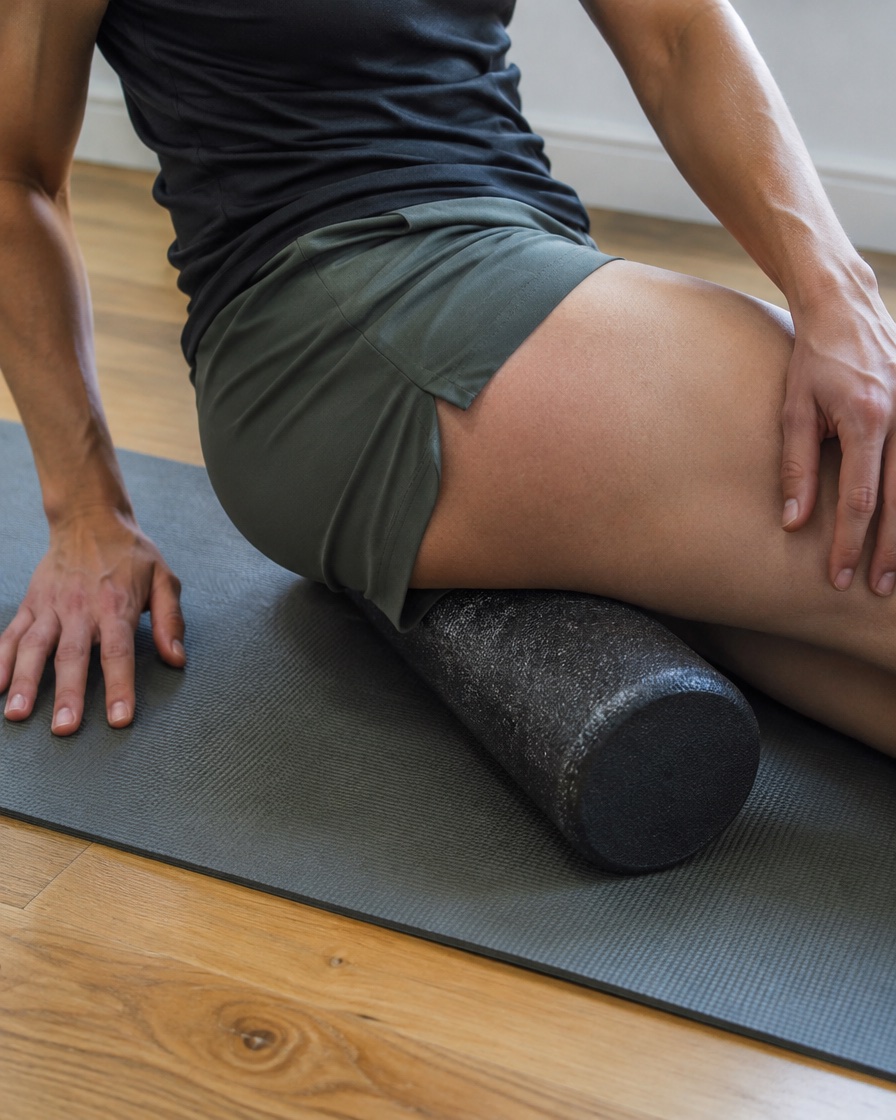
Use the foam roller by rolling slowly along the back of the thigh, never pressing directly and firmly on the ischium in the painful phase. The goal is to relax the tissues around the insertion, not to compress the irritated tendon itself.
A pain at the upper hamstring insertion that is setting in?
HOPP lets you identify your injury in 3 minutes and start a personalized care program right away, designed by FIFA-certified sports physios with more than 17 years of experience. No waiting for an appointment, wherever you are.
Frequently asked questions
Why does this injury mostly affect female dancers?
Because the pursuit of strength at extreme hip ranges, typical of dance (splits, développé), places particular stress on the upper insertion of the hamstrings, on the ischial tuberosity. Repeated and loaded over time, this stress ends up irritating the tendon insertion.
What are the signs of a tendinopathy at the upper hamstring insertion?
A deep pain in the lower buttock, where you sit, that increases when sitting for a long time, in an extreme hip stretch or in large-range movements, rather than in simple running.
Why does treatment take longer than for a classic hamstring tendinopathy?
Because it is not enough to apply the usual progressive loading protocol. You also need to restore mobility to the hip, pelvis and lower back to distribute stress better and reduce the strain on the ischium. It is the combination of both approaches, not one or the other, that allows lasting recovery.
Is the foam roller useful for this injury?
Yes, as a complement to load and mobility work, to relax the tissues around the insertion. Use it on the back of the thigh without pressing directly and firmly on the ischium in the painful phase.
Scientific references
- Askling C, Lund H, Saartok T, Thorstensson A. Self-reported hamstring injuries in student-dancers. Scandinavian Journal of Medicine & Science in Sports, 2002;12(4):230-235. PubMed : pubmed.ncbi.nlm.nih.gov/12199872
- Goom TS, Malliaras P, Reiman MP, Purdam CR. Proximal Hamstring Tendinopathy: Clinical Aspects of Assessment and Management. Journal of Orthopaedic & Sports Physical Therapy, 2016;46(6):483-493. PubMed : pubmed.ncbi.nlm.nih.gov/27084841
- Askling CM, Tengvar M, Saartok T, Thorstensson A. Proximal hamstring strains of stretching type in different sports: injury situations, clinical and magnetic resonance imaging characteristics, and return to sport. American Journal of Sports Medicine, 2008;36(9):1799-1804. PubMed : pubmed.ncbi.nlm.nih.gov/18448581
- Krause F, Wilke J, Niederer D, Vogt L, Banzer W. Acute effects of foam rolling on passive stiffness, stretch sensation and fascial sliding: A randomized controlled trial. Human Movement Science, 2019;67:102514. PubMed : pubmed.ncbi.nlm.nih.gov/31499386
- Lempainen L, Johansson K, Banke IJ, Ranne J, Mäkelä K, Sarimo J, Niemi P, Orava S. Expert opinion: diagnosis and treatment of proximal hamstring tendinopathy. Muscles, Ligaments and Tendons Journal, 2015;5(1):23-28. PubMed : pubmed.ncbi.nlm.nih.gov/25878983
Une blessure à la cuisse ?
Get the facts on your injury in 3 min
- Start your care without waiting
- Get back to your activities without wasting time