

What is patellar syndrome?
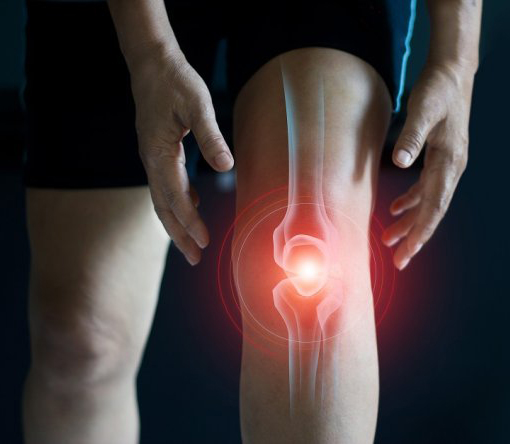
Patellar syndrome, a broad term for anterior knee pain
“Patellar syndrome” is a term historically used to describe all pain felt at the front of the knee, around or behind the kneecap. It actually covers what’s now more precisely called patellofemoral pain syndrome: a functional disorder linked to poor kneecap tracking within its groove (the trochlea), without serious structural damage.
Why does this pain appear?
Pain appears when the kneecap no longer glides in a perfectly centred way within its trochlea, or when the joint takes on repeated load beyond its capacity to adapt. An imbalance between the muscles stabilising the kneecap (inner quadriceps, hip), a too-rapid increase in training volume, or movements that heavily load the flexed knee are the most common causes.[1]
Patellar syndrome or chondropathy: what’s the difference?
Patellar syndrome is a functional disorder: the kneecap doesn’t track well within its trochlea, but the cartilage itself isn’t necessarily damaged. Patellofemoral chondropathy, by contrast, refers to actual structural cartilage damage, confirmed by imaging. The two can coexist, but patellar syndrome remains by far the most common in young, active athletes.
The structures involved in patellar syndrome
Several structures play a role in how well the patellofemoral joint functions:
- The quadriceps, particularly its inner portion (vastus medialis), which actively centres the kneecap
- The iliotibial band, which can pull the kneecap outward if it’s too tight
- The hip muscles (gluteus medius in particular), which stabilise the pelvis and prevent knee valgus
- The femoral trochlea, the bony groove the kneecap needs to glide through in a centred way
Symptoms and diagnosis of patellar syndrome
Typical pain and its triggers
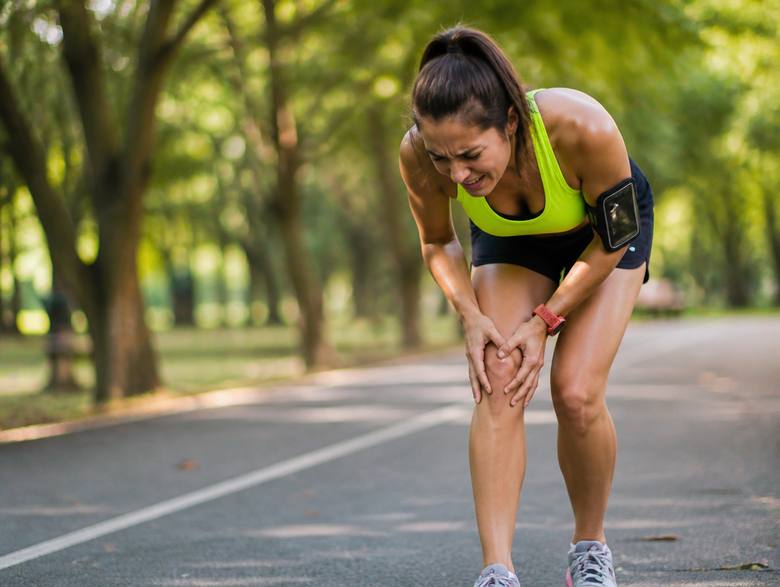
The pain is most often diffuse at the front of the knee, around or behind the kneecap, sometimes hard to pinpoint exactly. It’s classically triggered by prolonged sitting with bent knees (the “moviegoer’s knee” sign), going down stairs more than up, squatting, or running downhill. It can come with small cracking or grinding sensations, without this necessarily being a sign of anything serious.
How symptoms progress without treatment
Without treatment, the pain tends to appear during increasingly moderate activities, sometimes eventually interfering with walking or sitting for long periods in everyday life. The knee can also become more sensitive to changes in activity, with flare-ups after a return to training or an increase in load.
Differential diagnosis
Several other kinds of knee pain can resemble patellar syndrome, which is why a precise assessment matters:
- Patellofemoral chondropathy: structural cartilage damage, confirmed by imaging
- Patellar tendinopathy (jumper’s knee): more localised pain, on the tendon just below the kneecap
- Prepatellar bursitis: localised swelling at the front of the kneecap, often linked to prolonged kneeling
- A meniscus injury: pain more on the sides of the joint, sometimes with locking
Causes and risk factors
Patellar syndrome almost always results from an imbalance between the forces stabilising the kneecap and the load placed on the joint.
Biomechanical and personal factors
- Quadriceps weakness, particularly in its inner portion
- Hip muscle weakness, which encourages dynamic knee valgus (the knee caving inward on landing or weight-bearing)[2]
- Poor flexibility in the iliotibial band or hamstrings
- A collapsed arch that alters lower limb alignment
- Too rapid an increase in training volume or intensity
Which sports contribute to patellar syndrome?
Any sport that loads the flexed knee, repeatedly or suddenly, carries a particular risk:
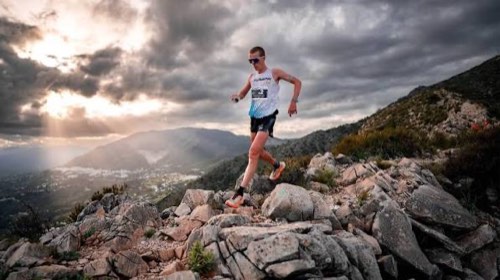
- Running, especially downhill or on asphalt
- Cycling with a poorly adjusted saddle
- Hiking on uneven terrain
- Volleyball and basketball (jumping, landing)
- Weight training with deep squats or heavy lunges
- Dance and sports with repeated squatting
Why does this pain appear with no apparent reason?
This is a very common situation: no impact, no fall, and yet pain gradually sets in. It almost always reflects a gradual overload of the patellofemoral joint, which slowly exceeds the stabilising muscles’ capacity to properly centre the kneecap, without any single identifiable event.
Treating patellar syndrome in rehab with a sports physio
The goal of treatment is to rebalance the forces that stabilise the kneecap within its trochlea, while temporarily reducing load on the joint until pain decreases.
Phase 1 – Pain reduction
In the first few days, the goal is to calm the pain without stopping everything: temporarily easing off the most triggering movements (stairs, deep squatting), combined with isometric quadriceps work, which often gives immediate pain relief.
Phase 2 – Progressive strengthening
Once the pain is better controlled, strengthening the quadriceps and hip becomes the priority, moving from concentric to eccentric work, to better centre the kneecap within its trochlea with each knee bend.
Phase 3 – Return to sport
The final phase progressively reintroduces running, jumping and changes of direction, before a full return to training and then to competition.
In practice, this programme breaks down into 10 concrete steps:
- 1Hip and knee mobility
- 2Strengthening the quadriceps (vastus medialis)
- 3Strengthening the hip muscles (gluteus medius)
- 4Correcting weight-bearing and the kinetic chain
- 5Eccentric strengthening
- 6Working on the posterior chain
- 7Progressive reintroduction of running
- 8Light plyometrics
- 9Progressive return to your sport
- 10Return to competition
“It’s not that the kneecap is out of place, it’s that the overall load on the knee needs to be better distributed.”
Strengthening, the cornerstone of treatment
Strengthening the quadriceps, particularly its inner portion, helps better centre the kneecap within its trochlea. It’s complemented by hip strengthening, because an unstable pelvis increases strain on the knee with each step.
In brief
- Strengthening the quadriceps, particularly its inner portion
- Strengthening the hip to stabilise the pelvis
- Progressively correcting at-risk movements
- Gradual return: mobility, then load, then sport
Ready to take your patellar syndrome seriously?
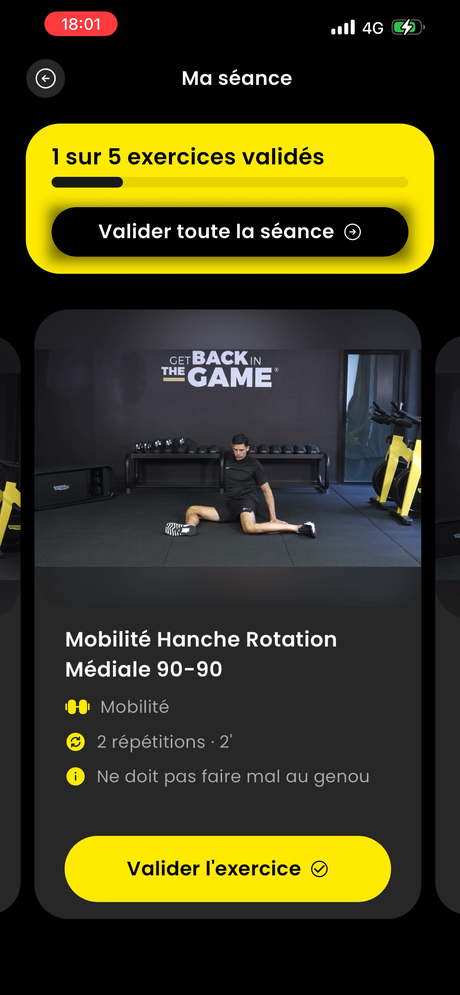
Start the HOPP programme designed by sports physios.
Should you rest or keep playing sport?
Total rest is generally not necessary and isn’t the most effective solution. It’s better to temporarily adapt your activity by reducing the movements that clearly reproduce the pain, while starting quadriceps and hip strengthening as soon as possible.
Think you might have a different knee injury?
Take your free test in 3 minutes flat.
When should you see a specialist for patellar syndrome?
If pain persists for more than three to four weeks despite adapting your activities, or if it comes with clear swelling, mechanical locking or a feeling of instability, a medical opinion is recommended to rule out other causes of anterior knee pain.
Recovery time: how long does it take to recover from patellar syndrome?
Most athletes see a clear improvement within 6 to 8 weeks of well-run rehab, with a full return to impact activities (running, jumping) typically between 8 and 12 weeks. Long-standing cases, present for several months, often require more patience.
Factors that speed up or slow down recovery
- How long the pain had been present before treatment started
- How consistently you keep up quadriceps and hip strengthening
- Following the load progression properly for running and jumping
- Correcting any biomechanical factors identified (footwear, running technique)
Preventing relapses
Patellar syndrome often comes back if strengthening isn’t kept up once the pain has gone.
The 10% progression rule
Not increasing training volume or intensity by more than 10% per week, whether in running distance, elevation gain, or squat load, durably protects the patellofemoral joint.
Controlling dynamic knee valgus
The reference exercise for prevention is the controlled step-down: standing on a step, slowly lower the other leg toward the ground without letting the knee cave inward, keeping the knee aligned with the second toe. Done regularly, this exercise maintains the hip and knee motor control that protects the kneecap from the repeated demands of sport.
The HOPP care programmes to treat your patellar syndrome and get back to sport
To heal durably, patellar syndrome requires progressively rebalancing the forces around the knee. HOPP offers you a precise exercise programme, allowing you to get back to your activities as quickly as possible.
The programme runs from 3 to 9 weeks depending on the injury and ends with a reconditioning phase allowing a return to competition in the best possible conditions. Each programme is designed by the HOPP team, made up of two sports physiotherapists who are experts in assessing and treating athletes. You’ll also find theoretical content throughout your progression, so you master every aspect of your recovery and can adjust your treatment independently. If needed, our team of physiotherapists is on hand to support you.
Essential
FROM INJURY TO
BACK TO YOUR ACTIVITIES
59€
One-time payment
“AT YOUR OWN PACE WITH
DAILY ADAPTATION”
- 100% of the treatment programme
- Daily personalisation
- Flexibility / Mobility
- Strengthening
- Proprioception
- Progress tracking
- Return-to-running programme
- Theoretical content included
Performance
TO GET BACK TO SPORT
IN THE BEST CONDITIONS
79€
One-time payment
“GET BACK TO YOUR LEVEL
WITHOUT RISK OF RELAPSE”
- 100% of the treatment programme
- Daily personalisation
- Flexibility / Mobility
- Strengthening
- Proprioception
- Progress tracking
- Return-to-running programme
- Theoretical content included
- + 4-week return-to-play plan with 6 difficulty levels
Expert
PERSONALISED VIDEO-CALL
SUPPORT, ANY TIME
149€
One-time payment
“A PHYSIO
WHENEVER YOU NEED”
- 100% of the treatment programme
- Daily personalisation
- Flexibility / Mobility, Strengthening, Proprioception
- Progress tracking
- Return-to-running programme
- Theoretical content included
- + 4-week return-to-play plan with 6 difficulty levels
- + 2 video calls with an expert sports physio / return check-up
A programme that adapts to you every day
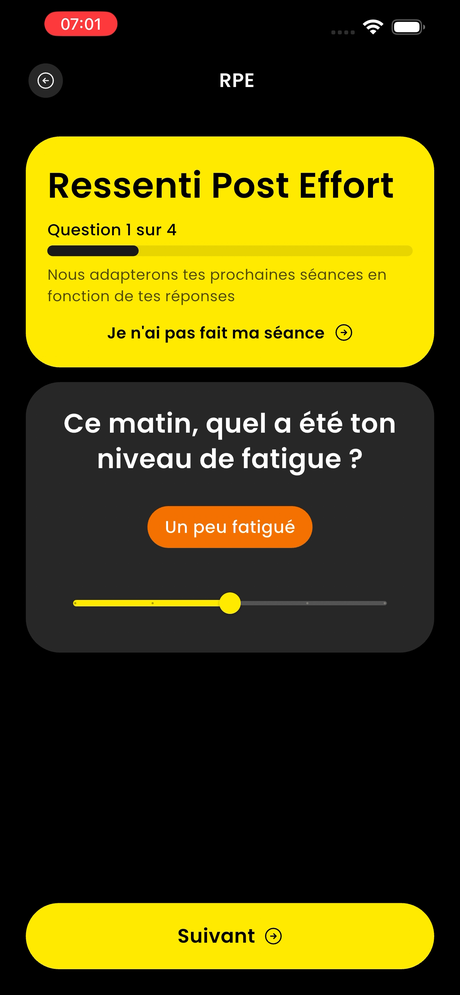
Every day, how you feel (RPE) is factored in to automatically adjust the rest of your programme: more load if all is well, a bit less if your knee is complaining. This daily personalisation is what makes the difference compared to a fixed, paper-based programme.

Ready to start your programme?
Join the HOPP support programme designed by sports physios.
F.A.Q
Does the HOPP programme replace a medical consultation?
No. HOPP is a support and rehab tool designed by sports physiotherapists, but it doesn’t replace a doctor’s opinion. If in doubt, or if the pain persists, see a health professional.
Is the programme suited to all sporting levels?
Yes. Every programme is personalised to your sport, your level and how you feel each day, whether you’re a recreational athlete or preparing for competition.
Are patellar syndrome and patellofemoral pain syndrome the same thing?
In the vast majority of cases, yes: they’re two names for the same clinical reality, the second being the current medical term, more precise about the mechanism involved.
Can I keep running with patellar syndrome?
In most cases, yes, by temporarily adapting your volume and terrain, while starting quadriceps and hip strengthening in parallel.
How long does it take to recover?
A structured programme generally gives a clear improvement within a few weeks, with a full return to sport after several weeks of progressive strengthening.
Can patellar syndrome become chronic?
Yes, if strengthening isn’t kept up once the pain has settled. It’s an injury that comes back easily without regular quadriceps and hip maintenance work.
Is cycling good for patellar syndrome?
Often, yes: it’s a low-impact activity that lets you keep loading the knee without the impact of running. That said, make sure your saddle is high enough to limit excessive knee bend.