


No confirmed diagnosis yet?
This page assumes your knee osteoarthritis (or arthropathy) is confirmed or strongly suspected, and gets straight to the point: which movements to adopt day to day, and which to avoid. If you are first trying to identify the cause of your knee pain, without being sure of the diagnosis, start instead with this guide, which helps you pinpoint the likely cause based on the exact location of your pain, whether your discomfort shows up when bending the knee or when straightening it. And if you want to understand in detail what knee osteoarthritis is, its stages and its causes, head to our dedicated page on knee osteoarthritis (arthropathy).
Why moving remains essential with knee osteoarthritis
The most natural reflex when a joint hurts is to rest it. With osteoarthritis, though, this reflex is one of the worst you can have: prolonged rest does not just maintain stiffness, it makes things worse.
Cartilage has no blood vessels of its own: it is nourished almost exclusively through movement, which circulates the synovial fluid and delivers the nutrients it needs.[1] A knee that is used too little sees its cartilage less well irrigated, its surrounding muscles weaken, and the joint becomes even more sensitive to the slightest load. It is a self-perpetuating cycle: the less you move, the more fragile the knee becomes, and the more fragile it becomes, the less you feel like moving.
Conversely, regular, well-dosed movement maintains joint mobility, strengthens the muscles that protect the knee (the quadriceps in particular) and improves the joint’s tolerance to effort. This is not a hunch: it is now one of the best-established messages in osteoarthritis management, and it has replaced the old advice to ‘go easy’ on the joint.[2]
Physio insight
it is not movement that wears down osteoarthritic cartilage, it is the lack of well-dosed movement. The right reflex is not to move less, but to choose more carefully how you move.
Want to know what you really have?
Take the HOPP test in 3 min: it identifies your injury and suggests the right programme.
Movements to avoid and movements to favour
Managing knee osteoarthritis is actually quite counter-intuitive: it is not about moving less, but about moving differently. Some movements load the joint in a way it tolerates poorly during a painful phase, others maintain it without aggravating it.
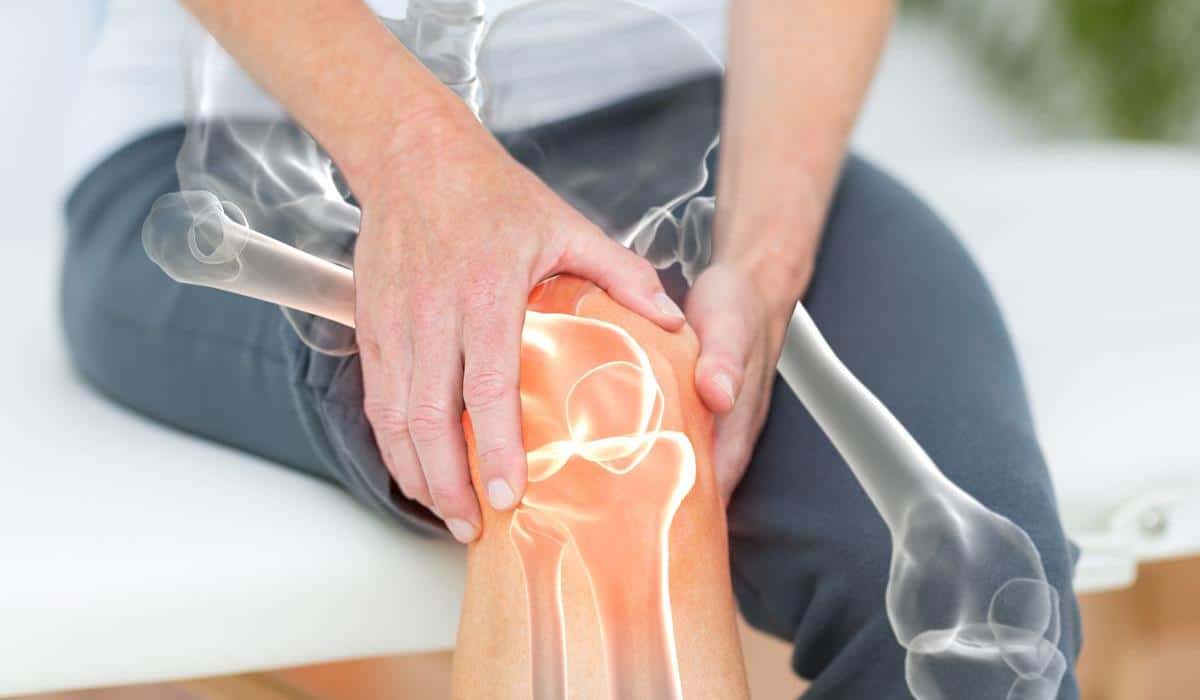
Movements to avoid (or to adapt heavily)
- Repeated deep loaded flexion (deep squats, deep lunges, crouching with weights): the deeper the knee bends under load, the higher the pressure on the patellofemoral cartilage.[3] On already worn cartilage, this repeated compression keeps inflammation and pain going.
- Twisting on a bent knee (pivots, sharp changes of direction with the knee bent, some racket or ball sports): this movement generates shear stress on already weakened joint surfaces, with a risk of further micro-damage.
- Repeated high-intensity impacts on hard ground during a painful flare-up (running on tarmac at a brisk pace, repeated jumps, landings): every footstrike sends a force several times your body weight through the knee. As long as the joint is still clearly painful, this kind of repeated impact feeds the irritation more than it relieves it.
- Prolonged crouching (gardening, DIY on the floor, some everyday tasks): holding a deep bend for long minutes prolongs the compression on the cartilage, with a cumulative effect comparable to repeated loading.
- Stopping all activity completely and for a long time: at the other extreme, no longer using the knee at all out of excessive caution maintains stiffness, weakens the quadriceps and makes the joint even less tolerant to effort as soon as you load it again.

Movements to favour
- Cycling, on flat ground and with a properly adjusted saddle: a circular, impact-free movement that takes the knee through a large range of motion without compressing it.
- Swimming and aqua fitness: the buoyancy of the water takes much of your body weight out of the equation, so you can move the joint freely and pain-free, even in the acute phase.
- Regular walking, adapted in duration and terrain (favour flat, soft surfaces over long descents): a low-impact movement that maintains mobility and the circulation of synovial fluid.
- Closed-chain strengthening with a controlled range of motion (for example partial squats without going past 90° of flexion, leg press over a small range): this type of strengthening works the quadriceps effectively without putting the cartilage under the stress of deep flexion. Our page on muscle strengthening in rehab details this logic of progressing through range and load.
- Joint mobility work, gently and outside painful phases, to maintain the knee’s range without forcing it: see our page on joint mobility.
Physio tip
a simple rule to sort your movements: if an activity causes pain that lasts more than 24 hours after the effort, it exceeds what your knee can tolerate today. Moderate discomfort during the effort that fades quickly, on the other hand, is not a warning sign.
Adapting your activity day to day
In practice, most athletes do not need to give up their favourite sport, but to adjust the dose. If you are a runner, for example, knee osteoarthritis does not necessarily spell the end of running: many keep running by reducing volume, choosing softer terrain and monitoring their tolerance session after session, rather than stopping altogether.
The rule that works best is progressive loading: increase the intensity or volume of an activity in small steps, watching how the knee reacts over the following 24 to 48 hours, rather than relying only on the pain you feel during the effort. This is exactly the logic of daily adjustment, based on how you feel, that a well-run HOPP programme follows.
Discover the movements suited to your knee osteoarthritis
Pinpoint your situation and start a programme that adjusts every day to how you feel.
Start your rehab programme
Exercises designed by sports physios, adjusted every day to how you feel.
When to see a doctor before adapting your movements yourself
In the vast majority of cases, knee osteoarthritis can be managed very well by gradually adapting your movements, without a prior medical opinion. Some signs, however, should prompt you to see a doctor before going any further:
- Clear, persistent swelling of the joint that does not go down with relative rest
- Obvious joint locking, with no way to fully bend or straighten the knee
- Night pain that regularly wakes you up, outside of any activity
- Progressive worsening despite seriously adapting your activities over several weeks
- A marked feeling of instability, as if the knee might give way
These signs call for a medical assessment, with imaging if needed, to clarify the stage of the osteoarthritis and rule out another associated cause before you continue adapting your activity.
FAQ
Should you stop sport completely with knee osteoarthritis?
No, and in most cases it is actually counterproductive. Stopping completely weakens the muscles that protect the joint and deprives the cartilage of the movement it needs to stay nourished. It is far better to adapt the most painful movements while keeping up a regular low-impact activity.
Which movements should you avoid with knee osteoarthritis?
The movements that combine heavy load and a large range of motion are the riskiest: repeated deep loaded flexion, twisting on a bent knee, or repeated impacts on hard ground during a painful flare-up. The problem is not the movement itself, but repeating it at an intensity the joint cannot tolerate yet.
Is running off-limits with knee osteoarthritis?
Not necessarily. Many athletes keep running with early osteoarthritis by adapting volume, terrain and pace to their tolerance. Cycling, swimming or walking remain the alternatives to favour during a painful phase or as a complement.
Why does moving do an osteoarthritic knee good?
Because cartilage is nourished by movement: every bend and straighten circulates the synovial fluid that feeds it. Moving also maintains muscle strength around the knee, which reduces the load taken directly by the joint.