


Injury
The iliolumbar ligament: the forgotten cause of low back pain that lingers
When you have low back pain, the classic approach is to restore mobility in the hips, the iliac bones and the sacrum, and to strengthen the back. And yet, despite all that work, the pain sometimes stays. One structure is often forgotten in this approach: the iliolumbar ligament, which directly connects the lower lumbar vertebrae to the pelvis and which can, on its own, keep chronic pain going.
 By Thibault
1 November 2026
5 min read
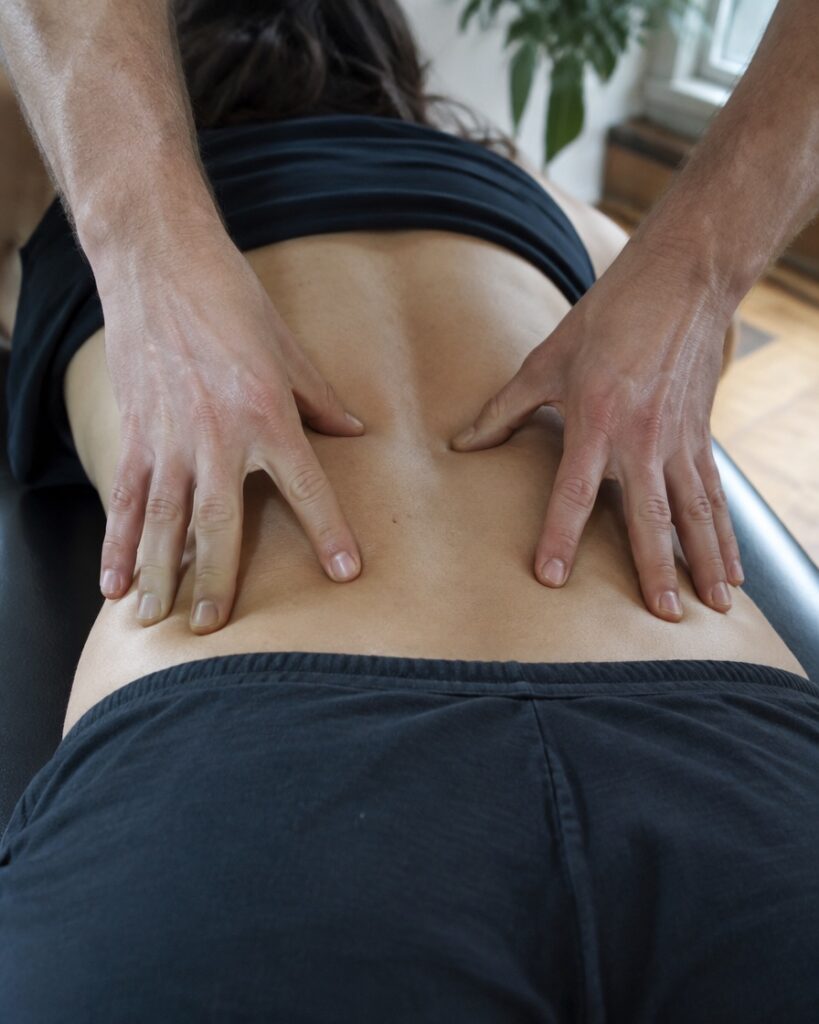
The iliolumbar ligament, a structure we forget to treat directly
A discreet stabiliser of the lumbopelvic junction
The iliolumbar ligament connects the last lumbar vertebrae to the iliac crest. It plays a central role in the stability of the junction between the lower back and the pelvis: cutting it clearly increases the mobility of this area in flexion, extension and lateral bending[1], and it also contributes to the stability of the neighbouring sacroiliac joint[2]
.
Why the pain persists despite classic mobility work
It is precisely because it is discreet that it gets forgotten. We restore mobility in the hips, the iliac bones and the sacrum, we strengthen the back, and we think we have covered the problem. But if the ligament itself stays shortened and irritated, it keeps generating pain, independently of the work done on the neighbouring joints[3]. This picture is even described as a syndrome in its own right, with its own diagnostic injection technique[4]
.
How this ligament loses its mobility
Prolonged poor positions
The iliolumbar ligament can end up lacking mobility: it struggles to stretch normally. This is often the result of a poor position held for a long time, such as sitting with your legs crossed at your desk all day. The passive tissue of the lower back stiffens with time spent in prolonged sitting[5], and the iliolumbar ligament is no exception.
The protection mechanism during a sudden movement
When the body protects itself during a movement that is too fast or too heavy, there is of course the well-known protective muscle spasm. But the ligament, too, can end up held in a shortened position. It is the tension placed on it during a change of position that then creates the pain, sometimes long after the initial movement.
What should make you think of the iliolumbar ligament
- Low back pain that persists despite mobility work on the hips, the sacrum and the back
- A low pain, close to the iliac crest, that appears mostly when you change position
- Days spent sitting for long periods, legs crossed, that make the discomfort worse
Restoring mobility to the iliolumbar ligament
Manual techniques, especially fascia work
The goal is to restore mobility to this ligament. It is possible through manipulations, and personally I find that fascia techniques are the most effective for this precise area. More broadly, myofascial release has shown a significant effect on pain and function in chronic low back pain[6].
Physio’s take
When low back pain resists despite mobility work on the hips, the iliac bones and the sacrum, I systematically check the iliolumbar ligament. It is an area that is too often underestimated, even though it sometimes explains on its own a pain that has been dragging on for months.
The windmill, an active movement to work this area
Alongside manual techniques, a movement like the windmill, well performed and well dosed, lets you actively work this area that is too often underestimated. The movement combines trunk rotation and lateral flexion, exactly the movements the iliolumbar ligament must be able to absorb every day.

At your desk, avoid keeping your legs crossed for long periods: change position regularly so that the iliolumbar ligament does not stiffen in a prolonged posture.
Low back pain that will not go away despite your efforts?
HOPP lets you identify your injury in 3 minutes and start a personalised care programme right away, designed by FIFA-certified sports physiotherapists with more than 17 years of experience. No waiting for an appointment, wherever you are.
Frequently asked questions
How can I tell if my low back pain comes from the iliolumbar ligament?
One sign that should alert you: low back pain that persists despite mobility work on the hips, the iliac bones and the sacrum, and strengthening of the back. The pain is often located near the iliac crest and appears mostly when you change position.
Why does the iliolumbar ligament lose its mobility?
Mainly because of poor positions held for a long time, such as legs crossed at the desk, or following a protective movement that was too fast or too heavy and keeps the ligament in a shortened position.
Which techniques restore mobility to this ligament?
Manipulations and especially fascia techniques are particularly effective on this area. Alongside them, active movements like the windmill, well dosed, help maintain the mobility you have regained.
Does the iliolumbar ligament explain all low back pain?
No. Low back pain has multiple, often combined causes. The iliolumbar ligament is a lead to check systematically, especially when the pain persists despite mobility and strengthening work already well done on the neighbouring structures.
Références scientifiques
- Yamamoto I, Panjabi MM, Oxland TR, Crisco JJ. The role of the iliolumbar ligament in the lumbosacral junction. Spine, 1990;15(11):1138-1141. PubMed: pubmed.ncbi.nlm.nih.gov/2267607
- Pool-Goudzwaard A, Hoek van Dijke G, Mulder P, Spoor C, Snijders C, Stoeckart R. The iliolumbar ligament: its influence on stability of the sacroiliac joint. Clinical Biomechanics, 2003;18(2):99-105. PubMed: pubmed.ncbi.nlm.nih.gov/12550807
- Sims JA, Moorman SJ. The role of the iliolumbar ligament in low back pain. Medical Hypotheses, 1996;46(6):511-515. PubMed: pubmed.ncbi.nlm.nih.gov/8803933
- Harmon D, Alexiev V. Sonoanatomy and injection technique of the iliolumbar ligament. Pain Physician, 2011;14(5):469-474. PubMed: pubmed.ncbi.nlm.nih.gov/21927051
- Beach TA, Parkinson RJ, Stothart JP, Callaghan JP. Effects of prolonged sitting on the passive flexion stiffness of the in vivo lumbar spine. The Spine Journal, 2005;5(2):145-154. PubMed: pubmed.ncbi.nlm.nih.gov/15749614
- Wu Z, Wang Y, Ye X, Chen Z, Zhou R, Ye Z, Huang J, Zhu Y, Chen G, Xu X. Myofascial Release for Chronic Low Back Pain: A Systematic Review and Meta-Analysis. Frontiers in Medicine, 2021;8:697986. PubMed: pubmed.ncbi.nlm.nih.gov/34395477

Une blessure au dos ?
Get the facts on your injury in 3 min
- Start your care without waiting
- Get back to your activities without wasting time