


Injury
Chopart and Lisfranc: the forgotten joints that make your ankle hurt
When you have ankle or foot pain, the examination almost always focuses on the area that hurts. Yet a little further along, in the middle of the foot, there are two joint lines that are almost systematically forgotten when testing: the Chopart and Lisfranc joints. If they lack mobility, the whole midfoot stiffens, and that stiffness shifts stress onto the neighbouring joints, starting with the ankle.
 By Thibault
24 October 2026
5 min read
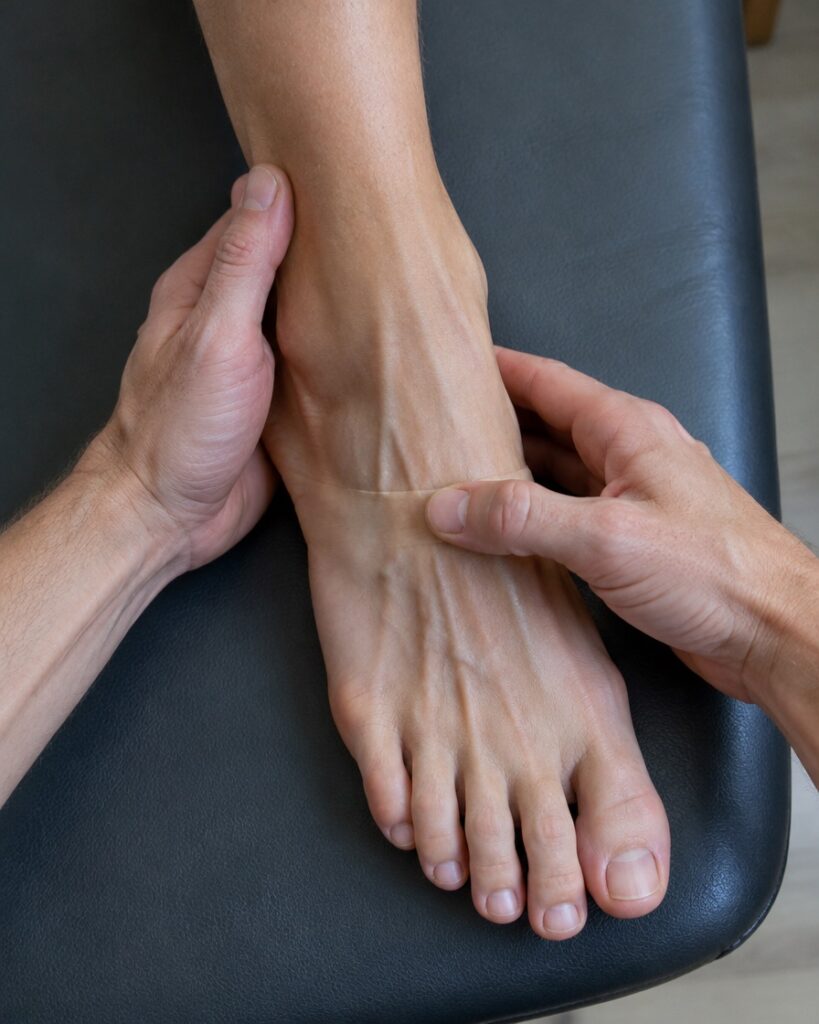
Chopart and Lisfranc, two joint lines at the heart of the midfoot
Two joints, one role: adapting the foot to the ground
The Chopart joint, or midtarsal joint, connects the hindfoot to the front of the midfoot. The Lisfranc joint connects the midfoot to the base of the metatarsals. Together, they allow the foot to switch between two states: supple and shock-absorbing on landing, then rigid to transmit the push at propulsion[1]. This constant locking and unlocking is what gives the midfoot its full ability to adapt to the terrain.
Joints we forget to test
When an ankle or a foot hurts, the examination naturally focuses on the painful area itself: the ankle ligaments, the joint that swells. Midfoot mobility is rarely tested systematically. As a result, a loss of mobility in the Chopart or Lisfranc joints can go unnoticed for months, while it quietly fuels the pain of a neighbouring joint.
A stiff midfoot that makes the ankle hurt
The compensation mechanism
A midfoot that lacks mobility behaves differently during walking or running. Biomechanics studies show that midfoot stiffness directly changes ankle kinematics and the stress it bears during the propulsion phase[2]. In practice, the foot compensates elsewhere for what it can no longer do at the Chopart and Lisfranc level, and the ankle absorbs part of that overload.
What should make you think of a midfoot origin
- Ankle pain that does not settle despite treatment focused only on the ankle
- A midfoot that feels stiff on palpation, with little mobility in torsion
- Discomfort that gradually works its way up toward the ankle after an old foot injury
The physio’s role: identify the problem and restore mobility
In this case, my work starts by testing the mobility of these two joint lines on their own, independently of the ankle itself. If it is limited, I mobilise the midfoot to give back the range it lacks.
Physio’s take
When ankle pain drags on, I systematically test the mobility of the Chopart and Lisfranc joints, even when nothing points to them directly. Mobilising them often gives the midfoot back the range it lacks, and the ankle benefits in return: midfoot joint mobilisation improves perceived ankle function, including in chronic instability[4].
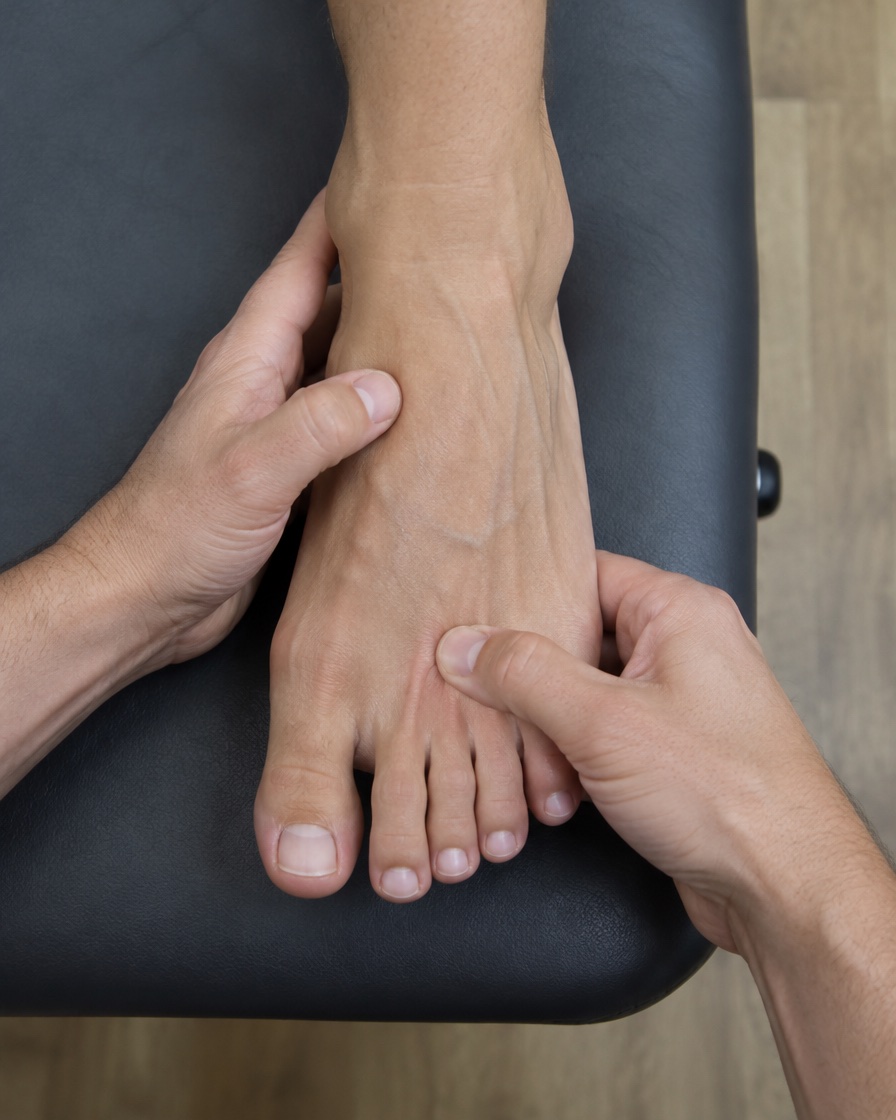
When the trauma directly affects Chopart or Lisfranc
Rare sprains, but real ones in rehabilitation
Occasionally, these joints suffer a real trauma: a midfoot sprain, or even an injury to the Lisfranc joint. It is relatively rare in my rehabilitation practice, but it happens, especially after a direct blow, a fall with the foot stuck on the ground, or a violent twisting mechanism[3].
Pain on top of the midfoot, together with a bruise under the sole of the foot, an inability to put weight on the foot, or very localised pain between the metatarsals, should make you suspect a Lisfranc injury. This requires prompt medical attention with imaging: it is an injury you should never downplay.
Foot core training, an essential ally for recovery
After this type of trauma, foot core training becomes all the more important. Strengthening the intrinsic muscles of the foot helps to actively stabilise the midfoot and support the Chopart and Lisfranc joints while the tissues heal, alongside the mobility work[5].
If ankle pain persists without a clear explanation in the joint itself, think about having your midfoot mobility tested. It is often a neglected lead that unblocks a stalled rehabilitation.
Ankle or foot pain you cannot explain?
HOPP lets you identify your injury in 3 minutes and start a personalised care programme right away, designed by FIFA-certified sports physios with more than 17 years of experience. No waiting for an appointment, wherever you are.
Frequently asked questions
How can I tell if my ankle pain actually comes from the midfoot?
One warning sign: ankle pain that does not settle despite treatment focused only on the joint itself. A stiff midfoot, with little mobility in torsion on palpation, or discomfort that gradually works its way up from an old foot injury, are clues that should lead to testing the Chopart and Lisfranc joints.
How does a physio test the Chopart and Lisfranc joints?
By stabilising the hindfoot with one hand and mobilising the front of the midfoot with the other, in a controlled twisting movement. This test assesses the available range and identifies any localised stiffness, independently of the mobility of the ankle itself.
Is a Lisfranc joint sprain serious?
Yes, it is an injury that must be taken seriously. Pain on top of the foot combined with a bruise under the sole or an inability to put weight on the foot requires prompt medical attention with imaging, because a poorly managed Lisfranc injury can have lasting consequences on foot function.
Why is foot core training important after a midfoot injury?
Because it actively stabilises the Chopart and Lisfranc joints while the tissues heal. Strengthening the intrinsic muscles of the foot, alongside the mobility work, helps to support the midfoot and to make the gradual return to weight bearing safer.
Scientific references
- Blackwood CB, Yuen TJ, Sangeorzan BJ, Ledoux WR. The midtarsal joint locking mechanism. Foot & Ankle International, 2005;26(12):1074-1080. PubMed : pubmed.ncbi.nlm.nih.gov/16390642
- Magalhães FA, Fonseca ST, Araújo VL, Trede RG, Oliveira LM, Castor CGME, Pinto RZ, Souza TR. Midfoot passive stiffness affects foot and ankle kinematics and kinetics during the propulsive phase of walking. Journal of Biomechanics, 2021;119:110328. PubMed : pubmed.ncbi.nlm.nih.gov/33611052
- Nunley JA, Vertullo CJ. Classification, investigation, and management of midfoot sprains: Lisfranc injuries in the athlete. American Journal of Sports Medicine, 2002;30(6):871-878. PubMed : pubmed.ncbi.nlm.nih.gov/12435655
- Jaffri AH, Fraser JJ, Koldenhoven RM, Hertel J. Effects of midfoot joint mobilization on perceived ankle-foot function in chronic ankle instability: a crossover clinical trial. Journal of Sport Rehabilitation, 2022;31(8):1031-1040. PubMed : pubmed.ncbi.nlm.nih.gov/35894993
- Jaffri AH, Koldenhoven R, Saliba S, Hertel J. Evidence for intrinsic foot muscle training in improving foot function: a systematic review and meta-analysis. Journal of Athletic Training, 2023;58(11-12):941-951. PubMed : pubmed.ncbi.nlm.nih.gov/35724360

Une blessure au pied ?
Get the facts on your injury in 3 min
- Start your care without waiting
- Get back to your activities without wasting time