


Injury
Ankle syndesmosis: the injury we forget to test
As soon as an ankle swells up and hurts on the outside, everyone thinks the same thing: a classic sprain, the one involving the anterior talofibular ligament. It is the patient’s reflex, and sometimes even the clinician’s. But a bit higher up, between the tibia and the fibula, there is another area we far too often forget to test, and it alone explains a good number of sprains that never really heal as expected.
 By Thibault
17 October 2026
5 min read
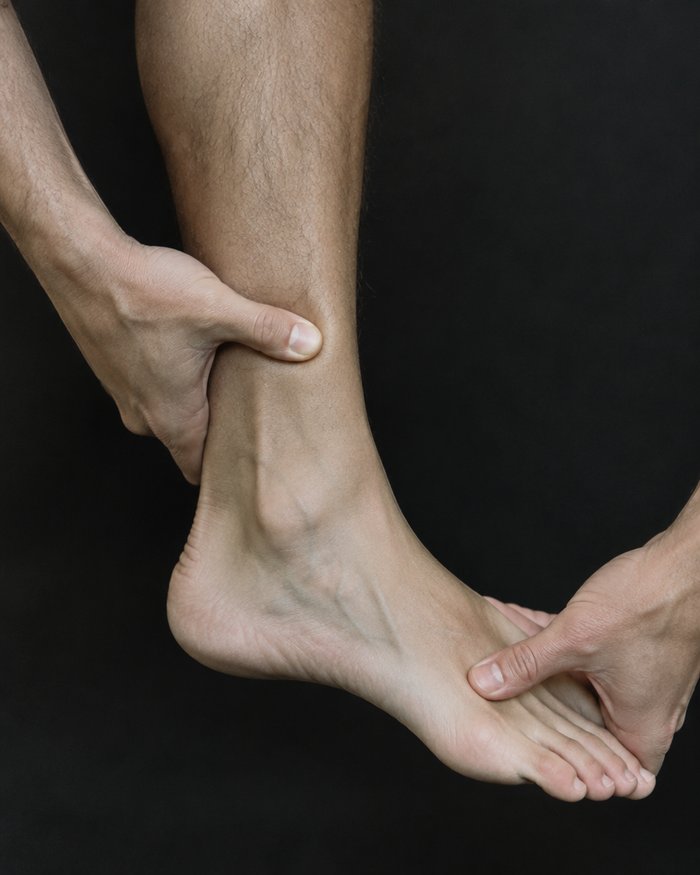
The syndesmosis, the area we forget to look at
Why we miss it so often
When an ankle swells after a twist, the eye is naturally drawn to the outer side, where it swells and where it hurts first. That is the territory of the anterior talofibular ligament (ATFL), the famous “classic sprain”. The problem is that this painful, visible area captures all the attention, at the expense of another structure located higher up: the syndesmosis, the set of ligaments that links the tibia and the fibula just above the ankle.
The mechanism that should raise a flag
This injury is still fairly common. It typically occurs when the foot is flexed at the moment the ankle twists: the classic mechanism combines dorsiflexion and a forced rotation, often external, while the foot stays planted on the ground[1]. In this position, it is the ligament between the tibia and the fibula that takes the stress, not the ATFL. And that is where complications begin if the area is never tested.
What should make you think of the syndesmosis
- An ankle twist with the foot flexed, not a simple roll onto the side
- Pain higher up, between the tibia and the fibula, above the ankle itself
- A sprain that stalls, stays unstable or drags on well beyond the usual timeframe
Why the diagnosis often comes too late
The classic scenario: a recovery that stalls
I have noticed, like many sports physios, that a syndesmosis injury is often diagnosed during a second visit to the doctor, when the recovery from a “simple” sprain is not going as planned and stalls. That is when imaging and a more thorough clinical examination bring this injury to light, but with a delay in care.
Physio’s take
No single test taken in isolation is enough to confirm a syndesmosis injury with certainty[1]. That is why, personally, when a patient comes to see me with an ankle problem, I systematically test this area, even when everything seems to point to a classic lateral sprain.
The tests that should be part of every ankle assessment
Direct palpation of the anterior ligament
The simplest move is to palpate the anterior tibiofibular ligament directly, just above the ankle joint, between the tibia and the fibula. Marked, well-localized pain at this precise spot is one of the most useful signs pointing to a syndesmosis injury[1].
The external rotation test
This test consists of stabilizing the leg at the same spot, just above the ankle, then turning the foot outward. This movement reproduces the stress behind the injury and triggers localized pain between the tibia and the fibula if the syndesmosis is affected.
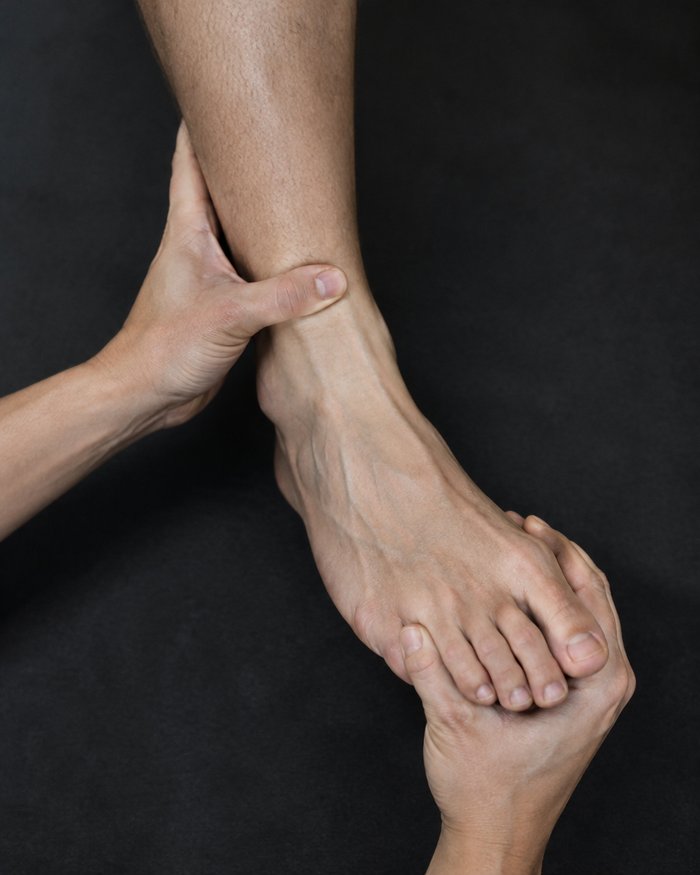
If your ankle sprain drags on, stays unstable or feels higher than usual, explicitly ask your practitioner to test the syndesmosis, not only the outer ligament. It is often the question that unlocks a diagnosis that has been stuck for several weeks.
Why this injury takes more time and more caution
A much longer recovery time
A syndesmosis injury is not treated like a classic lateral sprain, and it does not heal at the same pace either. In a study of professional American football players, the average time lost was 15.4 days for a syndesmosis injury, versus 6.5 days for a lateral sprain of comparable severity[2].
A sprain that takes a long time to heal, stays unstable or keeps bothering you well beyond the usual timeframe is not necessarily a sprain that is healing badly: it is also a signal that should make you think of the syndesmosis. Better to check than to prolong a poorly targeted rehab.
Offloading the area to let it heal
Management first aims to offload the area so that it can heal. Soft support, such as strapping, is effective for stabilizing the joint while letting rehab progress. Strengthening and return to sport come next, at a generally more cautious pace than for a lateral sprain, precisely because the syndesmosis stabilizes a joint that is more heavily loaded in rotational movements.
An ankle sprain that won’t go away?
HOPP lets you identify your injury in 3 minutes and start a personalized care program right away, designed by FIFA-certified sports physios with more than 17 years of experience. No waiting for an appointment, wherever you are.
Frequently asked questions
How can I tell if my sprain involves the syndesmosis rather than the outer ligament?
The main sign is where the pain is located: higher up, between the tibia and the fibula, above the ankle itself, rather than on the outer side. Direct palpation of the anterior ligament and the external rotation test point toward the diagnosis, but no single test is enough to confirm it with certainty: a full clinical examination, sometimes supplemented by imaging, remains necessary.
Why is this diagnosis so often made late?
Because the initial symptoms look like those of a classic lateral sprain, and attention naturally goes to the area that swells and hurts the most. It is often when recovery stalls, at a second medical opinion, that the syndesmosis is finally tested specifically.
How long does it take to recover from a syndesmosis injury?
It takes longer than a classic lateral sprain. Studies on elite athletes show a time lost roughly two to three times longer on average. Rehab must be carried out with caution, giving the area time to heal before returning to full weight-bearing.
Is support necessary?
Soft support, such as strapping, helps offload the area and secure healing in the first weeks, alongside rehab. The type of support and its duration depend on the severity of the injury, to be assessed with a professional.
Scientific references
- Sman AD, Hiller CE, Rae K, Linklater J, Black DA, Refshauge KM. Diagnostic accuracy of clinical tests for ankle syndesmosis injury. British Journal of Sports Medicine, 2015;49(5):323-329. PubMed: pubmed.ncbi.nlm.nih.gov/24255766
- Osbahr DC, Drakos MC, O’Loughlin PF, Lyman S, Barnes RP, Kennedy JG, Warren RF. Syndesmosis and lateral ankle sprains in the National Football League. Orthopedics, 2013;36(11):e1378-e1384. PubMed: pubmed.ncbi.nlm.nih.gov/24200441
Une blessure à la cheville ?
Get the facts on your injury in 3 min
- Start your care without waiting
- Get back to your activities without wasting time