


How can I optimise my recovery after sport?
Your recovery doesn’t only happen during your rehab or training session: it’s also built through your sleep, your hydration, how you balance sport and work, and your ability to listen to the signals your body sends you. Here are the four levers that really make the difference.
Sleep, the first recovery lever
Sleep is when your body repairs the tissues used during training and consolidates muscular adaptations. Below 6 hours a night on a repeated basis, recovery slows down noticeably, even if the rest of your lifestyle is good.[1] It’s not just the duration that counts: the quality of sleep (falling asleep easily, not waking up several times a night) plays just as important a role.
Hydration, an often underestimated factor
Water is involved in transporting nutrients to your muscles and eliminating waste produced by exercise. Insufficient hydration over time can increase feelings of stiffness and muscle fatigue, and make recovery longer after intense effort.[2]
Training load and work, a balance to find
The volume of sport you do per week and the number of hours you work add up in your body’s overall fatigue. A high training load combined with a busy work week leaves less room for recovery, even if each activity taken alone seems reasonable. It’s the sum of the two that counts, not just the training volume.
Listening to your body with RPE
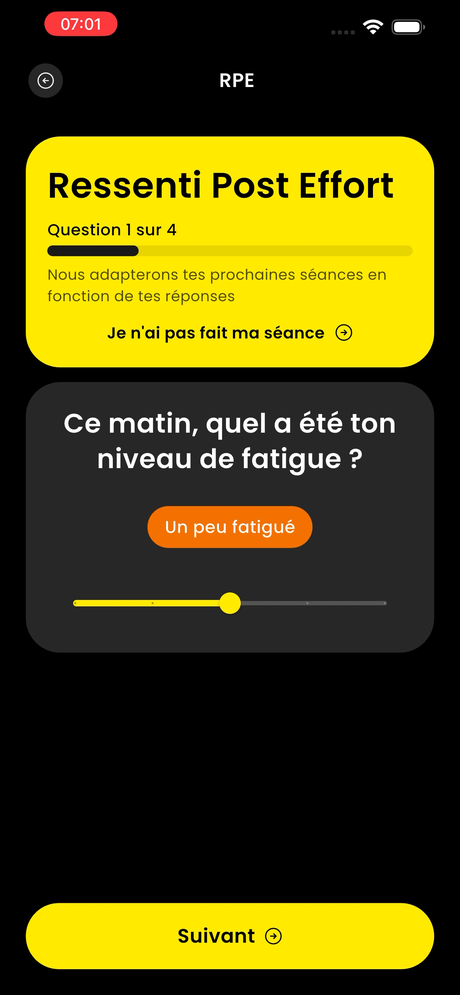
RPE (rate of perceived exertion, scored from 0 to 10) lets you simply measure how much a session or a day has cost you. Tracking your RPE right after exercise, the next morning and at the end of a work day gives a much more complete picture of your real fatigue than a single, occasional feeling.[3]
Ready to manage your recovery better?
Start a programme that adjusts to how you feel every day.
Is RPE a reliable indicator for avoiding injury?
Yes, RPE is a reliable indicator for limiting the risk of injury, as long as you track it regularly rather than occasionally. A high RPE that repeats session after session, or that stays high the next morning, signals a load your body can no longer fully absorb. It’s this signal repeated over time, more than a single day’s score, that should alert you.[3]
What is RPE and how do you measure it?
RPE is simply scored on a scale from 0 (no effort) to 10 (maximal effort), by asking yourself how difficult a session or a day felt. No equipment is needed: it’s a self-assessment, to note right after exercise to stay as close as possible to how you actually felt.
Interpreting your RPE day to day
A high RPE right after a session is normal for an occasional intense workout. What should alert you is an RPE that stays high the next morning when you wake up, or at the end of a work day when you haven’t even done sport that day: it’s a sign that your overall load, sport and work combined, is exceeding your current capacity to recover.
The limits of RPE
RPE remains a subjective measure: it varies depending on how tired, stressed or motivated you are that day, independently of the effort actually made. It doesn’t replace a professional opinion in the case of persistent pain, but it remains a simple, free tool for spotting a worsening trend before it becomes an injury.
Frequently asked questions
How can I optimise my recovery after sport?
Prioritise your sleep (duration and quality), your hydration throughout the day, and the balance between your training load and your work. Tracking your RPE regularly lets you adjust these levers before fatigue builds up.
Is RPE a reliable indicator for avoiding injury?
Yes, as long as you track it regularly rather than occasionally. A high RPE that repeats session after session, or that stays high the next morning, signals a load your body can no longer fully absorb: it’s this signal repeated over time that should alert you, more than a single day’s score.
What has the biggest influence on recovery after an injury?
Sleep, hydration, the balance between training load and work, and regularly tracking your RPE are the most well-documented levers for speeding up recovery.
Does this quiz replace medical advice?
No, it’s a general self-assessment tool. For a specific injury, use the HOPP assessment or consult a healthcare professional.
Ready to get started without waiting?
Identify your injury and get your personalised programme in 3 minutes.