



What is the posterior knee capsule
The knee is wrapped in a joint capsule, a sleeve of fibrous tissue that surrounds the joint and contributes to its stability, alongside the ligaments (cruciate, collateral) and surrounding muscles. The posterior part of this capsule, at the back of the knee, is precisely the structure that first limits knee extension beyond its neutral position.
The first line of defence against hyperextension
A landmark biomechanical study, which pushed knees to rupture through passive hyperextension, showed that the posterior capsule is the very first structure to give way, on average around 23° of recurvatum, even before the posterior cruciate ligament.[1] It’s the structure that absorbs the initial shock when the knee bends backward beyond its normal limit.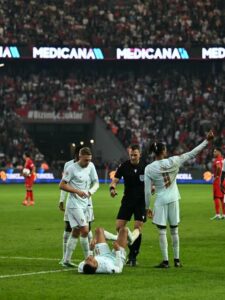
A frequent mechanism in contact and speed sports
This type of injury typically occurs when the knee is locked in extension while a force pushes the leg backward: planting the foot while striking, contact on the shin with the knee straight, or an off-balance landing. It’s a mechanism that regularly recurs in football, rugby, or pivoting sports.Mbappé’s case: what happened against Turkey
On 25 September 2026, during the Turkey-France match (a 0-1 win for the Bleus) in the Nations League, Kylian Mbappé injured his left knee right after scoring the match’s only goal. He immediately left the pitch and returned to Madrid to be treated by Real Madrid’s medical staff.[a]
The next day, the club officially announced the diagnosis: hyperextension of the posterior capsule of the left knee, with an estimated unavailability of 10 to 12 days.[b] He will miss France’s next three matches, but this timeline remains, at this stage, compatible with taking part in Real Madrid’s trip to Rome in the Champions League on 14 October.
Recovery time, and what it depends on
What all knee hyperextensions have in common is the mechanism. What changes everything, on the other hand, is the actual extent of the tissue damage, once past the initial shock wave that always hits the posterior capsule first.[1]
10-12 d
unavailability announced for K. Mbappé, isolated capsule injury
~23°
average recurvatum before posterior capsule rupture in the lab
Several months
of recovery if the posterior cruciate ligament is also affected
Isolated capsule: a short timeline
When hyperextension stays limited to a stretch or partial tear of the posterior capsule, without damage to the cruciate ligaments, recovery takes days to a few weeks, provided care is fast and well managed. This is the profile described for Kylian Mbappé.When other structures are affected
Recent biomechanical studies show that a more violent hyperextension can simultaneously damage several capsular and ligamentous structures (posteromedial capsule, posterolateral capsule, posterior cruciate ligament), with a much heavier clinical picture.[3] In extreme cases, hyperextension is the mechanism behind certain knee dislocations, a surgical emergency.Worried about a knee pain?
Take your HOPP assessment to precisely understand what’s going on.
The treatment steps
For an isolated injury to the posterior capsule, care follows a classic logic of initial protection followed by progressive loading, close to what’s used for a sprain.[2]
1. Protection and pain control (first days)
Ice, temporarily limiting movements that reproduce the pain, and sometimes a brace set to prevent full extension of the knee (the exact movement that caused the injury), while the capsule heals under good conditions.2. Regaining mobility
Once the acute pain has passed, the goal becomes progressively regaining the knee’s full range of motion, particularly flexion, without forcing terminal extension until the capsule has healed sufficiently.3. Muscle strengthening
The quadriceps and hamstrings are trained to better actively control knee extension and protect the capsule from repeated stress, a focus that matters even more as the sporting movement puts the knee back into forced extension.4. Proprioception and sport-specific movements
Balance and joint control work prepares the knee to react correctly during off-balance landings or contact, before reintroducing the specific movements of the sport practised (striking, changing direction, contact).5. Functional tests before return
Before returning to competition, strength, stability and confidence tests in the movement confirm the knee is ready, rather than relying solely on the timeline announced at diagnosis.Want a programme adapted to your knee injury?
Take your HOPP assessment to start a progressive, safe return.
The vocabulary of knee hyperextension
Capsule, recurvatum, PCL: a few pointers to understand what’s being discussed.
Joint capsule
A sleeve of fibrous tissue that surrounds a joint and contributes to its passive stability, alongside the ligaments. In the knee, its posterior part is the first structure stressed during hyperextension.Recurvatum (or genu recurvatum)
Medical term for knee hyperextension, meaning a knee that goes beyond its neutral extension position. Can be an acute injury mechanism or, in some people, a constitutional laxity.Posterior cruciate ligament (PCL)
Ligament located in the centre of the knee that limits the tibia from sliding backward relative to the femur. It’s one of the structures that can be affected if hyperextension goes beyond the posterior capsule alone.Posterolateral corner
A group of structures (ligaments and tendons) at the back-outside of the knee that, together with the PCL, contribute to stability against hyperextension and excessive rotation. Damage to this area significantly worsens the prognosis.Extension block brace
A brace set to prevent the knee from reaching full extension, used during the protection phase to let the posterior capsule heal without being put back under tension.Frequently asked questions
What is a hyperextension of the posterior knee capsule?
It’s a stretch, or even a partial tear, of the joint capsule at the back of the knee, caused by an excessive extension movement of the joint (the knee bends backward beyond its normal limit). According to biomechanical studies, the posterior capsule is the very first structure to give way during hyperextension, before the cruciate ligaments.What is Kylian Mbappé’s injury against Turkey?
On 25 September 2026, during the Turkey-France Nations League match, Kylian Mbappé injured his left knee right after scoring a goal. Real Madrid announced the next day a diagnosis of hyperextension of the posterior capsule of the left knee, with an estimated unavailability of 10 to 12 days.How long does recovery from a knee hyperextension take?
For an isolated injury to the posterior capsule, without associated damage to the cruciate ligaments, recovery generally takes days to a few weeks (10 to 12 days in Kylian Mbappé’s case). If other structures are affected (posterior cruciate ligament, posterolateral corner), the timeline lengthens considerably and can require several months, or even surgery.What are the treatment steps for a knee hyperextension?
Care follows a logic of protection then progressive loading: a few days of protection (ice, limiting weight-bearing if needed, sometimes a brace that blocks full extension), then gradual recovery of mobility, strengthening of the quadriceps and hamstrings, proprioception work, and finally functional tests before returning to sport.Is a knee hyperextension serious?
It entirely depends on the extent of the damage. Isolated to the posterior capsule, it’s a moderate injury with a quick return, as in Kylian Mbappé’s case. But hyperextension is also the mechanism that can, in the most violent cases, damage the posterior cruciate ligament or even lead to knee dislocation, a surgical emergency.Ready to understand your knee pain?
Take your assessment and get a personalised programme in 3 minutes.