


Quiz: sore muscles or real muscle injury?
Diffuse pain that sets in the next day, or sharp pain that hits suddenly during exercise: these aren’t the same thing. Answer these 4 questions to find out if your pain looks like classic soreness or a muscle injury worth watching.

How to recognize real muscle soreness
Muscle soreness, or delayed onset muscle soreness (DOMS), is a normal phenomenon after an unusual or intense effort, especially eccentric movements (braking on a downhill run, lowering a heavy load). It corresponds to micro-injury at the muscle fiber level, without the fibers actually tearing.[1]

A characteristic onset delay and pattern
Soreness doesn’t appear immediately: it sets in between 24 and 72h after exercise, peaks around the second day, then gradually fades over a few days.[1] It affects the muscle diffusely (the whole thigh, the whole calf) rather than one precise spot, and shows up mainly as stiffness and tenderness to pressure or stretching, not sharp pain at rest.
Why gentle movement doesn’t make it worse
Unlike a muscle injury, soreness doesn’t get worse with moderate effort: it can even seem to ease temporarily once the muscle warms up, before returning after exercise. It’s discomfort, not a reason to avoid movement.[2]
The signs that should suggest a real muscle injury
A strain, pull, or tear behaves very differently from soreness. What these injuries have in common: real damage to muscle fibers, at one precise spot, with a clear onset moment.
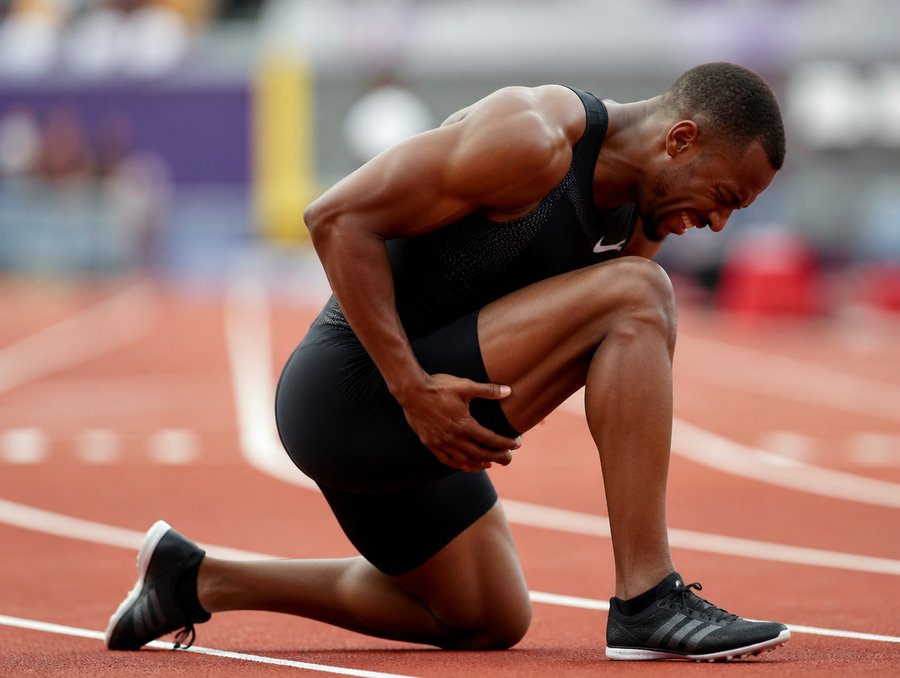
A sudden onset
A muscle injury happens at one precise moment: an acceleration, a jump, a sudden movement, sometimes with a sensation described as a “snap” or a “whip” in the muscle. This turning point doesn’t exist with soreness, which always sets in gradually.
Localized pain, sometimes a bruise
Pain from a muscle injury stays concentrated at one precise spot, sometimes with swelling or a bruise appearing in the hours after the trauma, a sign of local bleeding. These elements, absent from classic soreness, should have you easing off training rather than pushing through.
Still not sure what’s going on?
Do your HOPP assessment to precisely identify the nature of your muscle pain.
Can you prevent sore muscles, and what to do once they’re there
There’s no method that fully eliminates soreness after a genuinely unusual effort, but certain levers clearly reduce how intense it gets.
A gentler progression limits how bad soreness gets
The main trigger for marked soreness is how unfamiliar the effort is, especially eccentric movements (braking, descending, controlling a load). Introducing this type of effort gradually, rather than all at once, leads to noticeably milder soreness in following sessions: this is what’s called the “repeated bout effect”.
What actually helps once soreness has set in
Gentle movement and light activity remain the most reliable levers for feeling better while you wait it out. Cold baths or cryotherapy give mixed results depending on the study and the person: neither useless nor miraculous, worth testing based on how you respond rather than treating as essential.
The rare but serious signal to know: exertional rhabdomyolysis
In very rare cases, an intense, unusual effort (a first very demanding CrossFit session, an overly aggressive comeback after a long break) can cause severe muscle breakdown called exertional rhabdomyolysis, well beyond simple soreness.[3]
The signs that set this rare case apart from simple soreness
Marked, widespread muscle swelling, pain disproportionate to the effort made, dark urine, and intense general fatigue are the signs to watch for. They go well beyond classic soreness and warrant prompt medical attention, not just rest.
Muscle pain vocabulary
Soreness, strain, tear: these words are often used interchangeably even though they describe very different things.
DOMS
Short for “delayed onset muscle soreness”: the scientific name for sore muscles.
Eccentric contraction
Contraction of a muscle while it lengthens, for example braking on a downhill run or lowering a heavy load. It’s the type of effort that causes the most soreness.
Muscle micro-injury
Very small injuries at the level of the muscle fibers, behind soreness. They have nothing to do with a real tear: the fibers stay largely intact.
Lactic acid
Long wrongly blamed for soreness, lactic acid is actually cleared by the body within a few hours and so doesn’t explain pain that appears the next day.
Strain, pull, tear
Three degrees of severity of a real muscle injury, from simple excessive stretching of the fibers (strain) to a partial (pull) or complete (tear) rupture.
Frequently asked questions
How do I know if it’s sore muscles or a real muscle injury?
Sore muscles (DOMS) build up gradually 24 to 72h after exercise, they’re spread across the whole muscle, and they fade within a few days. A muscle injury (strain, tear) usually appears suddenly, during a specific movement, with pain localized to one spot, sometimes swelling or rapid bruising.
How long does normal muscle soreness last?
Usually 2 to 5 days, peaking around 24 to 72h after exercise. If pain lasts beyond a week, gets worse instead of better, or comes with major swelling, it’s probably no longer simple soreness.
Should I worry about a bruise appearing after sport?
A bruise that appears quickly after exercise, especially localized to one spot, is more a sign of muscle fiber damage than plain soreness. It isn’t always serious, but it deserves attention and adjusting your return to training accordingly.
Can you keep training with sore muscles?
Yes in most cases, at moderate intensity: movement doesn’t worsen normal soreness and can even speed up its disappearance. It’s different for a real muscle injury, where pushing through sharp, localized pain can make the injury worse.
Can you prevent sore muscles?
Not entirely, but a gentler progression in intensity or training volume, especially for unfamiliar eccentric movements, clearly reduces how bad it gets. A gradual warm-up helps too, even though no method eliminates it completely after a genuinely unusual effort.
Does a cold bath or cryotherapy relieve sore muscles?
Study results on cold exposure (ice bath, cryotherapy) remain mixed: some people feel real relief, others don’t, and the effect on actual muscle recovery speed is debated. Gentle movement and good overall recovery (sleep, nutrition) remain the most reliable levers.
When should sore muscles genuinely worry you?
If the muscle pain is extreme, with major swelling, unusually dark urine, and significant general fatigue after an intense, unusual effort, this may no longer be simple soreness but exertional rhabdomyolysis, a rare but real medical emergency. If so, seek care immediately.
Does this quiz replace a medical opinion?
No, it’s a general self-assessment tool that gives you a direction, not a diagnosis. If in doubt, especially with sharp, localized pain, use the HOPP assessment or consult a healthcare professional.
Ready to understand your pain?
Do your assessment and get a personalized program in 3 minutes.


Go further
Scientific references
- Cheung K, Hume PA, Maxwell L. Delayed onset muscle soreness: treatment strategies and performance factors. Sports Medicine, 2003;33(2):145-164. PubMed: pubmed.ncbi.nlm.nih.gov/12617692
- Clarkson PM, Hubal MJ. Exercise-induced muscle damage in humans. American Journal of Physical Medicine & Rehabilitation, 2002;81(11 Suppl):S52-69. PubMed: pubmed.ncbi.nlm.nih.gov/12409811
- Rawson ES, Clarkson PM, Tarnopolsky MA. Perspectives on Exertional Rhabdomyolysis. Sports Medicine, 2017;47(Suppl 1):33-49. PubMed: pubmed.ncbi.nlm.nih.gov/28332112
This page is based on peer-reviewed scientific publications. It remains a general self-assessment tool and does not replace medical advice.