

What is a lateral meniscus injury?
Lateral meniscus anatomy
The lateral meniscus is a crescent-shaped piece of fibrous cartilage, located between the femur and tibia on the outer side of the knee. More mobile than the medial meniscus, it plays a key role as a shock absorber and load distributor, particularly during rotation and deep knee flexion.
Why does the lateral meniscus get injured?
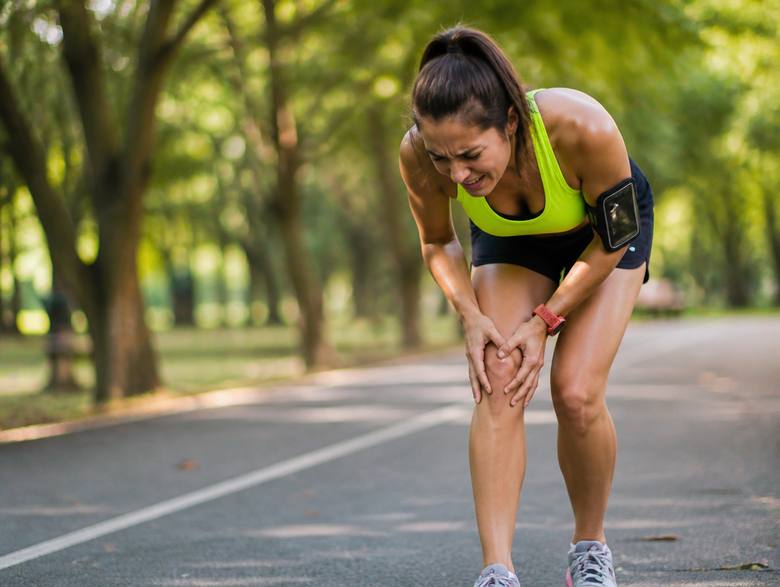
Injury most often occurs from a twisting movement of the flexed knee, foot planted on the ground, or during a rotational jump landing.[1] Its greater mobility compared with the medial meniscus exposes it to different injury mechanisms, particularly deep flexion combined with rotation, such as in a squatting position.
Symptoms and diagnosis of a lateral meniscus injury
Typical pain and what triggers it
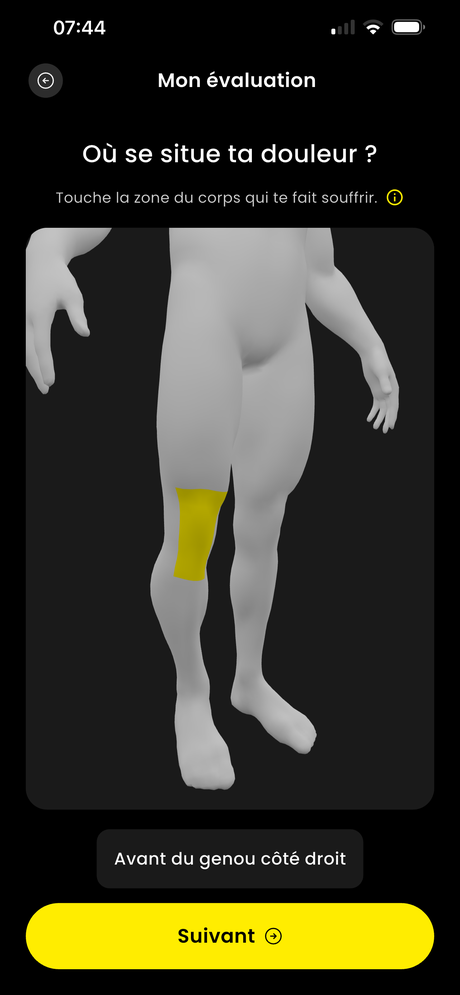
The pain is located along the outer joint line of the knee, classically triggered by a deep squat position, rotating the knee under load, or going up/down stairs. A catching or pseudo-locking sensation is sometimes present.
How symptoms progress without treatment
Without treatment, pain can persist during rotation and deep flexion movements, with a higher risk of clear mechanical locking if a meniscal fragment becomes unstable.
Differential diagnosis
Several types of outer knee pain can resemble a lateral meniscus injury:
- An LCL sprain, which follows a specific injury
- Iliotibial band syndrome, pain located higher up, on the outer side of the thigh
- An associated popliteal (Baker’s) cyst, which causes a feeling of swelling at the back of the knee
Causes and risk factors
A lateral meniscus injury most often results from a twisting movement under load, sometimes made more likely by underlying factors.
Biomechanical and personal factors
- The lateral meniscus’s naturally greater mobility compared with the medial meniscus
- A deficit in motor control of the knee in rotation
- A history of knee trauma
- Repeated deep, loaded flexion (squats, squatting positions)
Which sports contribute to lateral meniscus injuries?
Sports involving deep flexion and weight-bearing rotation of the knee carry a particular risk:
- Football and rugby (pivoting, tackling)
- Basketball and handball (rotational landings)
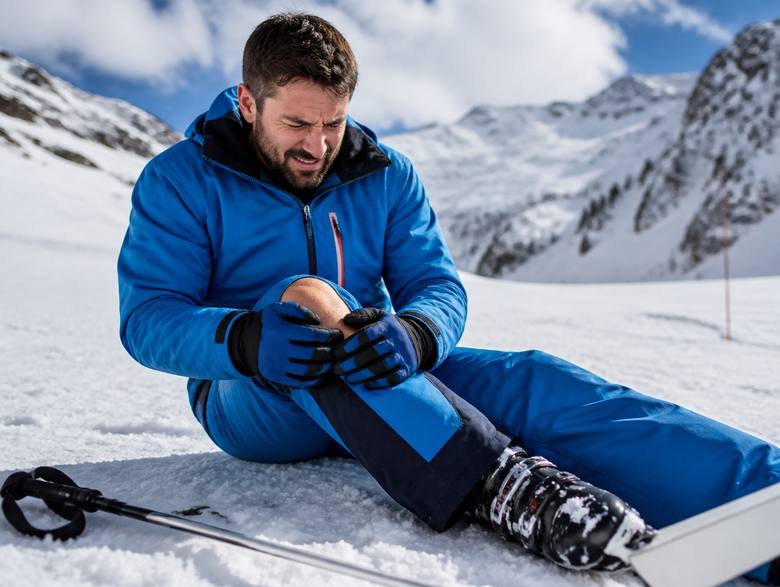
- Alpine skiing
- Weight training with deep loaded squats
- Combat sports involving squatting positions
Treating a lateral meniscus injury in rehab with a sports physio
The goal of treatment is to reduce local pain and inflammation, then strengthen the muscles that protect the joint to compensate for the meniscus’s shock-absorbing function.
- 1Reducing pain and swelling
- 2Recovering full knee mobility
- 3Strengthening the quadriceps
- 4Progressive strengthening of the chain (hip, calf)
- 5Proprioceptive work
- 6Controlled rotational dynamic stability
- 7Progressive straight-line running
- 8Working on changes of direction
- 9Progressive return to your sport
- 10Return to competition
DEMONSTRATION
Video by Hemrick, co-founder of HOPP.
“A damaged meniscus doesn’t always need surgery: in many cases, the body adapts very well with targeted strengthening.”
Strengthening, the cornerstone of treatment
Strengthening the quadriceps better absorbs the strain passing through the knee and eases the load on the injured portion of the meniscus. It’s complemented by hip and ankle work to improve overall load distribution, and by proprioceptive work to make rotational weight-bearing safer.
In brief
- Strengthening the quadriceps to ease the load on the meniscus
- Progressive strengthening of the hip – knee – ankle chain
- Proprioceptive work to make rotational weight-bearing safer
- Gradual return: mobility, then load, then sport
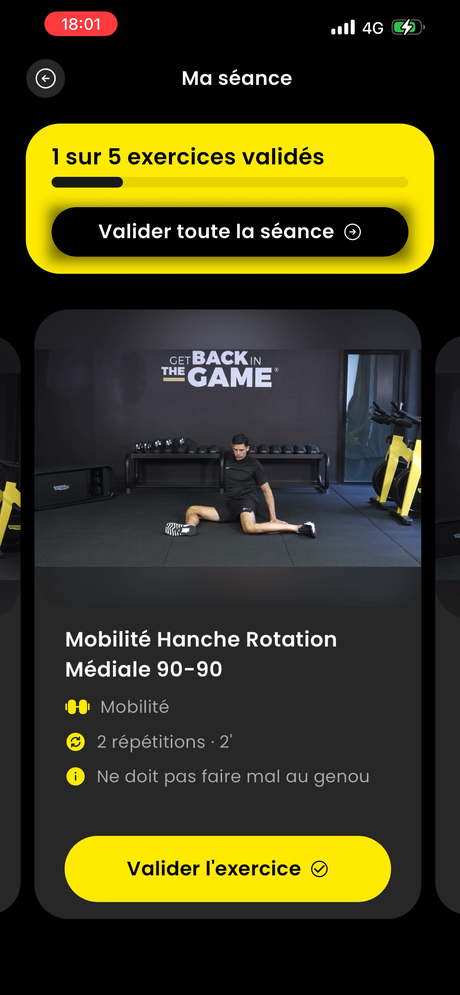
Ready to take your lateral meniscus injury seriously?
Start the HOPP programme designed by sports physios.
Should you rest or keep playing sport?
Total rest is generally not necessary, unless there’s clear locking of the knee. It’s better to temporarily adapt your activity, avoiding deep flexion combined with rotation, while staying physically active and starting strengthening as soon as possible.
Think you might have a different knee injury?
Take your free test in 3 minutes flat.
When should you see a specialist for a lateral meniscus injury?
If you feel clear locking of the knee, significant swelling, or pain that persists for more than two to three weeks despite adapting your activities, a medical opinion is recommended. An MRI can clarify the type and extent of the meniscal injury.
Recovery timeline for a lateral meniscus injury
A stable injury managed with rehab alone often improves markedly within 4 to 8 weeks. A full return to sport, particularly to pivoting movements, is safer between 8 and 12 weeks. With surgery, the timeline is guided directly by the surgeon.
Factors that speed up or slow down recovery
- The type of injury (stable or unstable)
- Whether mechanical locking is present
- How consistently you keep up quadriceps and chain strengthening
- Following the load progression before returning to pivoting movements
Preventing recurrence
A well-strengthened knee copes better with the rotational strain that stresses the meniscus.
The 10% progression rule
Not increasing your volume of deep squats or pivoting movements by more than 10% per week limits the risk of overloading the meniscus again.
Ongoing maintenance strengthening
Regular work on the quadriceps and the hip-knee-ankle chain, kept up even after rehab ends, helps better distribute rotational strain and protect the meniscus in the long run.
The HOPP care programmes to treat your lateral meniscus injury and get back to sport
To heal durably, a lateral meniscus injury requires progressive support that strengthens the knee’s natural protection. HOPP offers you a precise exercise programme, allowing you to get back to your activities as quickly as possible. By combining mobility, strengthening and training management, HOPP supports you all the way back to the field.
The programme runs from 3 to 9 weeks depending on the injury and ends with a reconditioning phase allowing a return to competition in the best possible conditions. Each programme is designed by the HOPP team, made up of two sports physiotherapists who are experts in assessing and treating athletes. You’ll also find theoretical content throughout your progression, so you master every aspect of your recovery and can adjust your treatment independently. If needed, our team of physiotherapists is on hand to support you.
Essential
FROM INJURY TO
BACK TO YOUR ACTIVITIES
59€
One-time payment
“AT YOUR OWN PACE WITH
DAILY ADAPTATION”
- 100% of the treatment programme
- Daily personalisation
- Flexibility / Mobility
- Strengthening
- Proprioception
- Progress tracking
- Return-to-running programme
- Theoretical content included
Performance
TO GET BACK TO SPORT
IN THE BEST CONDITIONS
79€
One-time payment
“GET BACK TO YOUR LEVEL
WITHOUT RISK OF RELAPSE”
- 100% of the treatment programme
- Daily personalisation
- Flexibility / Mobility
- Strengthening
- Proprioception
- Progress tracking
- Return-to-running programme
- Theoretical content included
- + 4-week return-to-play plan with 6 difficulty levels
Expert
PERSONALISED VIDEO-CALL
SUPPORT, ANY TIME
149€
One-time payment
“A PHYSIO
WHENEVER YOU NEED”
- 100% of the treatment programme
- Daily personalisation
- Flexibility / Mobility, Strengthening, Proprioception
- Progress tracking
- Return-to-running programme
- Theoretical content included
- + 4-week return-to-play plan with 6 difficulty levels
- + 2 video calls with an expert sports physio / return check-up
A programme that adapts to you every day
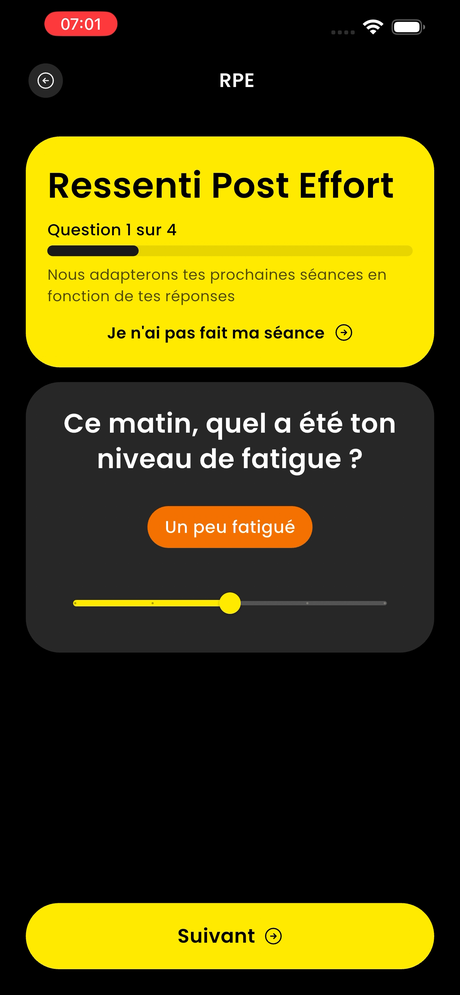
Every day, how you feel (RPE) is factored in to automatically adjust the rest of your programme: more load if all is well, a bit less if your meniscus is complaining. This daily personalisation is what makes the difference compared to a fixed, paper-based programme.

Ready to start your programme?
Join the HOPP support programme designed by sports physios.
F.A.Q
Does a lateral meniscus tear always need surgery?
No, not systematically. Many meniscal injuries, particularly without clear locking, respond well to rehab alone. Surgery is mainly considered for persistent mechanical locking or when conservative care hasn’t worked.
Can I keep playing sport with a lateral meniscus injury?
In many cases, yes, by temporarily adapting deep flexion and rotation, while strengthening the knee in parallel. A medical opinion is useful for assessing the necessary restrictions depending on the type of injury.
How long does it take to recover from a lateral meniscus injury?
It depends on the type of injury and the care chosen. A stable injury managed with rehab can improve markedly within a few weeks; surgery involves a longer recovery time, guided by the surgeon.
Can a lateral meniscus injury heal on its own?
It depends on the area affected: the outer part of the meniscus has a better blood supply and heals more easily than the central part, which has very little. Imaging and a clinical examination help clarify the healing potential.
Does the lateral meniscus grow back after a partial removal?
No, removed tissue doesn’t grow back. That’s why surgery today favours repair over removal whenever possible, to preserve as much of the meniscus’s shock-absorbing function as it can.
Does the HOPP programme replace a medical consultation?
No. HOPP is a support and rehab tool designed by sports physiotherapists, but it doesn’t replace a doctor’s opinion. If in doubt, or if the pain persists, see a health professional.
Is the programme suited to all sporting levels?
Yes. Every programme is personalised to your sport, your level and how you feel each day, whether you’re a recreational athlete or preparing for competition.