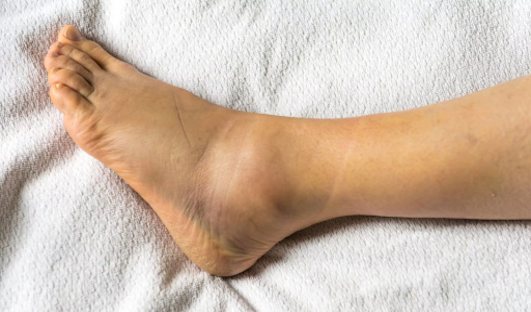


What are long-term after-effects on the ankle?
Understanding where your pain really comes from
Pain that shows up in the ankle doesn’t always start in the ankle. An old knee injury (sprain, meniscus tear), even one that seems to have healed well, can leave residual quadriceps weakness or a loss of control that quietly changes how the ankle absorbs load with every step. We talk about “long-term after-effects” when the consequence of an old injury shows up, months or years later, in a different area from the one originally affected.
Why does the pain appear in the ankle rather than the knee?
After an old knee injury, even one well treated at the time, a loss of quadriceps strength or knee control can persist without ever causing pain in the knee itself.[1] The ankle then has to absorb more with every step to compensate for this lack of control above it: it’s this repeated overload, transmitted from one joint to another, that eventually becomes painful at the ankle, long after the knee was declared healed.[2]
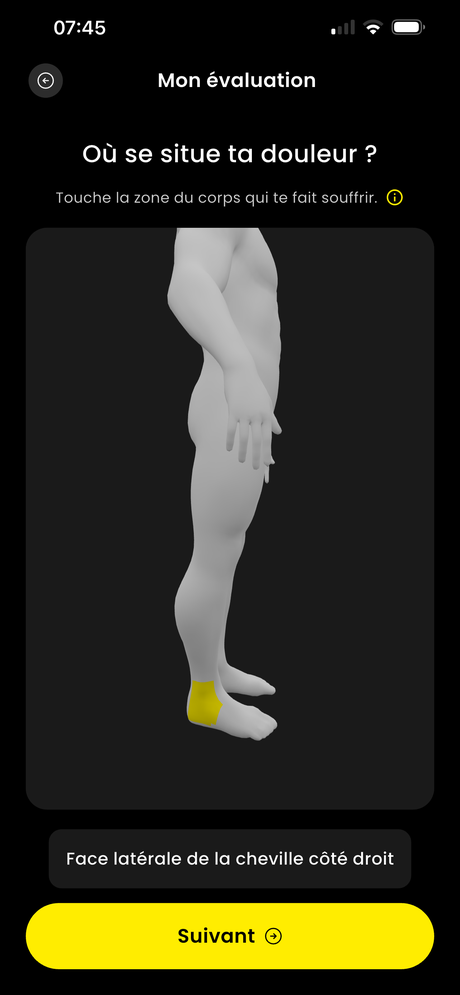
Which sports most often reveal this pain?
Any sport that places intense demand on the ankle can reveal this old deficit carried over from the knee to the ankle:
- Basketball and handball
- Football and rugby
- Trail running and hiking
- Racquet sports
- Dance
- Mountain sports
Symptoms and diagnosis
Recognizing the signs of a referred after-effect
This ankle pain has characteristics that set it apart from a typical injury:
- Discomfort that builds up gradually, with no recent impact or sprain to the ankle
- Pain that appears months, or even years, after an old knee injury
- A feeling of fatigue or overload at the end of training rather than a sharp, localised pain
- Discomfort that varies mainly with how intense your sporting activity is, rather than a fixed painful spot
- No visible swelling or bruising, unlike a recent injury
Differential diagnosis
Other ankle conditions can cause similar symptoms, which is why a precise assessment matters before concluding it’s a referred after-effect:
- An ankle joint condition, which affects the joint directly rather than being an indirect consequence of it
- A recent or poorly healed ankle sprain, which has a direct injury mechanism and usually an identifiable history of impact
Causes and risk factors
Why does this after-effect develop?
Several factors contribute to this referred overload developing:
- Insufficient or incomplete rehab after the initial knee injury
- A lack of proprioceptive strengthening work to restore knee control
- Repeated knee sprains or injuries that were never properly treated
- Returning to sport too soon, before regaining full quadriceps strength
Treating this referred pain in rehab with a sports physio
The goal of treatment isn’t to focus solely on the painful ankle, but to identify and treat the underlying residual knee deficit, removing the cause of the overload rather than just relieving the symptom.
- 1Assessing current function
- 2Recovering full mobility
- 3Isometric strengthening
- 4Progressive concentric strengthening
- 5Proprioceptive work
- 6Eccentric strengthening
- 7Correcting established compensations
- 8Strengthening under sport-specific load
- 9Progressive return to your sport
- 10Return to competition
“Pain sometimes shows up far from where the problem actually began.”
Strengthening the knee, the cornerstone of treatment
Strengthening the quadriceps and working on knee control restores the stability that’s been missing since the old injury, which directly reduces the overload transmitted to the ankle with every step.
In brief
- Full assessment of the knee, the real root of the problem
- Quadriceps strengthening
- Correcting the established compensation at the ankle
- Gradual return: mobility, then load, then sport
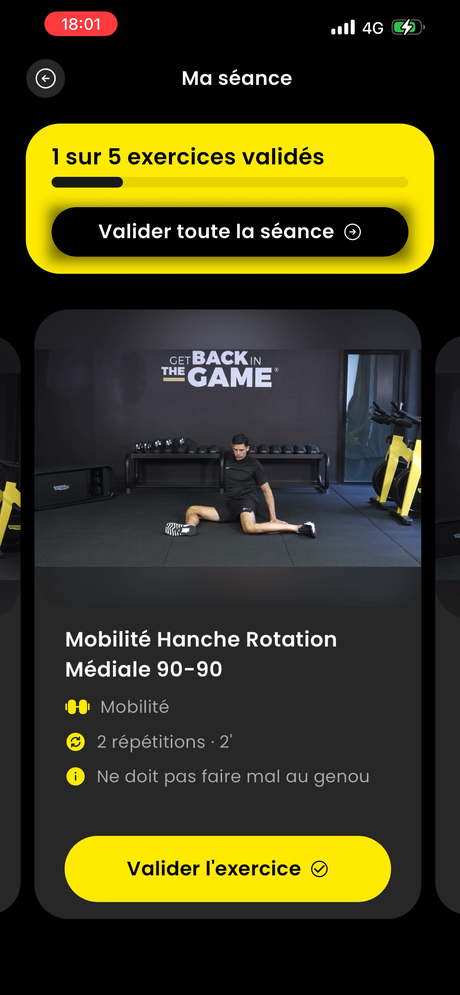
Ready to seriously treat this pain from an old referred injury?
Start the HOPP programme designed by sports physios.
Should you rest or keep playing sport?
Resting the ankle alone generally isn’t enough if the underlying knee deficit isn’t treated: it’s targeted work on the knee, combined with suitably managed load, that resolves the pain for good.
Think you might have a different ankle injury?
Take your free test in 3 minutes flat.
When should you see a specialist for this pain?
If the ankle pain persists despite work on the knee, or is accompanied by swelling, clear instability or mechanical locking, a medical opinion is recommended to rule out another local cause.
How long does it take to feel better?
Because this pain is the result of a deficit that’s been there for a long time, improvement is gradual: it usually takes several weeks of targeted knee strengthening before you feel real relief in the ankle, as regained control and strength reduce the overload passed down the chain.
How can you prevent this after-effect?
The best prevention is not to consider a knee injury fully healed just because the pain has gone: a strength and control assessment at the end of rehab, followed by regular monitoring of asymmetries between your two legs, helps spot and correct a residual deficit before it ends up overloading another joint.
The HOPP care programmes to treat the root of your pain and get back to sport
This pain requires treating the knee, the real root of the problem, not just the ankle. HOPP offers you a precise exercise programme, allowing you to get back to your activities as quickly as possible.
The programme runs from 3 to 9 weeks depending on the injury and ends with a reconditioning phase allowing a return to competition in the best possible conditions. Each programme is designed by the HOPP team, made up of two sports physiotherapists who are experts in assessing and treating athletes. You’ll also find theoretical content throughout your progression, so you master every aspect of your recovery and can adjust your treatment independently. If needed, our team of physiotherapists is on hand to support you.
Essential
FROM INJURY TO
BACK TO YOUR ACTIVITIES
59€
One-time payment
“AT YOUR OWN PACE WITH
DAILY ADAPTATION”
- 100% of the treatment programme
- Daily personalisation
- Flexibility / Mobility
- Strengthening
- Proprioception
- Progress tracking
- Return-to-running programme
- Theoretical content included
Performance
TO GET BACK TO SPORT
IN THE BEST CONDITIONS
79€
One-time payment
“GET BACK TO YOUR LEVEL
WITHOUT RISK OF RELAPSE”
- 100% of the treatment programme
- Daily personalisation
- Flexibility / Mobility
- Strengthening
- Proprioception
- Progress tracking
- Return-to-running programme
- Theoretical content included
- + 4-week return-to-play plan with 6 difficulty levels
Expert
PERSONALISED VIDEO-CALL
SUPPORT, ANY TIME
149€
One-time payment
“A PHYSIO
WHENEVER YOU NEED”
- 100% of the treatment programme
- Daily personalisation
- Flexibility / Mobility, Strengthening, Proprioception
- Progress tracking
- Return-to-running programme
- Theoretical content included
- + 4-week return-to-play plan with 6 difficulty levels
- + 2 video calls with an expert sports physio / return check-up
A programme that adapts to you every day
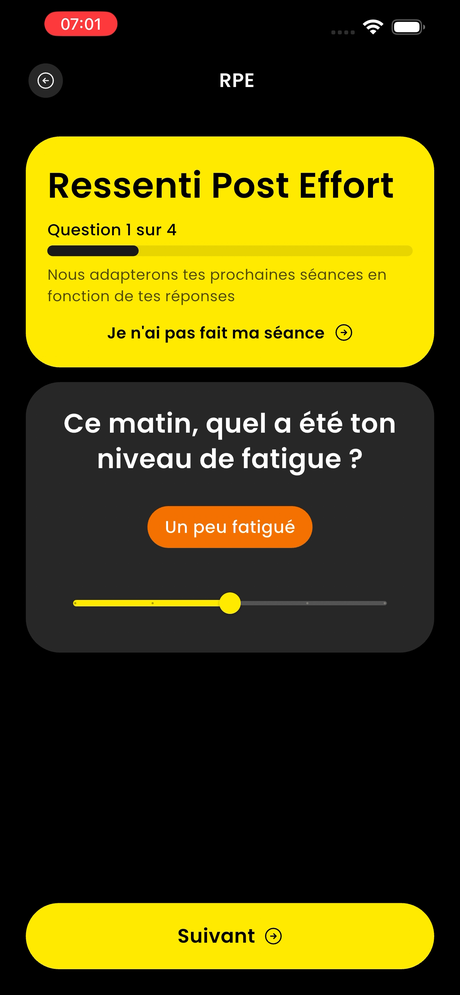
Every day, how you feel (RPE) is factored in to automatically adjust the rest of your programme: more load if all is well, a bit less if your ankle is complaining. This daily personalisation is what makes the difference compared to a fixed, paper-based programme.

Ready to start your programme?
Join the HOPP support programme designed by sports physios.
F.A.Q
Does the HOPP programme replace a medical consultation?
No. HOPP is a support and rehab tool designed by sports physiotherapists, but it doesn’t replace a doctor’s opinion. If in doubt, or if the pain persists, see a health professional.
Is the programme suited to all sporting levels?
Yes. Every programme is personalised to your sport, your level and how you feel each day, whether you’re a recreational athlete or preparing for competition.
Why does my ankle hurt when the problem is actually my knee?
A strength or control deficit at the knee, even an old, painless one, forces the ankle to constantly compensate. This repeated overload eventually becomes painful at the ankle, long after the knee appeared to have healed.
Should I treat my ankle or my knee?
Both: relieve the ankle pain in the short term, but above all treat the underlying knee deficit to stop the pain coming back.
How can I know if my knee is really the cause?
A side-to-side comparison of strength and control in both knees generally reveals the residual deficit behind the overload at the ankle.
How long after a knee injury can a referred after-effect appear in the ankle?
This varies a lot: some after-effects show up just a few months after the initial injury, others only several years later, once the knee control deficit eventually generates enough overload to become painful at the ankle.
Can a referred after-effect affect a different joint than the ankle?
Yes. The same compensation mechanism can involve other joints depending on the chain that’s under strain: a hip or knee deficit, for example, can affect the opposite knee or the lower back, and not only the ankle.